
Most “AI grading” apps are built for one guy grading one card for fun. This one was built by a dealer drowning in inventory, and it shows.
Every grading submission is a bet.
You pick a card. You pay a fee. You wait weeks, sometimes months. And then a flat envelope arrives with a number on it that either makes you money or makes you feel stupid. There’s no take-backs, no partial credit, and no refund for “I genuinely thought the corners were sharper than that.”
Multiply that bet by a thousand cards a month and you’ve described the actual daily problem of being a card dealer. Not finding inventory. Not listing it. Deciding what deserves a submission fee, over and over, fast, without a lead grader’s eye and without the luxury of being wrong very often.
Mint Condition was built inside that problem. And it’s one of the more interesting products in the hobby right now, partly because of what it does and partly because of a strange thing that’s happening on eBay as a result.
TL;DR
What it is: AI pre-grading for trading cards. Condition reports with centering, corners, edges, and surface subgrades, plus a digital vault for inventory.
Who it’s for: Dealers, show buyers, hobby shops, and high-volume sellers. Collectors are welcome, but the product is unapologetically built for people running an operation.
What it nails: Throughput. Batch, bulk, browser, and phone. Four different intake paths, all feeding one vault.
Where it’s unproven: Independent verification of accuracy, and the adoption curve on its newest surfaces.
Bottom line: The most operationally serious pre-grading tool we’ve looked at. Just be clear-eyed that a pre-grade is a triage signal, not a grade.
Built By a Guy Who Needed It
Mint Condition comes from Philip Greenberg, founder and CEO of Vintage Card Co, a large vintage operation on eBay and a regular on the national show circuit. Per the company’s own materials, the platform was developed against a personal collection north of 150,000 cards, with a technical lead whose background runs through large-scale AI program management and consulting.
That origin matters more than the usual founder-story boilerplate, because it explains every design decision in the product. This isn’t a novelty app that grades your one Jordan rookie and shows you a confetti animation. It’s an intake pipeline. The features exist because someone came home from a show with three shoeboxes and a problem.
The Features: A Tour
1. Batch, the Show Table Workflow
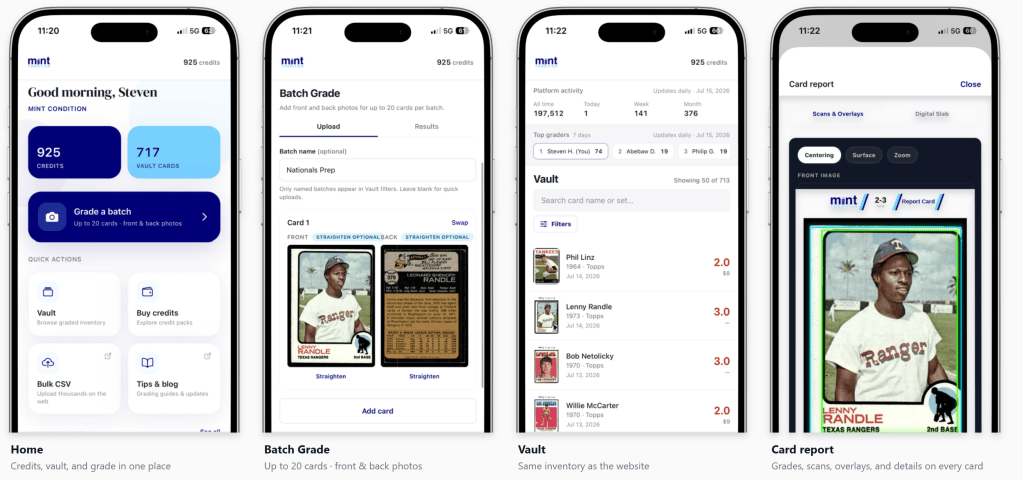
Drag and drop up to twenty cards at a time as front/back pairs. The system auto-groups them by filename or scan order, then returns measured centering, detected defects, subgrades, and a value estimate. The company puts turnaround at well under a minute for a batch.
This is the walk-in workflow. Someone dumps a box on your table, and you need a defensible read on what’s in it before you make an offer. Twenty at a time, in under a minute, is a genuinely different negotiating posture than squinting through a loupe while the seller watches.
2. Bulk, the Warehouse Workflow
CSV upload, up to ten thousand cards per run, results back typically in a couple of hours. This is the feature that separates Mint Condition from the consumer field entirely. Nobody building a casual collector app builds a ten-thousand-row CSV pipeline. That’s a back-office feature for people with actual back offices.
3. The Vault
Every graded card syncs to a personal vault with filtering by status, grade, and valuation, plus bulk CSV export. It’s inventory management, and the export matters most. Your data leaves in a format you can drop into your listing tool, your accounting, or your own spreadsheet without a fight. Tools that let you take your data out are tools that are confident you’ll come back.
4. Marketplace Grade, the Most Interesting Feature
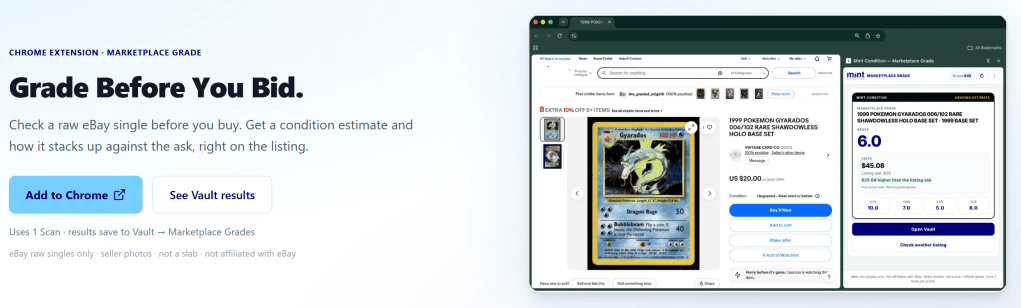
A free Chrome extension that puts a pre-grade on an eBay listing before you bid.
You open a raw single, pick the seller’s front and back photos, and get a condition estimate plus a read on how that estimate stacks against the ask. Results land in your vault under a separate Marketplace Grades section.
Think about what that actually does. The entire raw card market on eBay runs on the asymmetry between a seller who has handled the card and a buyer who has three JPEGs and a prayer. This extension attacks that asymmetry directly. It doesn’t eliminate it, since you’re still grading the seller’s photos, with the seller’s lighting, at the seller’s chosen angles. But it puts a structured second opinion on the page at the exact moment of decision.
The company is admirably blunt about the limits: raw singles only, slabs and lots are blocked, it’s not an official grade, it’s based on seller photos rather than a physical inspection, and it isn’t affiliated with eBay. Listing photos are held roughly a day and then deleted, and the company states they aren’t used to train its models.
5. iOS App and Sandbox
There’s an iPhone app for grading at shows. Snap front and back, batch up to twenty, results in seconds, same vault and login as the web. And there’s an interactive sandbox with sample cards that requires no account at all, which is the single smartest marketing decision on the site. You can see exactly what a report looks like before you give anyone an email address.
A Partner API for marketplaces, point-of-sale, and inventory systems is listed as coming soon. That’s the one to watch. If pre-grades start flowing into other platforms’ infrastructure, the strategic position changes considerably.
6. The Report Itself
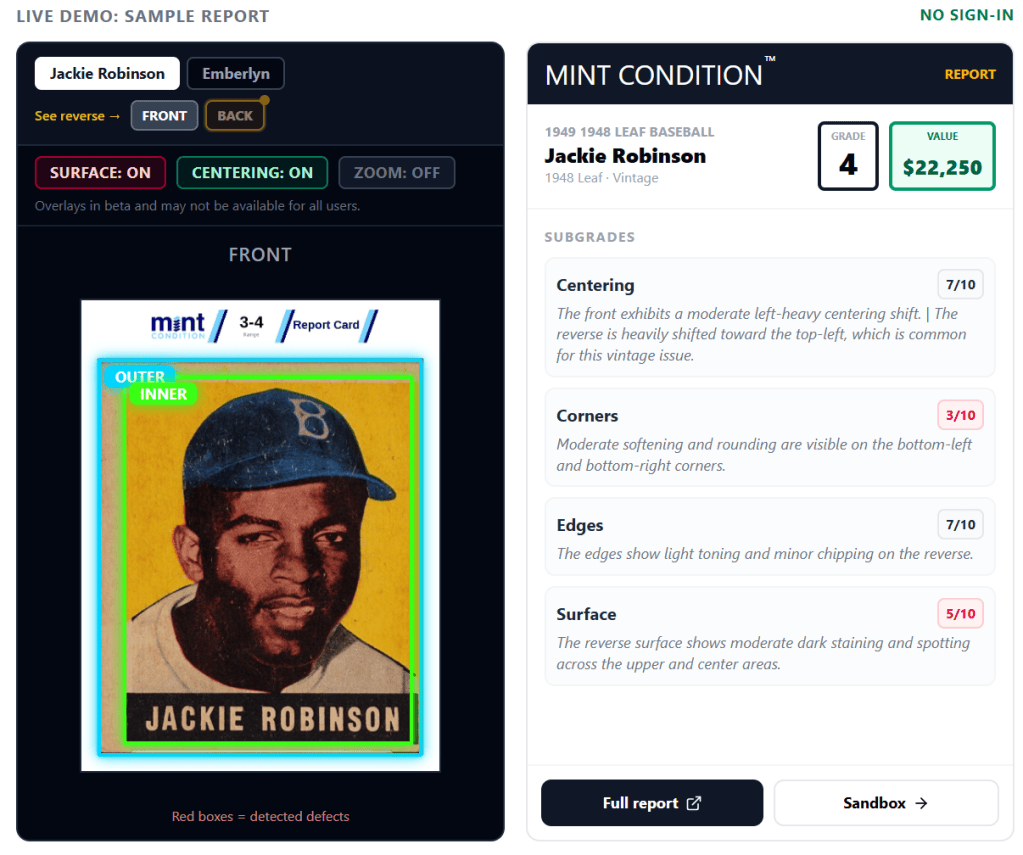
The demo report is clean and specific: an overall grade, subgrades across centering, corners, edges, and surface, a value estimate, and defect overlays that draw boxes around what the model actually found, with plain-language notes on each dimension. On a vintage example we reviewed, the notes flagged directional centering shift on both sides, specific corner softening by location, and reverse surface staining.
That last part is the important part. A bare number is a black box. A number plus “here is the specific corner and here is the specific stain” is something you can go verify with your own eyes in ten seconds. Verifiable beats confident.
7. Pricing Model
Pay-per-card credit packs. No subscription. Credits don’t expire. The per-card cost steps down as volume goes up, there’s a discounted first pack, and there’s a small block of free scans to start. Higher-confidence reports come from uploaded scans, while live camera captures are positioned as quicker triage at a lower confidence tier. That’s a distinction the company makes explicitly rather than burying.
Per CardVestr policy we don’t publish specific figures. Check the pricing page directly, since terms change.
The eBay Thing
Here’s the number that stopped us. As of this writing, the company points to more than seventy thousand listings on eBay carrying a Mint Condition grade reference, searchable by their MCG identifier.
That’s not a marketing impression. That’s sellers voluntarily attaching an AI pre-grade to a live listing as a credential, and buyers apparently not running away.
It’s also the development most worth thinking hard about, because it quietly changes what the product is. A pre-grade used privately to decide what to submit is a triage tool, and a wrong answer costs you one submission fee. A pre-grade published in a listing is a trust signal offered to a buyer, and a wrong answer costs somebody else money.
There’s no slab, no physical inspection, no third-party chain of custody. The company is clear that its outputs aren’t official grades, and that disclosure is in the right places. But the hobby has a long, well-documented history of condition claims drifting from careful to optimistic once they become a sales tool. This is a space that will need watching, and CardVestr intends to watch it.
What Users Say, and What They Haven’t Said Yet
We’ll be straight with you. There isn’t much independent review volume on Mint Condition specifically, and we’re not going to manufacture some.
As of September 14, 2026, the Marketplace Grade Chrome extension showed a low double-digit user count and no ratings, with its current version published in late August 2026. The eBay listing footprint is substantial. The third-party review footprint is not yet. That’s the profile of a product whose web and bulk workflows have real dealer traction while its newest consumer-facing surfaces are still early.
What we can report are the themes that run consistently across the broader AI pre-grading category, and they’re the right questions to bring to any trial.
1. Within-one-grade is the realistic bar. The most honest operators in this category describe accuracy in terms of landing within roughly a grade of the eventual professional result most of the time, not nailing it. That’s still decisively useful for triage and useless as a guarantee.
2. Photo quality is the hidden variable. Every photo-based grader lives or dies on lighting, angle, and resolution. Mint Condition’s own two-tier structure, higher-confidence uploaded scans versus quick camera triage, is an implicit acknowledgment of exactly this. We’d rather see a company say it out loud than pretend the phone snap is as good as the flatbed.
3. Surface is where models struggle. Centering is geometry, and machines are excellent at geometry. Micro-scratches, print lines, pressure marks, and gloss breaks are where camera-based systems have historically had the hardest time, and where human graders still earn their keep.
4. Consistency may matter more than accuracy. This is the point most of the category misses. For a dealer sorting a thousand cards, a model that runs systematically half a grade optimistic but never contradicts itself is enormously valuable, because you learn the offset and adjust. A model that’s occasionally perfect and occasionally random is worthless at scale. Mint Condition markets on applying identical objective parameters to every card, which is the right thing to be marketing on.
The CardVestr Verdict
Mint Condition is doing the unglamorous work, and we respect it.
The category is crowded with apps that want to show a collector a fun number. This one built CSV pipelines, a vault with bulk export, and a browser extension that intervenes at the moment of purchase. Those are the features you build when your users are running businesses and your own money is in the inventory.
The disclosures are also better than the category norm. “Not an official grade.” “Based on seller photos, not a physical scan.” “For your own research only.” Stated plainly, in multiple places, not buried in terms of service. In a hobby where AI tools have a habit of overclaiming, a company that draws its own boundaries earns credibility.
Use it if: you buy at shows, run a shop, move raw volume on eBay, or submit enough cards that a bad submission decision is a recurring line item rather than an occasional sting.
Skip it if: you submit a handful of cards a year. The math doesn’t work, and your own careful eye plus a centering tool gets you most of the way there.
Test it like this: run cards through it that you’ve already had professionally graded, and check the offset. Not whether it matched, but whether it was consistently wrong in the same direction. That’s the number that tells you whether you can build a workflow on it. And the sandbox costs you nothing but a few minutes.
The best version of this product isn’t a machine that tells you what PSA will say. It’s a machine that lets one dealer make a thousand consistent decisions in the time it used to take to make fifty inconsistent ones. On that measure, Mint Condition is aimed at exactly the right target.
Check out Mint Condition Grading today: https://mintconditiongrading.com/




 CardVestr
Leave a comment