
The platform that turned “what’s this thing worth?” into an actual research question — and mostly answers it.
There’s a moment every collector knows. You’re standing at a table at a show, or you’re three minutes from the end of an eBay auction, and someone says a number out loud. And you have absolutely no idea whether that number is a gift, a robbery, or exactly right.
For most of this hobby’s history, the answer to that question was vibes. A dog-eared price guide. A buddy who “knows cards.” A frantic eBay sold-listings scroll with your thumb sweating on the glass.
Card Ladder decided that wasn’t good enough. Six years in, it’s the closest thing the trading card market has to a real data terminal — and it’s become the reflexive second browser tab for a serious chunk of the hobby.
We spent time with it. Here’s the full breakdown.
TL;DR
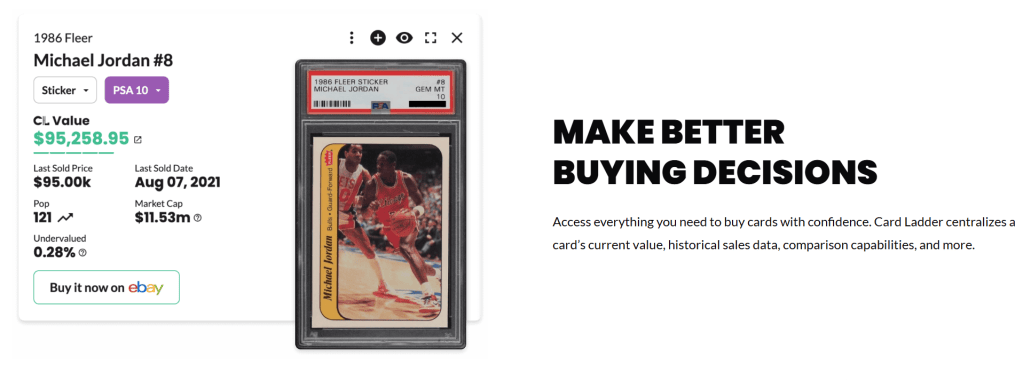
What it is: A sales database, valuation engine, index provider, and collection tracker for sports, TCG, and non-sports cards.
Who it’s for: Collectors who want to see the receipts before they buy. Investors who think in portfolios and benchmarks. Anyone who has ever said “I feel like this card is up” and wanted to prove it.
What it nails: Depth of sales history, index construction, collection value tracking, and a genuinely pleasant interface.
Where it strains: Manual entry, obscure parallels, and value estimates on cards that trade rarely.
Bottom line: If you treat cards as assets, this is table stakes. If you’re a set builder who buys what you love, the free tier may be all you ever need.
The Origin Story Is Extremely Hobby
Card Ladder launched on June 23, 2020 — and yes, that date is a flex. 6/23. Jordan and LeBron. The founders, Chris McGill and Joshua Johnson, were collectors before they were software people, and the whole product still carries that fingerprint.
Eighteen months later, in December 2021, Collectors Universe — the parent company of PSA — acquired it. That’s a detail worth sitting with, because it cuts both ways. On one hand, Card Ladder got resources, population data pipelines, and integration with the PSA ecosystem. On the other, the hobby’s dominant data platform is now owned by the hobby’s dominant grader.
To their credit, the company said at the time of the deal that the platform would stay agnostic on data and grading sources, and in practice it still surfaces population reports from PSA, BGS, SGC, and CGC side by side. But it’s the kind of structural question a research publication should keep flagging rather than filing away. We’ll keep flagging it.
The Features: A Tour
1. The Sales Database Is the Moat
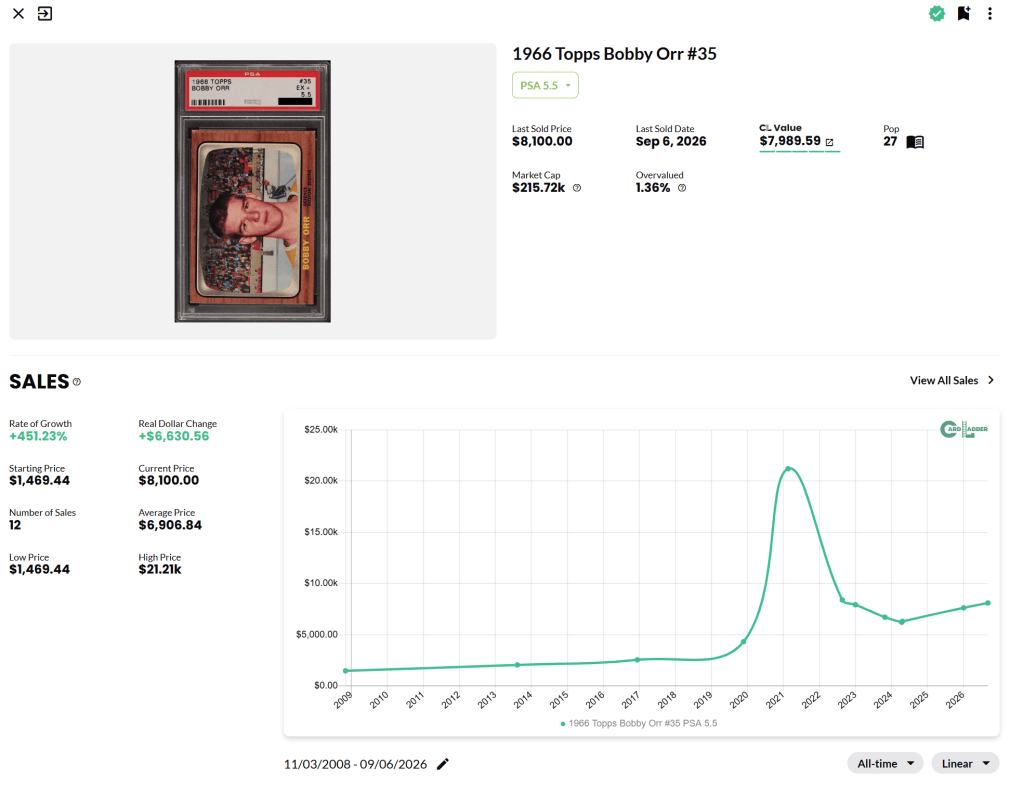
Everything else is built on top of this. Card Ladder’s pitch, per its own site as of this writing, is a database of over 100 million historical sales stretching back more than two decades, aggregated across roughly two dozen marketplaces — eBay, Goldin, Fanatics Collect, Heritage, REA, Alt, MySlabs, Pristine, Mile High, and a long tail of regional auction houses.
Those are company-stated figures, and you should read them as company-stated figures. But the practical effect is real: when you pull up a card, you’re not looking at the last three eBay sales. You’re looking at a chart with years of dots on it, across venues, with grade filters.
The differentiator the team leans on hardest is vetting. A research team reviews transactions and strips out the noise — shill-looking sales, wildly mispriced lots, listings that aren’t what they claim to be. Anyone who has ever tried to comp a card off raw marketplace data knows why this matters. Raw data is full of lies. Curated data is a product.
2. CL Value: The Estimate Engine
This is the headline Pro feature. CL Value produces an estimated current value for a card, even one that hasn’t sold in years, by blending its own sales history with the movement of the relevant player and market indexes.
Think of it as the difference between “here’s the last sale” and “here’s what the last sale is probably worth today, given everything that’s happened to this player’s market since.” For high-volume modern cards, it’s genuinely useful. For vintage and rare parallels, it’s a starting point rather than a verdict — more on that in the reviews section.
Nice touch: you can choose between multiple pricing methodologies rather than being force-fed a single number. That’s a small design decision that signals a lot of respect for the user.
3. The Indexes Are the Underrated Star
This is the feature that separates Card Ladder from every “what’s my card worth” app on the store.
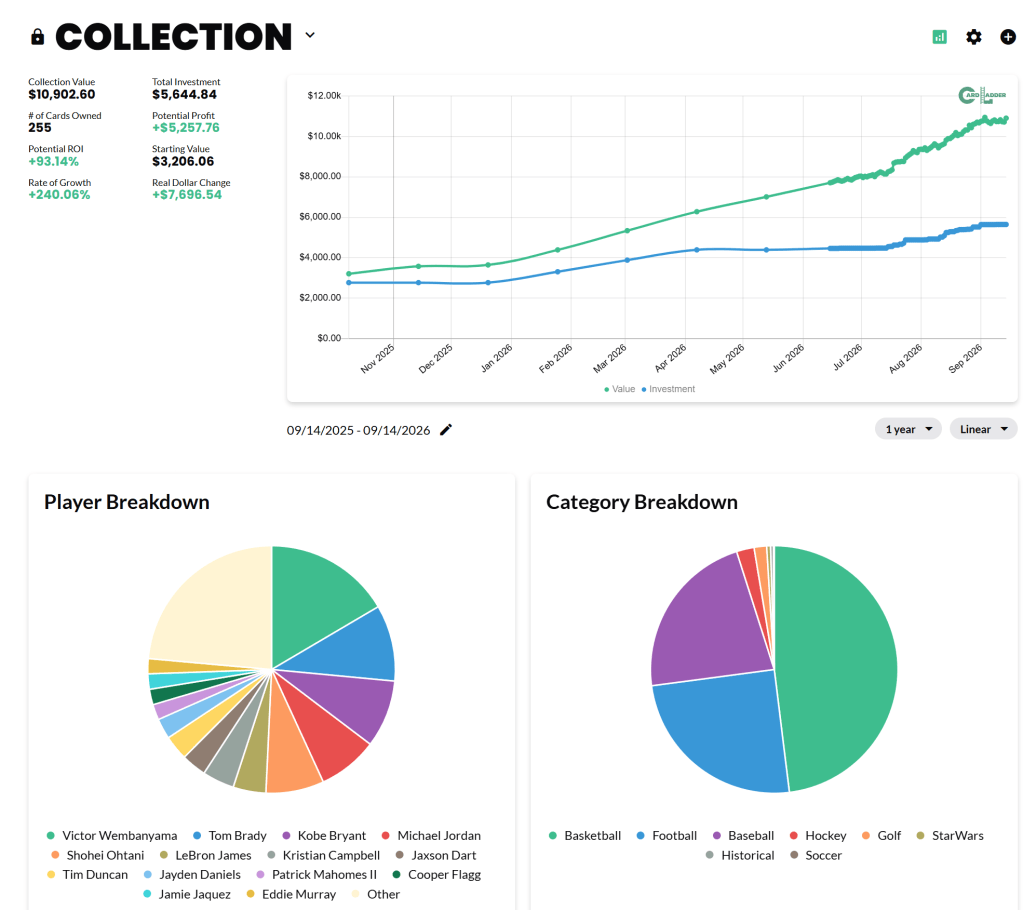
The platform maintains thousands of player indexes — roughly 3,550 at last count on its own stats page — plus market-wide and segment indexes. You can watch a player’s market as a line, not a datapoint. You can see whether a run-up is that player or the whole market lifting.
And with Pro, you can build custom indexes. Pick a basket of cards, name it, and track it as a single instrument. If you’ve ever wanted to know how “high-grade vintage rookies” performed against “modern numbered parallels” over a specific window, this is the tool that answers it. For anyone running a thesis-driven approach to collecting, this is the single most valuable thing in the product.
4. Collection Tracking and the Daily Value Update
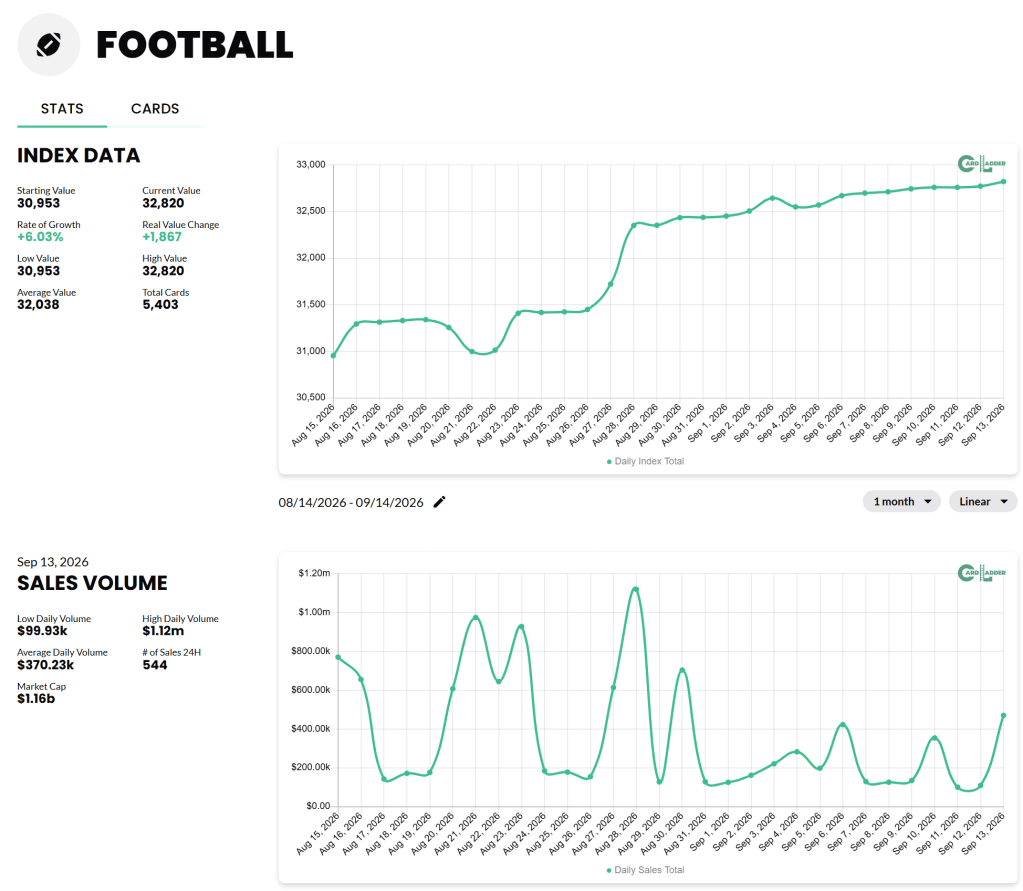
Upload your collection, and Card Ladder gives you daily value estimates on every card and a rolling total. Cost basis in, current estimate out, gain or loss visible at a glance.
You add cards via search, CSV import, or camera search — point your phone at a graded slab and it reads the label. The camera route is meaningfully faster than typing, and the app has been steadily improving it.
Then there’s Showcase, which lets you publish a collection as a shareable, browsable gallery. Half portfolio statement, half flex. It’s the most fun part of the product, and it’s the part most likely to pull a new user in.
5. Population Reports
Pro users get full population data across the major graders, including growth over time — which is the part that actually matters. A pop 9 today means one thing. A pop 9 that was a pop 3 eighteen months ago means something very different about the supply curve you’re buying into. Seeing pop as a trend line rather than a snapshot is a real analytical edge.
6. Watchlists, Alerts, Compare, and Saved Filters
The daily-driver layer:
- Watchlist with price alerts — set a target, get pinged when your grail comes into range.
- Compare — put multiple cards or indexes side by side and settle the argument about which is the better buy.
- Saved filters — build a repeatable screen for the kind of card you’re hunting and check it like a saved search.
- Custom dashboard — arrange the modules you actually use instead of the ones someone else thought you’d use.
7. The Free Tier Is Not a Trap
Worth calling out, because a lot of hobby software gates everything. Card Ladder’s free tier includes the price guide, indexes, the daily sales recap, the news feed, shop links across marketplaces, and Showcase browsing. That’s a real product.
What’s behind the wall: full all-time sales history, CL Value, collection tracking, camera search, pop reports, alerts, custom indexes, advanced search, and compare. Pro runs on a monthly subscription with an annual option that works out to two months free, and there’s a seven-day trial. Pricing did increase a while back after holding flat since launch, which the company attributes to the volume of data and features added in the interim.
Our editorial policy is to skip specific figures — check the pricing page directly, since subscription terms change.
What Users Actually Say
We read across App Store reviews, third-party review sites, and hobby forums. The themes are remarkably consistent, and they’re consistent in a way that’s useful.
The praise clusters around three things:
1. It becomes a daily habit. The most common shape of a positive review isn’t “good features.” It’s “I open this multiple times a day.” That’s the highest compliment a tool gets. Reviewers describe it as an all-in-one price guide, news source, and reference library rolled together.
2. The interface doesn’t fight you. Repeated praise for smooth navigation, clean design, and a mobile app that feels like it was built this decade. In a category full of software that looks like a 2011 forum, this is a differentiator.
3. The data changes decisions. Users consistently describe checking sales history before pulling the trigger on a deal — and the platform shifting what they were willing to pay. That’s the whole value proposition working exactly as designed.
The criticism clusters around four things:
1. It’s a database, not a scanner. This is the most common structural complaint. Card Ladder’s camera search reads graded slabs well, but collectors looking for an AI-identifies-any-raw-card-from-a-photo experience — especially on modern parallels and refractors — often end up reaching for a dedicated scanning app instead.
2. Manual collection entry is a grind. Getting a large collection into the system takes real effort. Several reviewers describe spending more time on data entry and correction than on analysis.
3. Coverage gaps on variants and parallels. “Still not finding all the cards in my collection” is a recurring line. Coverage varies by set, language, printing, and marketplace. The catalog grows daily, but it isn’t exhaustive.
4. Estimates get shaky when comps are thin. The sharpest and most sophisticated critique we found: when a player index moves a large percentage, that move can get applied to a high-end card whose last comp is many months stale — inflating an estimate for a card whose actual market may not have moved at all. Users have asked for reduced index weighting on illiquid, high-value cards, and it’s a legitimate methodological point.
Reviews surveyed September 2026. Individual experiences vary and are not universal results.
The CardVestr Verdict
Here’s the honest framing.
Card Ladder is not a magic number machine, and the platform is careful never to claim it is. CL Value is an estimate. The estimate is only as good as the comps underneath it, and the platform is transparent enough to let you go look at those comps yourself. That transparency is the actual product.
The users who get the most out of it are the ones who treat the estimate as a hypothesis and the sales history as the evidence. If you’re going to click the number and stop reading, you’re paying for something you’re not using. If you’re going to click the number, open the sales history, filter by grade, check the pop trend, pull up the player index, and then decide — you’re using the most powerful research tool the hobby has produced.
Buy the subscription if: you hold a portfolio you’d like benchmarked, you buy with any regularity, you care about market structure, or you want to build custom indexes to test a thesis.
Stay on free if: you buy what you love, you’re a set builder, or you only need occasional ballpark checks.
Test during the trial: search your own cards. Specifically your weirdest parallels and your most illiquid vintage. That’s where coverage and estimate quality get stress-tested, and it’s the fastest way to know whether the platform fits your collection or someone else’s.
The hobby spent decades operating on folklore. Card Ladder is a big part of why that’s changing. It isn’t perfect — but the gap between “I think this is worth something” and “here is what this has actually traded for, across every venue, for two decades” is the single most important gap that’s been closed in this market. Card Ladder closed it first, and it’s still the one to beat.
Visit Card Ladder today: https://www.cardladder.com/




 CardVestr
Leave a comment