
AI scan, grade-specific comps, ROI tracking, and a national card show map walk into a cockpit. We took a look at the app trying to become mission control for collectors.
You know the moment. You are three tables deep at a show, someone slides a slab across the felt, and the number coming out of their mouth is either a steal or a mugging. You have about eleven seconds to decide which. So you do what everyone does: squint, nod thoughtfully, and open six browser tabs with your thumb while pretending to examine the corners.
Card Pilot built an entire product around killing that eleven seconds.
It launched with an aviation theme running through every inch of it, from “mission control” branding to membership tiers labeled by rank. Is it a little extra? Absolutely. Does it work? Also yes, because the metaphor is pulling real weight. This is a tool built to be flown, one-handed, while standing up, with a seller watching you think.
And honestly, that focus is the best thing about it.
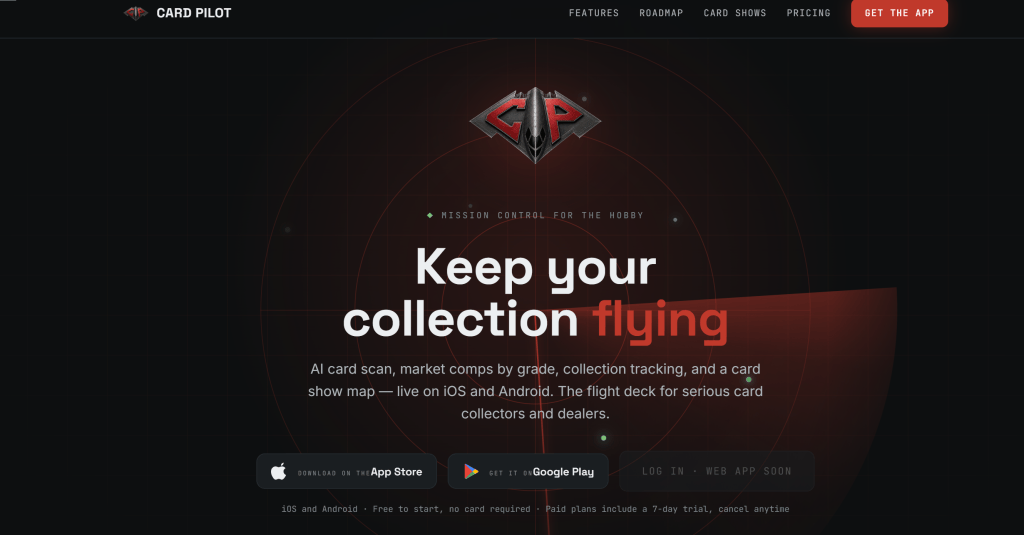
The scan is the party trick. The comps are the point.
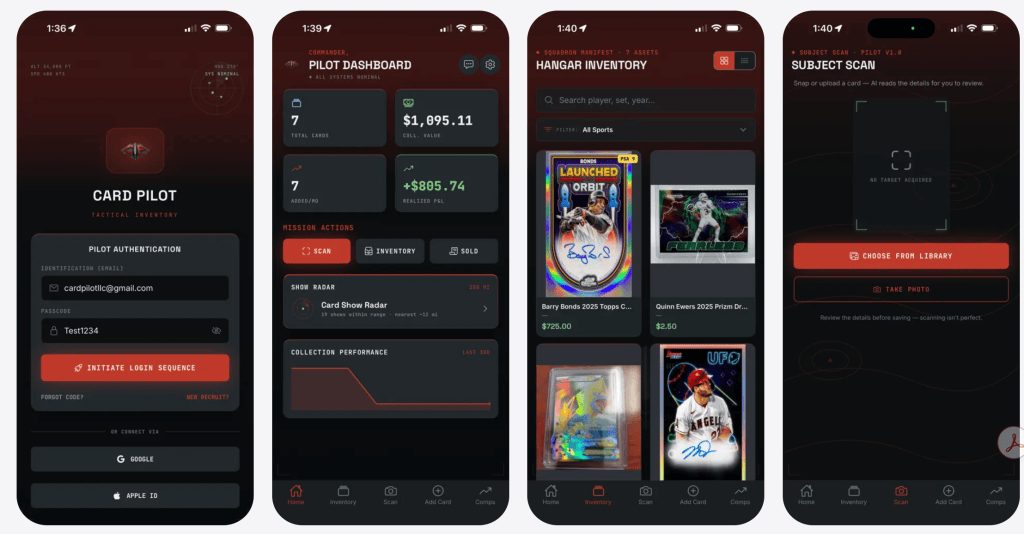
Yes, the AI recognition is the feature that makes people go “ohhh” at the table. Point your camera, and it reads player, set, year, and card number straight off the cardboard, then matches it to a database entry. Per the company’s FAQ, you get to eyeball the match before anything saves, so when it lands on the wrong parallel you fix it in a tap instead of discovering the mistake six months later.
Good. Fine. Every scanner app promises this.
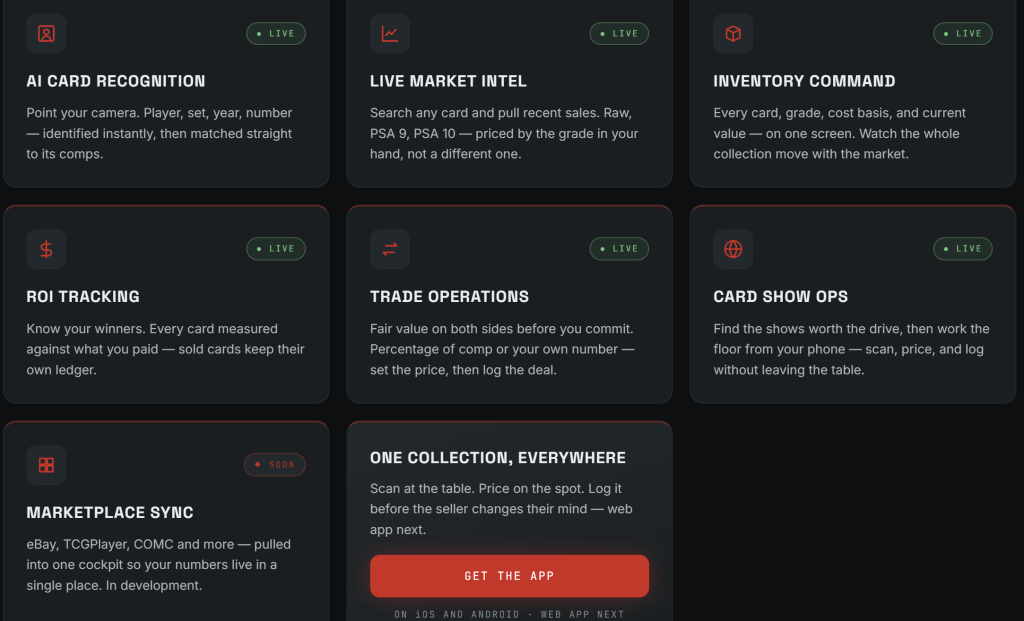
Here is what actually made us sit up: Card Pilot prices the card in your hand, not a different version of it. Raw is raw. PSA 9 is PSA 9. PSA 10 is its own universe. The app separates them.
That sounds like table stakes. It is not. Pricing a 9 against 10 comps is one of the fastest ways in this hobby to talk yourself into a purchase you will quietly resent, and plenty of quick-lookup tools smudge that line. Card Pilot drawing it clearly is a sign that somebody on the product team has actually been burned at a show. That kind of scar tissue shows up in software, and you can feel it here.
Your collection, finally behaving like a portfolio
This is the part CardVestr readers are going to care about most.
Card Pilot tracks cost basis. It tracks current value against that basis. And crucially, when you sell something, the card does not just evaporate from your inventory. It moves to its own ledger.
That last detail is small and it is enormous. A tracker that deletes sold positions is a scrapbook. A tracker that keeps them is a performance record. If you are running any kind of strategy, the sold ledger is the difference between “I think I did okay this year” and actually knowing.
Pair that with grade-level pricing and you have something that behaves less like a card app and more like a real position monitor that happens to live in your pocket.
The show map might be the sneakiest good idea in here
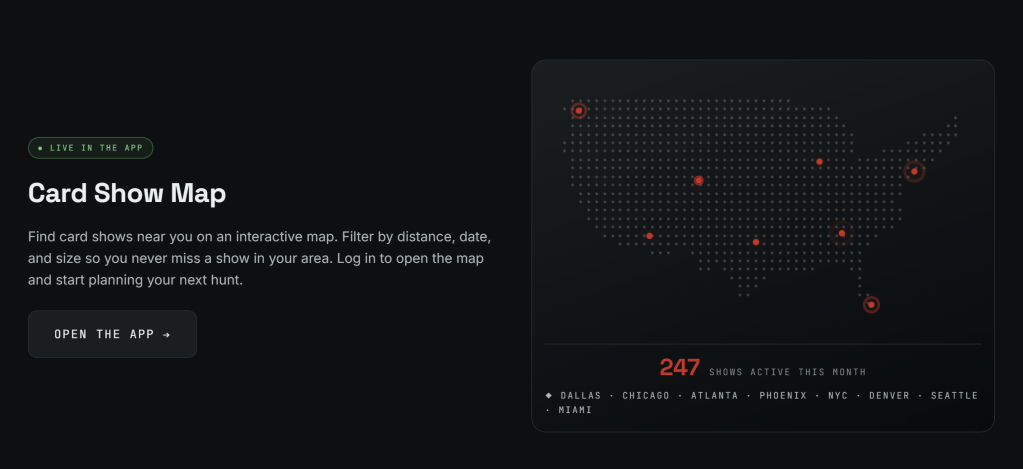
Everyone is going to lead with the AI. We think the card show map is more interesting, because card show discovery in 2026 is still genuinely broken. It lives in regional Facebook groups, promoter mailing lists, and flyers taped up next to the register at your local shop.
Card Pilot put shows on a filterable national map. Distance, date, size. As of September 14, 2026, the company’s site reported 247 shows active for the month across markets including Dallas, Chicago, Atlanta, Phoenix, New York, Denver, Seattle, and Miami.
Even better: listing a show is free for promoters and vendors, per the site. That is exactly the right call, because a map like this compounds. More listings make it more useful, which pulls in more collectors, which makes getting listed more valuable. Get that flywheel spinning and the map becomes a reason to open the app on days you are not buying anything at all.
For a lot of people, this feature alone justifies the download.
Trade math without the awkward silence
There is also a trade tool that prices both sides of a deal before anyone commits, either as a percentage of comp or at a number you set yourself.
Anyone who has stood across a table doing mental arithmetic on a four-for-one while both parties pretend to be relaxed will understand why this is a quality-of-life upgrade. Put the numbers on the screen, let the screen be the bad guy, shake hands.
What is still taxiing
Here is where Card Pilot earns some real credit, because the company is unusually straight about what has shipped versus what has not. Features on the site carry “Live” or “Soon” tags, and the social-feature screenshots are labeled as sample profiles rather than passed off as real users. That is more honesty than this category typically bothers with, and it is worth saying out loud.
The live stuff: scan, comps, inventory, ROI, trade tools, and the show map, available as of September 14, 2026 per the company’s site.
Still in the hangar: the whole social layer. That means an in-app Deal Room for negotiating directly with other collectors, browsing another collector’s inventory and making offers on what you see, and a follow graph so you can build a reputation. Marketplace sync with eBay, TCGPlayer, and COMC is also in development, along with a full web app that will sync to the same collection.
If that social layer lands well, Card Pilot stops being a utility and starts being a place. That is the whole ballgame for this kind of product, and it is the thing we are most curious to see.
One more to watch, and we flag it because we like the product enough to want it nailed: comp depth. The company says Market Comps pulls recent sales for the exact card and grade, and separately notes that direct eBay sold-price integration is in progress and will expand the data behind every comp. Comp data is the engine room of any pricing tool, so when that integration lands it should be a meaningful step up. Until then, the free tier is right there. Pull comps on a few cards where you already know the market cold and see how it reads.
Vintage collectors, same advice, slightly louder. Recognition engines generally learn on modern product because that is where the volume is, and pre-1980 cardboard is harder on both recognition and comp depth. The company’s FAQ is upfront that heavily worn or off-angle cards may need a manual search. Test it on your own stuff first.
Who should download this today
Show-floor buyers. This is the use case the entire app was engineered around. The scan, price, log loop is the point, and nothing else is built quite this deliberately for standing up.
Collectors who want portfolio discipline. Cost basis, live value, and a sold-card ledger in one place is the setup that turns a shoebox into something you can actually evaluate.
Anyone who drives to shows. Open the map. That is the whole pitch.
Anyone curious about where the hobby’s software is heading. Even the parts still in development tell you something about where this is going.
Two honest caveats. High-volume dealers will run into the inventory ceiling on the top tier, which caps in the low thousands of cards, so check the math against your own count before you commit. And it is mobile only right now, with the web app still in development.
The verdict
Card Pilot picked one specific, underserved, genuinely annoying moment in the hobby and built for it with real conviction. The grade-specific comps show domain understanding. The sold-card ledger shows respect for people treating this as more than a hobby. The show map is a quiet gem. And the roadmap labeling is more honest than the category norm, which counts for a lot.
It is not finished. The team says so themselves, loudly, on their own homepage. But what is flying today is genuinely useful, the free tier means you can find out for yourself without handing over anything, and the stuff still in the hangar is the stuff that would make this a fixture.
Visit Card Pilot today: https://cardpilothq.com/




 CardVestr
Leave a comment