
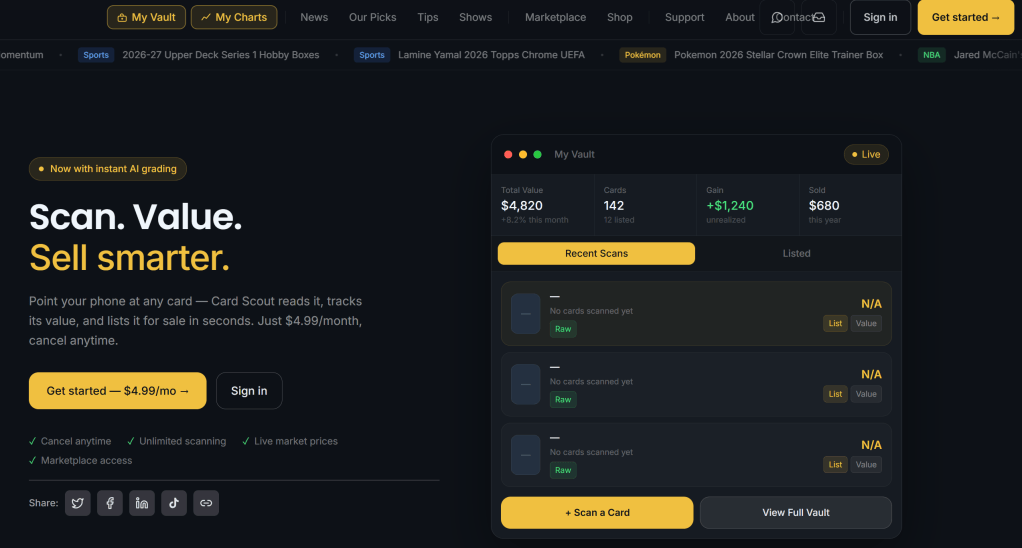
Point your phone at a card. Get a name, a grade guess, a price and a “list it” button. That is the whole pitch of Card Scout, and it is a bigger swing than the name suggests.
Card Scout (card-scout.io) launched in May 2026, according to its press release dated May 11, 2026 (PR.com). It covers sports cards and trading card games, and it wants to handle the full loop: identify the card, estimate its condition, track what it is worth, and sell it, all without leaving the site.
We have covered plenty of tools that do one of those things well. Card Scout is interesting because it tries to do all of them. Here is what that looks like in practice.
What it does
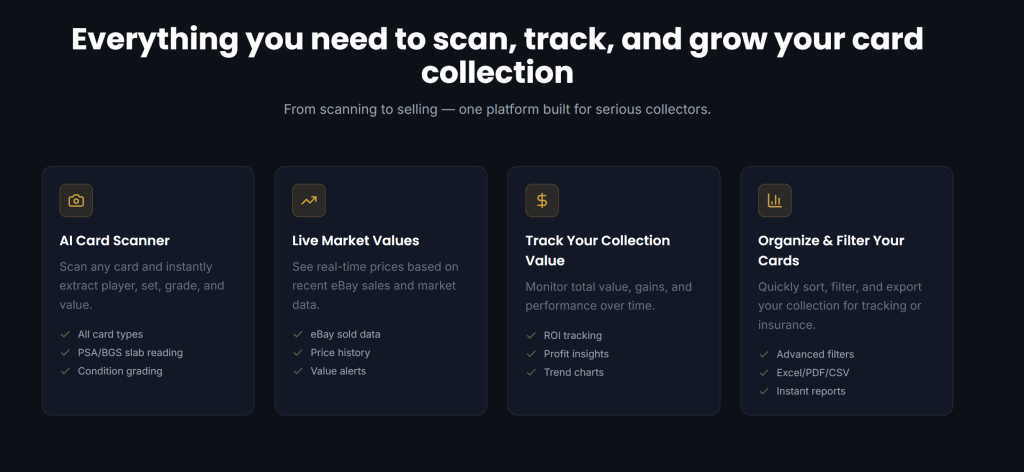
Scan. The scanner reads player, set, year, brand, card number and grade from a phone camera. The site says the smart camera detects all four corners, checks focus and glare, and captures automatically. That auto-capture detail is the kind of small thing that separates a tool you use once from one you use every Saturday morning with a stack of commons.
Grade. An AI condition check suggests a PSA-style grade with a confidence score, plus a breakdown of surface, corners, edges, creases and centering. Think of it as a pre-grading screener sitting inside your collection manager.
Value. Prices come from recent eBay sold listings, matched to the card’s details, per the site (accessed October 28, 2026). You also get per-card price history and price alerts.
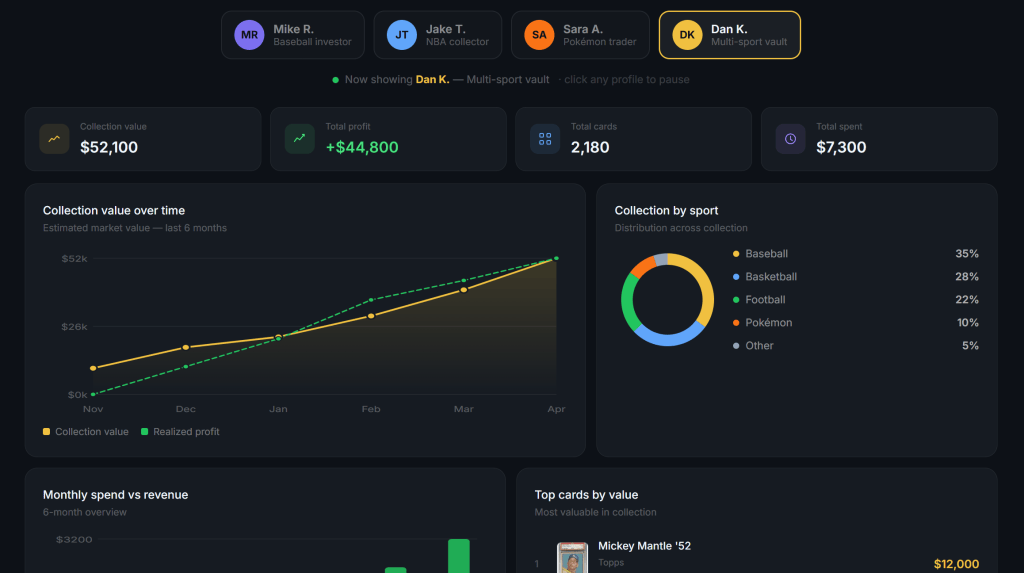
Track. The portfolio view shows total value, unrealized gains, ROI and charts, and you can export to Excel, PDF or CSV. If you have ever maintained a collection spreadsheet by hand, you know why export options matter.
Sell. This is the part that sets it apart. There is a built-in marketplace, an eBay listing generator, shipping and tracking, and seller payouts handled through Stripe. Buyers get search filters, checkout, messaging and a dispute system.
Read. There is also a content layer with daily hobby news, card show listings and collecting tips. Nice extra, not the reason to sign up.
How wide is it?
The site lists more than 13 card types and five grading companies: PSA, BGS, SGC, CGC and HGA (card-scout.io, accessed October 28, 2026). On the sports side that means NBA, MLB, NFL and soccer. On the TCG side it lists Pokémon, Magic: The Gathering, Yu-Gi-Oh and One Piece, plus Star Wars, Marvel, anime and vintage non-sports.
That breadth is a plus if your collection is a mix. It is also a flag: a tool that covers everything has to be good at the hardest category, not just the easy ones.
The money part
Pricing is where we want you to read the fine print. The launch press release framed Card Scout as free. The live site today describes a single paid monthly plan with full access after you subscribe, plus a small percentage fee when you sell through the marketplace. We could not find a free tier. Directionally, the subscription is priced like a light consumer app rather than a serious investor platform, but you should check the current terms before you commit.
Who it is for
Collectors who want one home for their cards and do not want to juggle a scanner app, a spreadsheet, a pricing site and a listing tool. It also suits casual flippers who like the idea of going from scan to sale in a few taps.
Investors who want deep market analytics, population data or long historical comps will likely want a dedicated pricing platform alongside it. Card Scout looks like a collection and selling tool first.
Good to know
Three honest caveats.
First, there is no public accuracy data for the AI grade or the value estimates. The site describes the grading output as a suggestion with a confidence score, and that is how you should treat it. An AI pre-grade is a screening step, not a promise about what a grading company will say.
Second, valuation leans on eBay sold listings, and the site does not name other sources. For liquid, popular cards that is a solid foundation. For thin-market cards, a handful of sales can swing the number.
Third, it appears to be a mobile-friendly website rather than a native iPhone or Android app. If you want offline scanning at a card show with spotty reception, test it first. Also note that the “real-time” price claim sits next to mentions of scheduled updates, so refresh timing is unclear.
The bottom line
Card Scout is a young, ambitious all-in-one: scan it, grade it, value it, track it, sell it. The appeal is convenience, and the concept is easy to understand. The open questions are accuracy and depth, and the pricing story has shifted since launch.
If your collection is a mixed pile and your current workflow is five apps and a spreadsheet, it is worth a trial. Scan a few cards you already know the value of, compare the numbers to what you see, and decide from there.
Visit Card Scout today: https://card-scout.io/







Leave a Reply