
The self-described “Bloomberg Terminal for cards” scans the market for you, does the arbitrage math, and hands you a shortlist. For anyone who’s ever lost a Saturday to eBay, that’s a big deal.
Here’s a thing every collector who has ever mailed cards to PSA learns the hard way. The grading isn’t the hard part. The finding is.
Anyone can do the arithmetic once they’ve got a card in hand. Raw value, graded value, fee, shipping, sell-through cost. It’s a spreadsheet. The brutal part is the hours before that, scrolling listing after listing hoping to spot the one raw card whose graded ceiling is high enough and whose gem odds are good enough to justify the submission. Most of that time produces nothing. It’s a needle-in-haystack problem, and humans are bad at haystacks.
KardSight was built by two collectors who got tired of it. Their founding story, told on the company’s About page, is refreshingly unglamorous. They were burning 20-plus hours a week on manual research to surface a handful of mediocre opportunities, decided that wasn’t sustainable, and built the thing they wanted.
What they shipped is genuinely interesting.
The pitch: stop researching, start buying
KardSight’s core product is called Top Buys, and the concept is simple enough to explain in a sentence. The platform scans marketplaces including eBay, Fanatics and Goldin on a weekly cycle, and surfaces raw cards where the spread between the raw price and the likely graded price is wide enough to be worth acting on.
You don’t get a database. You get a shortlist. That distinction is the whole product.
The company describes covering 10-plus categories, spanning MLB, NBA, NFL, NHL, MLS and UFC on the sports side, plus Pokémon, One Piece, Magic and Yu-Gi-Oh on the TCG side. That breadth matters more than it sounds. Grading arbitrage in Pokémon behaves nothing like grading arbitrage in vintage baseball, and a tool that only understands one of them is only half a tool.
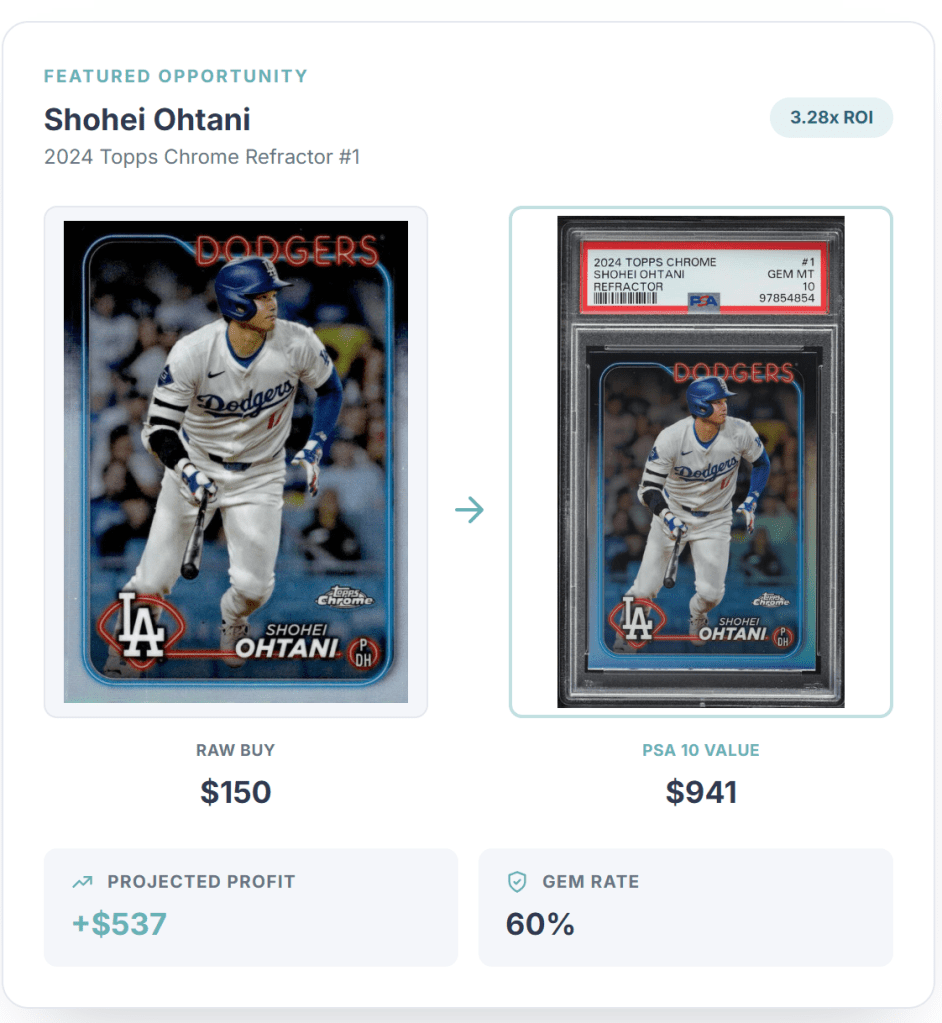
Each opportunity arrives with the supporting evidence attached: recent comparable sales for both raw and slabbed copies, price trend data, population and gem-rate figures, and a computed ROI that the company says already nets out grading fees, shipping and insurance. On the sample opportunities published to the KardSight homepage as of August 2026, that math is expressed as a return multiple alongside an explicit gem-rate assumption. A Topps Chrome Ohtani refractor is shown at better than a 3x return against a 60% gem rate, a Finest LeBron insert near 2.9x at 50%, a Pokémon illustration rare above 2x at 64%.
Displaying the gem rate right next to the ROI is the correct design decision, and it’s worth calling out. In grading arbitrage, the gem rate is the trade. A card with a spectacular spread and a terrible gem rate is a losing bet dressed as a winning one, and plenty of tools quietly bury that number. KardSight puts it on the card.
Four tools, one loop
The platform is organized around a workflow rather than a feature list, which is how you can tell it was designed by people who actually do this.
Top Buys is the discovery engine, the automated feed described above.
AI Card Search is the mobile counterpart. Snap a photo of a card in the wild, match it, pull comps and gem rate, and decide on the spot. This is the card-show use case, and it’s the one that will win people over. Standing in an aisle with a card in your hand and thirty seconds to make a call is exactly where good data is worth the most.
The AI Grader lets you upload photos and get a predicted grade before you spend a dollar. Worth being precise here, because the company is precise about it. Centering analysis is live, with corners, edges and surface described as coming soon. So today this is a centering screener with a grade-prediction roadmap attached. Genuinely useful, since centering is the most objective and most common PSA 10 killer, but not yet the full four-criteria read.
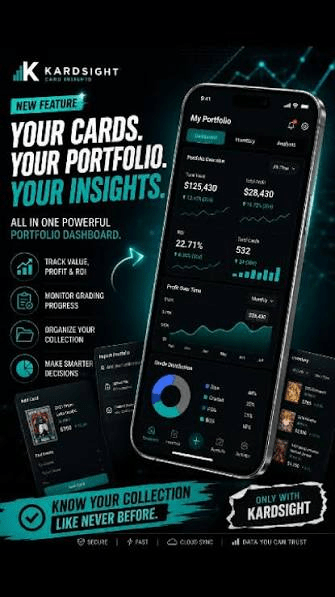
The Portfolio Tracker follows every card from raw purchase through submission to sale, covering realized and unrealized gains across both inventory and personal collection. For flippers running volume, this is the tool that turns a hobby into a book of business.
The partnerships are the credibility
Card analytics platforms live or die on data quality, and this is where KardSight has made smart choices rather than trying to build everything itself.
The platform integrates GemRate for PSA population and gem-rate data, Card Hedge for sports and TCG price analysis, and Raw2Riches for grading expertise and heat-index signals. There’s also a grading partnership with Diamond Service Grading. Those are recognized names in hobby data infrastructure, and leaning on them for the underlying numbers is a better bet than a young company scraping its own population data and hoping.
More than software
There’s a full education layer wrapped around the product: a learning center with guides on grading strategy and market timing, monthly live webinars with the team, a short-form video library, and a private Discord where founders are directly reachable. A supplemental Skool community launched recently.
For a category where most people are self-taught and half the received wisdom is wrong, that’s a real differentiator. Software tells you what to buy. Education tells you why, and the second one compounds.
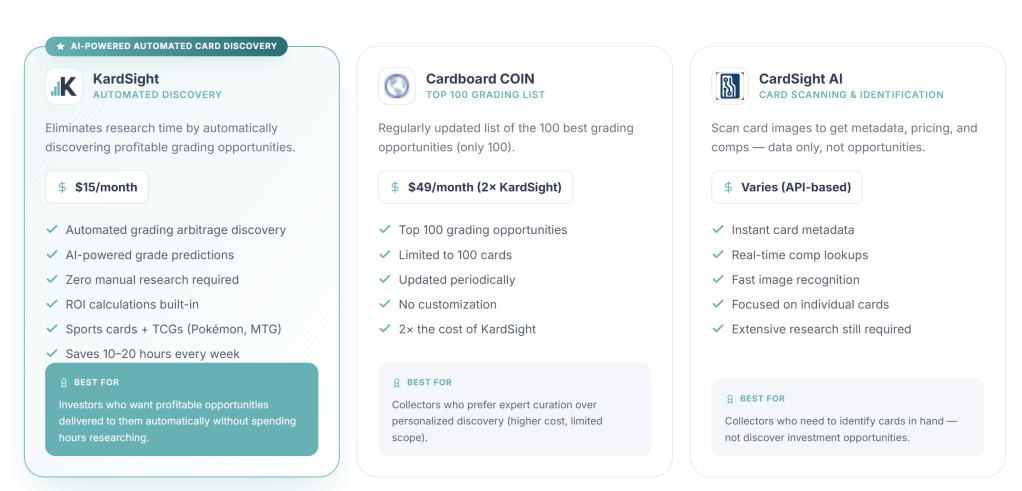
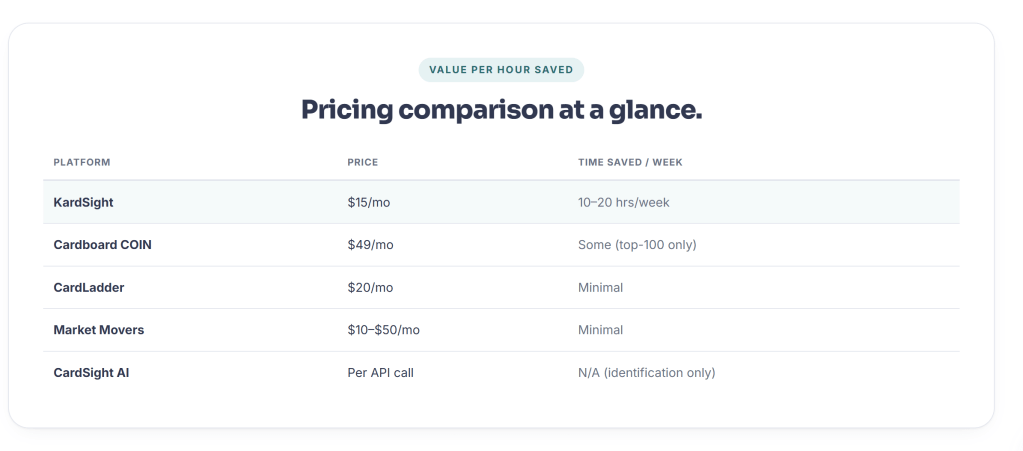
Pricing runs a monthly plan and a discounted annual plan, with a five-day free trial that doesn’t charge during the trial period. It sits at the accessible end of the category, well below what some competing grading screeners charge.
What users are saying, and an honest note on that
The testimonials KardSight publishes are warm and specific in the way real ones tend to be. Users describe the AI photo-upload flow working cleanly on the first try, praise the weekly insight emails as clear and concise, and, my favorite, one Discord member writes that the search time they used to burn coming up empty has effectively vanished. Another calls the educational videos the best training they’ve had on pricing and what to buy. Across the wall, the recurring theme isn’t “this made me money.” It’s “this gave me my time back.”
Now the honest part, because CardVestr readers deserve it. Every one of those testimonials is published by KardSight, collected from its own Discord, email and social channels. At the time of writing in August 2026, we could not locate a meaningful body of independent third-party reviews. No Trustpilot presence, no substantial Reddit thread, no app store corpus to weigh against the company’s own selection.
That is not a red flag. It’s what an early platform looks like before the community catches up, and the first-party quotes read as authentic rather than manufactured. But it does mean the five-day trial is doing real work here. Use it. Judge the Top Buys feed against your own knowledge of a category you know cold, and see whether the gem-rate assumptions match what you’d have guessed yourself.
Worth saying too: KardSight’s own disclaimer states plainly that projected profit is an estimate based on market data, grading assumptions, fees and comps, and that results aren’t guaranteed. That’s the right disclosure, and it’s the right mental model. Every ROI number on a platform like this is a probability-weighted estimate, not a forecast. The card still has to grade.
The verdict
KardSight is attacking the correct problem. Historical price databases have been solved for years, and a dozen platforms will tell you what a card did. Almost none will tell you what to do, and fewer still will do the searching for you.
For flippers and grading-focused investors, this is a compelling proposition at an accessible price with a low-friction way to test it. For collectors who mostly want to know what their shoebox is worth, it’s more machine than the job requires. And for anyone who has ever calculated a grading submission on the back of an envelope and wondered whether they were guessing at the gem rate, you were. This is a serious attempt to stop.
Take the trial. Bring your skepticism. That’s what it’s for.
Visit KardSight today: https://kardsight.com/






Leave a Reply