
A Navy veteran inherited 40 years of cardboard, tried every listing tool on the market, and gave up on all of them. So he built his own. Eight months after launch, dealers with tens of thousands of active listings are switching over inside an hour — and the feature list reads like a wish list someone actually granted.
Every sports card dealer running volume on eBay has the same tab open somewhere: the cleanup tab. The one where you fix the parallel the scanner missed, retype the team name because the software says “Hockey” and eBay wants “Ice Hockey,” and manually paste in card size and country because the item specifics came back half empty.
CardLuma‘s entire pitch is that this tab shouldn’t exist.
The platform launched publicly in January 2026, according to the company’s About page, and it is unapologetically narrow: scan cards, identify them, price them against sold comps, apply your rules, publish to eBay. Shopify and Whatnot are supported as downstream reuse of the same cleaned-up data, not as co-equal channels. That focus is the most interesting thing about it, and it’s also the thing worth interrogating hardest.
What it actually does
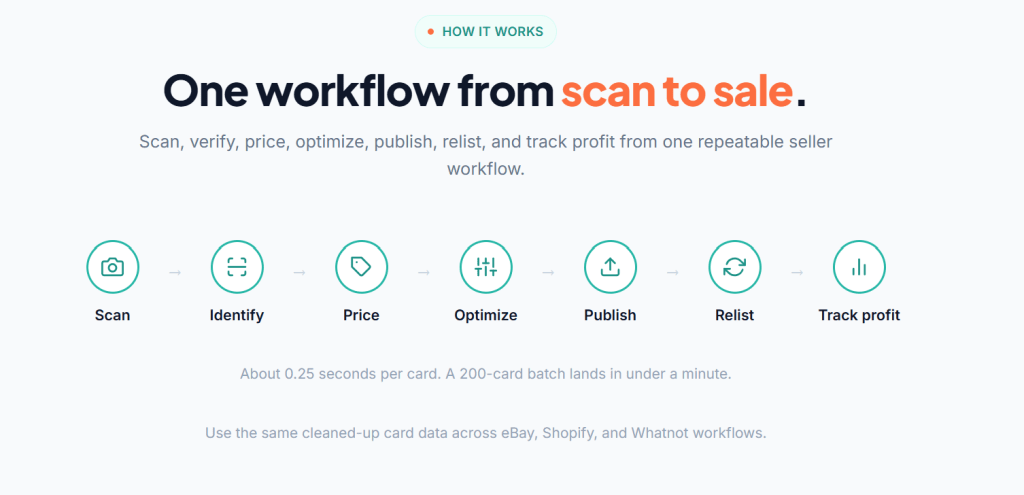
The workflow CardLuma describes is linear and short: scan, identify, price, optimize, publish, relist, track profit.
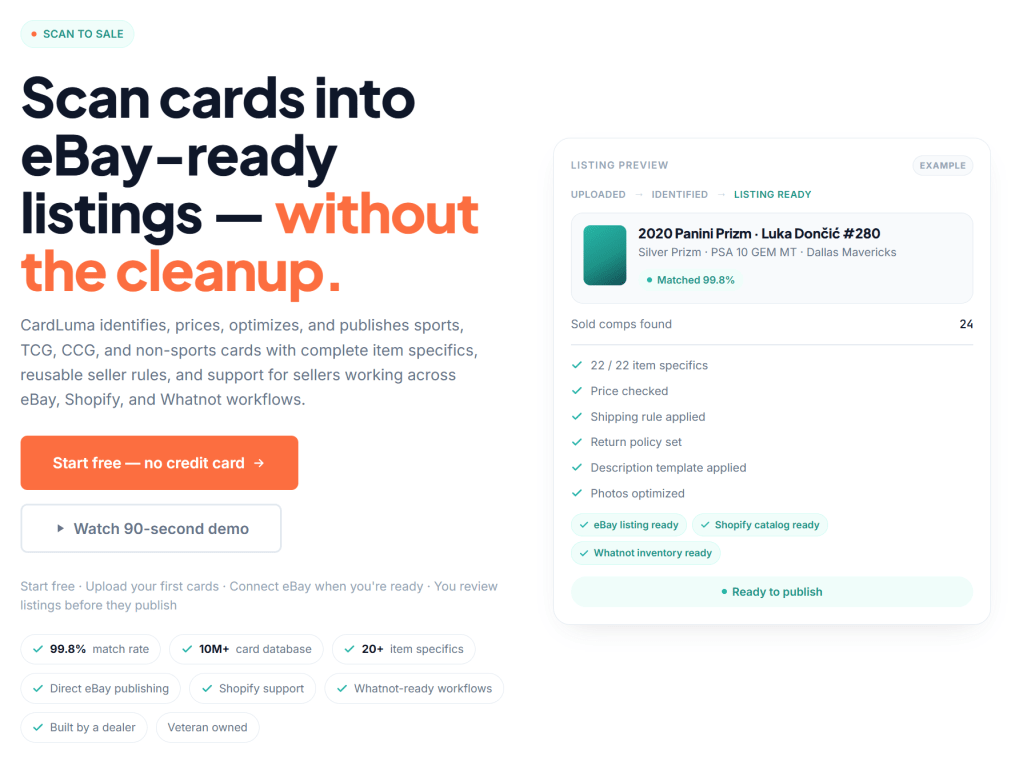
Identification runs through what the company calls a four-stage pipeline — image analysis, AI identification, database verification, then listing generation — checked against a card database the site describes as covering more than 10 million records. The company claims sub-five-second identification per card and a 99.8% match rate, with multi-candidate ranking and confidence scoring so ambiguous cards surface alternatives rather than silently guessing (CardLuma features page, accessed August 31, 2026).
Where it gets more interesting than the average scanner is what happens after the match. The platform auto-fills more than 20 eBay item specifics — player, year, set, card number, sport, team, parallel, rookie status, Hall of Fame status, autograph, serial number, card size, language, league, season, graded status. It detects rookie cards by cross-referencing the database. It flags Hall of Famers across baseball, basketball, and football. It reads serial numbers on sports, TCG, and CCG cards and pushes the print run into the title rather than burying it in a note.
Anyone who has watched a thin listing die in eBay search understands why that matters more than raw scan speed.
The rules engine is the actual product
Scanning is table stakes. The reason a dealer with thousands of active listings would move platforms is operational consistency, and that’s where CardLuma has built the most depth.
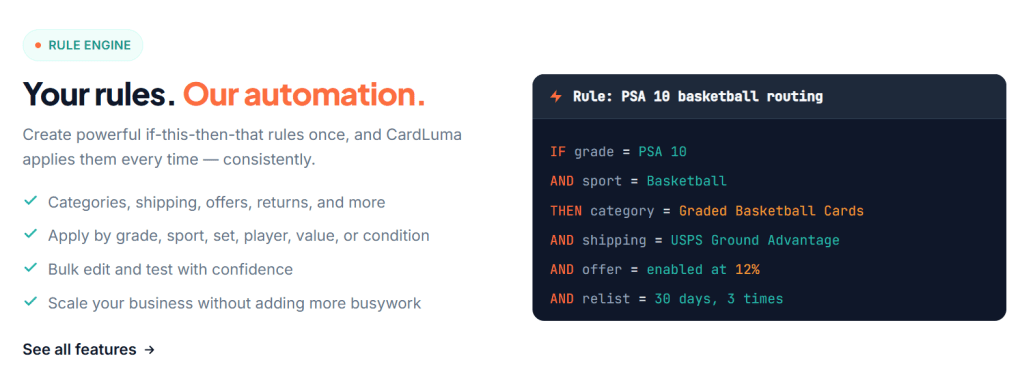
The automation layer is priority-ordered, if-this-then-that logic applied across the whole operation:
- Store category routing by player, sport, team, or HOF status — including a “team matches category” rule that collapses what would otherwise be thirty separate rules into one, plus automatic assignment of secondary store categories so a card lands in two browse paths without duplicating the listing.
- Independent rule sets for Sports vs. TCG/CCG, so your basketball logic doesn’t step on your Pokémon logic.
- Shipping policy automation driven by price, card type, or graded status, with a built-in rule tester and a catch-all default.
- Best Offer automation with minimum-offer percentages and auto-accept thresholds applied uniformly by price band.
- Description template automation that selects the right template by price, graded status, and quantity, first match wins.
- Title building via conditional placeholders, with live character counting and smart abbreviation that trims team names before it trims high-value keywords when a title runs past eBay’s 80-character limit.
There’s also a genuinely useful set of unglamorous features that suggest someone was actually listing cards when they designed this: bulk front/back image swap for when you scan an entire batch backwards, moving cards between batches without re-scanning, per-card description notes for the one card with soft corners, custom batch names instead of “Batch #5,” and keyboard shortcuts for condition grades.
On the analytics side, per-card profit and loss nets real eBay final value fees, promoted listing fees, shipping, and refunds against your acquisition cost, exportable to CSV with cost included in the same file. That’s a meaningful gap-closer for dealers currently reconciling margin in a separate spreadsheet.
Pricing and packaging
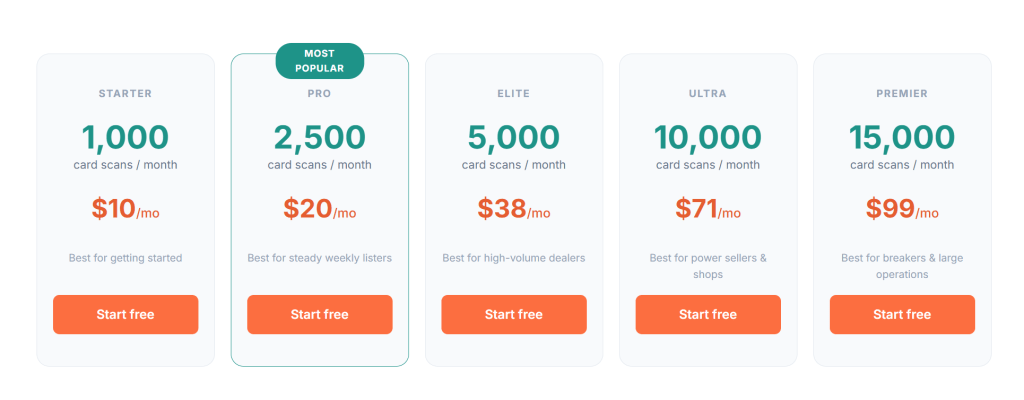
Three tiers — Starter, Pro, and Elite — separated by nothing except monthly scan allowance. Every plan includes the full platform, which is an unusual and defensible packaging decision in a category that normally gates automation behind the top tier. Scan credits don’t expire. A launch promotion offers a percentage discount on the first three months.
Pricing sits well below what comparable vertical SaaS typically commands, closer to a consumer subscription than a business tool. That’s a deliberate land-grab posture, and it’s worth asking how it holds up as infrastructure and support costs scale.
One inconsistency: the homepage and About page both promote a free start with no credit card required, while the features page and the Card Dealer Pro comparison page describe a 14-day free trial. Those aren’t necessarily contradictory, but the messaging doesn’t resolve cleanly across pages.
Try CardLuma: https://www.cardluma.com/







Leave a comment