
The scanner that started as a dad-and-kid project now handles millions of scans a day. Here’s what it actually does, where it shines, and what to know before you go all in.
Every collector has had the moment. You pull a shoebox out of the basement, blow the dust off, and stare at a stack of cardboard with absolutely no idea whether you’re holding lunch money or a car payment.
CollX — pronounce it “collects,” and yes, that’s the whole joke — was built for exactly that moment. Point your phone at a card. Get an ID and a market value. Done.
That’s a deceptively simple pitch, and it worked. Founded in Haddonfield, New Jersey by Ted Mann, a repeat founder who previously built the coupon app SnipSnap and later ran visual search company Slyce, CollX has spent four years quietly compounding. As of April 2026, the company reported roughly 4.5 million registered users, half a million monthly actives, and between one and two million card scans per day, according to a Technical.ly profile published April 29, 2026. In that same reporting, Mann said the company had reached profitability — a sentence you don’t get to write about consumer apps very often anymore.
So it’s growing, it’s making money, and it’s still free to download. Let’s get into what it actually does.
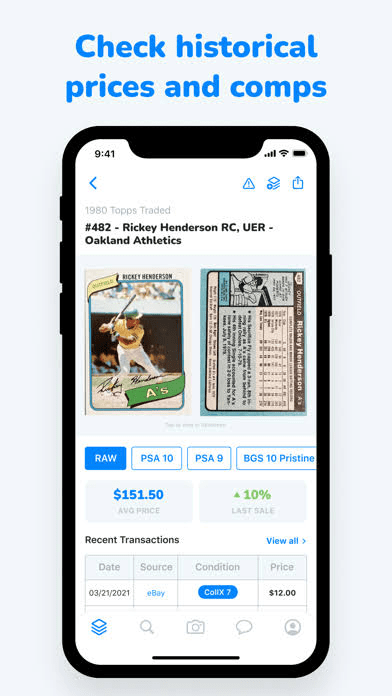
The scan is still the magic trick
The core loop hasn’t changed since launch, and that’s a compliment.
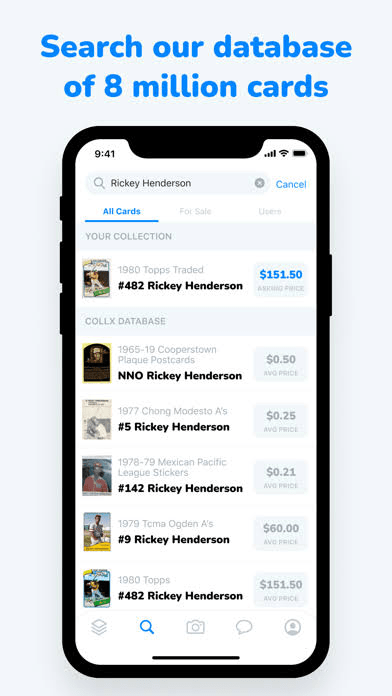
You open the camera, frame the front of the card (the back helps accuracy), and CollX’s visual search runs it against a database the company listed at more than 17 million sports and trading cards in its Google Play description as of its August 27, 2026 update. Seconds later you’ve got an identification and an average market value calculated from historical auction results.
It is genuinely satisfying. There’s a reason the app’s reviews are full of people describing marathon sessions with their kids at the kitchen table — once you scan one card, you scan the whole box. Mann told Technical.ly the average user ends up with a few hundred cards catalogued, with power users running into the thousands and beyond.
And the coverage is broad. This isn’t a baseball-only tool. Football, basketball, hockey, soccer, wrestling and the major trading card games are all supported, alongside non-sport categories. Tennis and golf were added in a 2026 update, per the company’s public release notes.
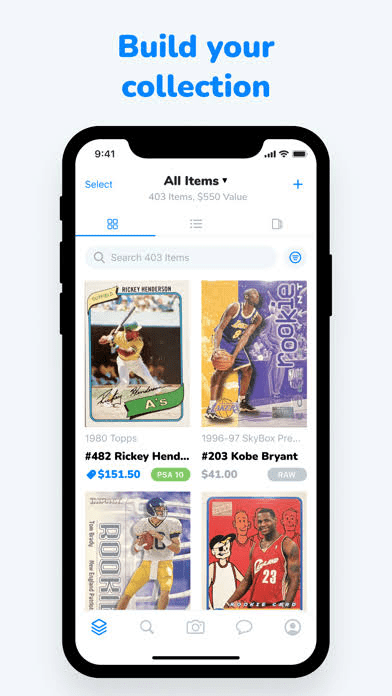
From scanner to actual software
Here’s where CollX has quietly outgrown its category. What started as a lookup utility now behaves like a real collection management platform.
Collection tracking that scales. Sort and filter by value, year, team, date added, or set. Watch your total portfolio value move. Track set completion and generate printable checklists so you know exactly which cards you’re still hunting. Pro subscribers can export the whole thing as a CSV — which, if you’re the kind of collector who maintains a real spreadsheet, is the single most important feature in the app.
A physical-world index. You can assign cards to storage locations and bulk-assign them in batches. Anyone who has ever torn apart four monster boxes looking for one card understands why this matters.
Pricing tools with teeth. A Pricing Assistant surfaces cards in your collection priced meaningfully above or below market. EasyPrice lets Pro users bulk-reprice mispriced listings to market average within a set tolerance and a floor. A “Great Value” filter flags listings sitting well below average — effectively a deal-hunting radar built into search. All of this shipped through 2026 updates documented in the company’s release notes.
Performance work. The team specifically optimized browsing for collections north of 10,000 cards. That’s not a glamorous release note. It’s the kind of thing that tells you they’re listening to their heaviest users.
The marketplace is the real business
Version 2.0 added a marketplace, and it’s since become the center of gravity.
You can list any card in your collection for sale, make offers on other collectors’ cards, bundle multiple cards into a single deal, and pay by credit card with shipping and tracking handled in-app. Sellers get bulk discount settings, offer acceptance, and a vacation mode. CollX Protect holds payment until cards land with the buyer, and CollX Envelope provides tracked shipping for lower-value items.
Layered on top is a genuine social feed — follow collectors and sellers you like, get notified when they list new inventory, chat individually or in groups. It makes the app feel less like inventory software and more like a card show that lives in your pocket.
There’s also a professional tier of the business most collectors never see. Card Dealer Pro, acquired by CollX in 2022, is separate software for card shops and dealers to inventory and cross-list across sales channels. Mann told Technical.ly in April 2026 that roughly 7,000 dealers use it — which means a meaningful share of the marketplace’s inventory is coming from actual professionals, not just weekend sellers.
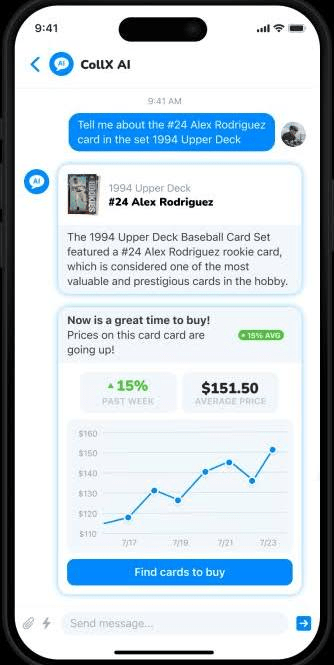
The AI chapter is just starting
CollX has run on computer vision since day one, but the newer work is more ambitious.
CollX AI, positioned by the company as a hobby-specific assistant, offers insights on cards and coaching on everything from negotiating to shipping. More interesting is what’s in development: Mann described “agentic tools” to Technical.ly — software that acts on a collector’s behalf rather than just answering questions. Think a card coach that helps you assemble a multi-card offer, or set a goal like completing a specific set and then works the market with you.
Mann floated an even further-out version: a collector at a show glancing at a card through smart glasses and getting real-time guidance without ever pulling out a phone. That’s speculative. But it’s the right instinct — the hard part of collecting was never identification. It’s judgment.
What the users actually say
The consensus is strong. CollX holds a 4.5-star rating across tens of thousands of Google Play reviews with well over a million downloads, per aggregated review analysis published in 2026. The praise is remarkably consistent: it’s fast, it’s fun, it’s free, and it’s the easiest on-ramp into the hobby anyone has built. Reviewers repeatedly note that the team ships updates constantly and responds to bug reports individually.
Two things are worth knowing before you lean on it heavily, and neither is a dealbreaker — but you’d want a friend to tell you.
The marketplace has more friction than the scanner. Smaller review samples on sites like Trustpilot skew considerably more negative than the app stores, and the complaints cluster tightly around seller-side dispute resolution — refunds resolved in the buyer’s favor, sellers absorbing loss on cards shipped through CollX’s own process. Any young marketplace has to solve this, and the honest read is that CollX’s dispute policy is still maturing faster than its transaction volume. If you’re selling meaningful cards, understand the protection terms first.
Treat the scan price as a starting point, not a comp. Competitor-run comparisons published in 2026 have claimed CollX’s values sit further above realized eBay sold prices than some rivals, and that parallel and refractor identification is where accuracy slips. Take those numbers with appropriate salt — they were produced by companies selling competing scanners. But the underlying point matches what experienced collectors say: for base cards and commons, CollX is excellent. For high-value parallels and short prints, verify against a dedicated price guide before you list or buy.
The verdict
CollX won the “what’s it worth” question years ago. What’s impressive in 2026 is that it didn’t stop there — it turned a free utility into a marketplace, a social network, a dealer platform, and now an AI experiment, and got profitable doing it.
For casual collectors, it’s the easiest yes in the hobby: free, fast, and genuinely delightful. For serious collectors, it’s a superb front door and cataloguing layer that pairs well with a dedicated price guide for your high-end material. And for anyone sitting on a basement box they’ve been meaning to deal with for fifteen years, it remains the single best reason to finally go get it.
Point your phone at the cardboard. See what happens.





Leave a Reply