
A new scan-and-sell app from a Long Island father-and-son team bets that collectors would rather see the evidence than take a number on faith.
Ask four card apps what your collection is worth and you might get four very different answers. That’s not a hypothetical. A July 2026 comparison by TCGinvest, cited on Hobbybook’s site, priced the same 25-card collection in four apps and found the highest total landed roughly 60% above the lowest.
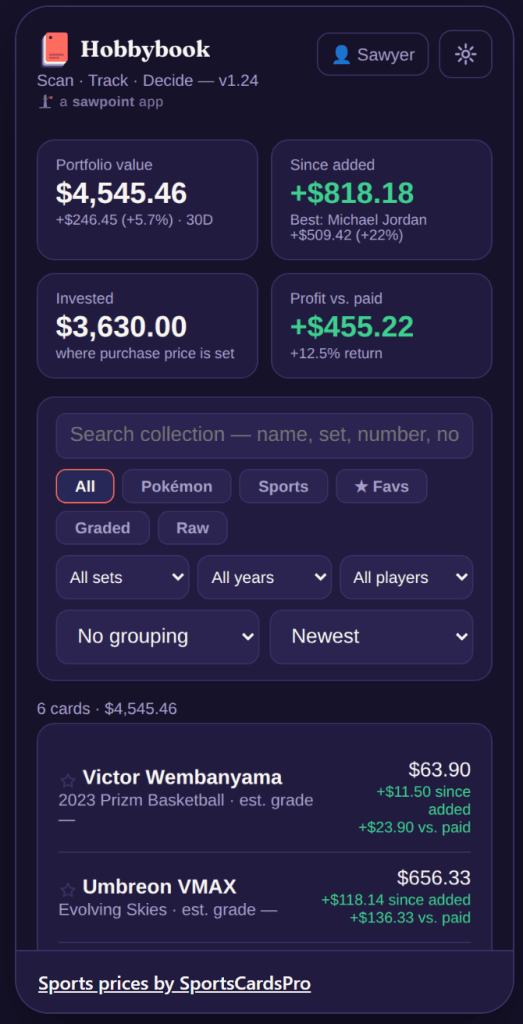
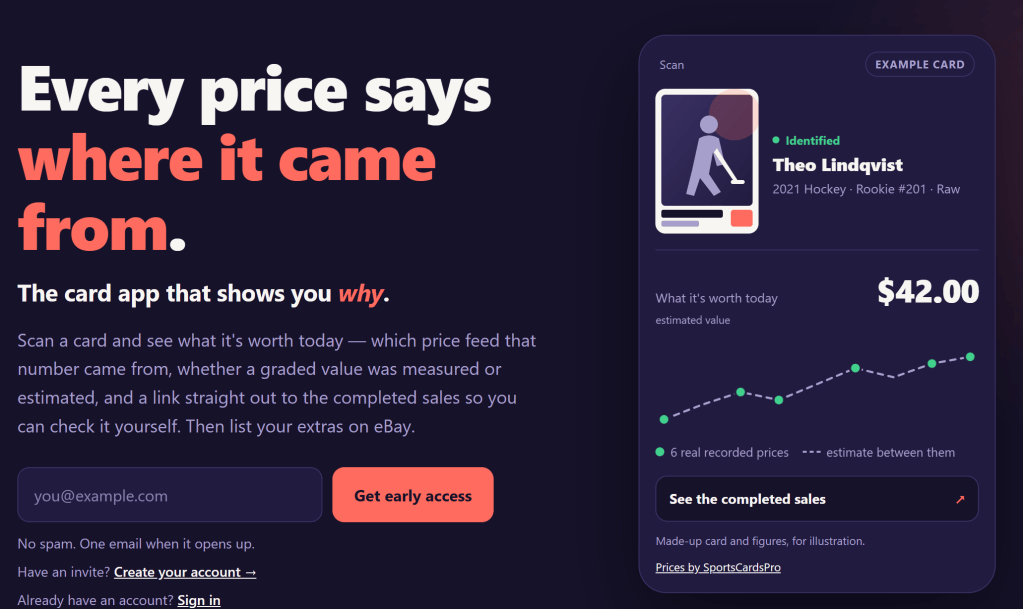
Hobbybook is built to fix exactly that. Its tagline says it plainly: every price says where it came from. Scan a card and the app tells you what it’s worth today, which price feed the number came from, whether a graded value was measured or estimated, and gives you a link straight to the completed sales so you can check the math yourself.
It’s in early access for now. The idea behind it is refreshingly simple, and it might be the most trustworthy pitch in card pricing right now.
A price chart that shows its work
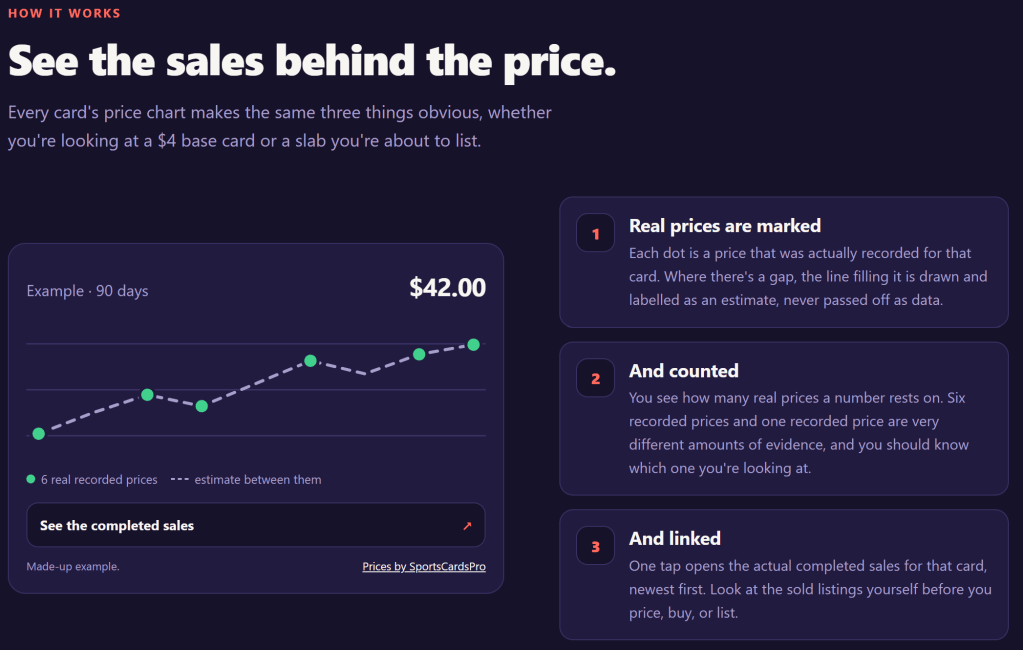
Every card in Hobbybook gets a price chart, and that chart is the whole show. It does three things most card apps skip.
- Real prices are marked. Each dot is a price that was actually recorded for that card. When there’s a gap, the line filling it is drawn and labeled as an estimate, never dressed up as data.
- They’re counted. You see how many recorded prices a value rests on. Six sales and one sale are very different amounts of evidence, and Hobbybook makes sure you know which one you’re looking at.
- They’re linked. One tap opens the actual completed sales for that card, newest first, so you can eyeball the comps before you buy, price or list.
Sports pricing comes from SportsCardsPro, and the app is upfront about its limits. “What it’s worth today” is labeled as a best read of recent sales, not an appraisal. Cards with thin sales history get flagged as still building. Cards too rare or too new to price well say so instead of getting a made-up number.
That last part matters more than it sounds. In a hobby where a confident-looking number can quietly be a guess, an app that admits what it doesn’t know earns a lot of trust.
Scan the pile, list the extras
The second half of Hobbybook is a selling workflow built for people who buy lots in bulk and flip what they don’t keep. It handles the tedious parts of a listing and leaves the decisions with you.
- Scan the pile. Photograph the front and back. Hobbybook returns the set, the card number, the player or Pokémon, and a condition estimate.
- Check the evidence. Review the recorded prices and completed sales for each card before deciding anything.
- Set your price. You type the number. Hobbybook never puts a price on a listing that you didn’t set yourself.
- Approve and list. The app drafts the title, condition and details. You review it, and it goes live on your own eBay account.
That third step is the clever bit. Plenty of tools would happily auto-price your listings. Hobbybook’s take is that the seller is usually the first person to notice when a price looks off, so the seller should be the one who sets it. Nothing gets published without your sign-off.
Sellers first, collectors too
Hobbybook is clear about its priorities. Sellers come first: eBay sellers moving cards every week, show vendors pricing a table on the fly, and anyone who buys lots and lists the extras.
Collectors get plenty, too. Sports cards and Pokémon live in one collection, totals keep themselves current, and you can export the whole thing to CSV whenever you like. That last feature is a quiet win for anyone who tracks their holdings in a spreadsheet.
The origin story fits the product. Hobbybook is made by Sawpoint and built on Long Island by a father and son who sell cards. One lists hockey on eBay; the other collects vintage baseball. They say they use it every day, and every feature exists because one of them needed it at the kitchen table.
For the investing-minded crowd, the appeal is obvious. Disciplined buyers already check comps before they act. Hobbybook just puts the comps one tap away and tells you how much weight each number can bear.
Pricing and availability
Hobbybook hasn’t set a price yet, and it says so right on the homepage. The team’s reasoning is on-brand: quoting a price before they know what the app costs to run would mean making up a number, which is the exact thing Hobbybook was built to stop.
For now, access is by early-access waitlist. Sign up on the Hobbybook site and you’ll get one email when it opens. Early-access members will hear the price before anyone is asked to pay it.
The bottom line
Card pricing has a trust problem, and most apps answer it with a bigger, shinier number. Hobbybook answers it with receipts. Marked data points, a visible count of real sales, and a one-tap path to the comps make it easy to see what a value is actually built on.
Add a seller workflow that does the grunt work but never touches your price, and Hobbybook looks like a smart pickup for anyone who sells regularly or simply wants to know why their binder is worth what it’s worth. It’s one to get on the waitlist for.
Visit Hobbybook today: https://hobbybook.app/





Leave a Reply