Two photos, a few seconds, and a public certificate. The company that started inside IAC’s incubator is quietly building the condition layer the hobby has been missing.
You know the moment. You’re three tables deep at a show, someone slides a raw rookie across the felt, and you’ve got about forty seconds to decide whether it’s a 9, a 10, or a heartbreak. You flip it, you tilt it toward the light, you squint at the corners, and then you make a gut call with real money attached.
chck.ai’s pitch is that you shouldn’t have to.
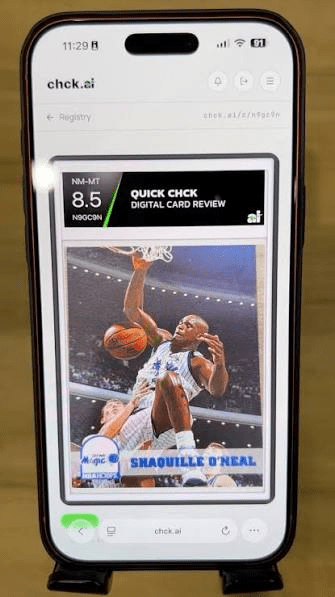
Two photos. Front, back. A few seconds later you’ve got a condition read, an estimated value range, and a link you can pull up on your phone. No mailer. No months. No refreshing a submission tracker at midnight.
That’s the promise. Here’s what’s actually under it — and it turns out to be more interesting than the pitch.

From a shoebox to an API
chck.ai didn’t start as an AI grading app. It started as Shoebox, a consumer product incubated inside IAC’s innovation program, built on a simple observation: collectors were mailing cardboard across the country to answer a question a camera could probably answer at home.
Shoebox let you scan, catalog, value, and pre-grade from your phone. It worked well enough that the company noticed something bigger — the computer vision engine underneath was more valuable than the app on top of it. In 2025, Shoebox folded into the chck.ai brand, and the mission changed from app for collectors to condition infrastructure for everyone who touches a card.
That’s a meaningfully different company. And it explains a lot about what the product does well.
Two speeds, and you’ll use both
chck.ai ships as two products, and the split is smarter than most.
Quick CHCK is the fast lane. Front photo, back photo, instant read. It’s built for the show floor, the marketplace scroll, the bulk sort, the “do I even care about this card” question. Seconds, not minutes.
Full CHCK is the deep dive. Through the iOS app, it walks you through 18 guided images — multiple angles, plus flash and no-flash passes over the surface. Roughly a minute of your time. This is the one you run before a submission, an insurance appraisal, or a consignment conversation.
Why 18 images? Because chck.ai will tell you, on its own services page, that two aren’t always enough. Surface scratches, print lines, gloss loss, edge softness — the stuff that actually separates a 9 from a 10 — routinely vanishes under a single light source. A card can photograph clean and grade rough.
Refreshingly, the company says this out loud instead of pretending the phone camera is magic. In a category full of tools claiming a single snapshot can replace a professional grader, “here’s what our fast mode can’t see” is a genuinely unusual sentence.
| Quick CHCK | Full CHCK | |
|---|---|---|
| Images | 2 | 18 |
| Time | Seconds | ~1 minute |
| Lighting | Single | Flash + no-flash |
| Damage detection | Visible defects | Multi-angle surface analysis |
| Best for | Buying, sorting, browsing | Grading, valuation, premium sales |
The four layers doing the work
Under the hood, chck.ai describes a four-stage pipeline, and each stage is doing something non-trivial:
Capture. Auto-frame, auto-rotate, auto-crop. On-device guidance while you shoot, server-side vision cropping after. Translation: it fixes your bad photography before it grades your card.
Grade. Centering, corners, edges, and surface, scored against BGS-style rules by a multi-model pipeline with damage overlay detection. Not one model guessing a number — several models, each looking at a different failure mode.
Value. Live comparables at raw, PSA 9, BGS 9.5, and PSA 10, pulled from SportsCardsPro. So you get condition and the market context around it in the same view.
Seal. A public certificate with a six-character ID and a registry link, anchored to your account.
That last one is the sleeper.
The certificate is the actual big idea
Every AI grader gives you a number. A number on your own screen is worth exactly as much as your own word.
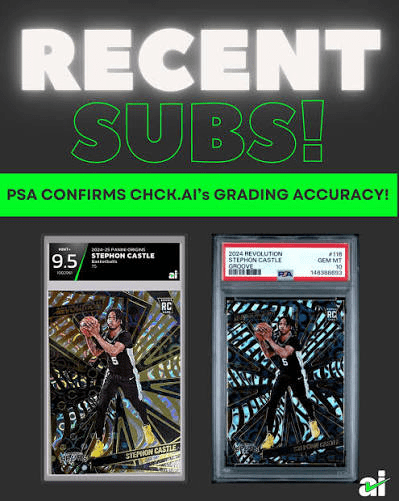
chck.ai gives you an artifact. Every grade produces a certificate at its own URL, searchable in a public registry by player, year, set, or six-character slug. Someone else can look it up. That’s the difference between “trust me, it’s a nine” and “here, check it yourself.”
And the report shows its work. The certificate payload includes the overall grade, all four sub-grades, horizontal and vertical centering offsets as actual percentages, an estimated value as a low/mid/high range with a confidence label, a timestamp — and a named engine version.
That last detail is a bigger deal than it sounds. Almost nobody in this category tells you which model produced your grade. Versioning the engine means the company expects to be asked, and expects to be held to an answer. It’s the kind of thing you only build if you’re planning to still be here in three years.
The developer docs give away the strategy
If you want to know where chck.ai is really headed, skip the homepage and read the API docs.
They’re good. Suspiciously good, for a hobby tool. Three clean endpoints — submit a grading, poll it, look up any live certificate. Server-side API key auth. Images by URL or base64. A synchronous response in roughly 15 to 40 seconds. Signed webhooks with HMAC verification, a replay window, and a copy-paste Node helper. A published OpenAPI spec you can drop straight into Postman.
Best detail: rejections are structured, and they’re free. Send a card that’s already slabbed and you get a specific reason code back — the optics of a holder would wreck the read, so the engine refuses rather than guessing. Same for a missing side or a front/back mismatch. You aren’t billed for a rejection.
That’s not consumer-app engineering. That’s the work you do when marketplaces, dealers, and auction houses are going to be calling your endpoint in production. The commerce partners on the site — an eBay storefront, a card shop, and a Ricoh card-digitization program that independently describes chck.ai’s API in its own materials — line up with that read.
What the hobby is saying
Here’s where we have to be straight with you: the public record on this product is thin, and most of it is stale.
The iOS app sits at 3.4 out of 5 across 29 total ratings as of August 27, 2026. Small sample. The positive reviews like the interface and note that pre-grade screening felt genuinely new. The critical ones complain about card identification misses and shaky pricing data.
But look at the dates. The surfaced negative reviews are from January 2023 and September 2024. The app’s own version history shows that manual human grading was replaced with a computer vision pipeline in January 2025, the rebrand landed in June 2025, and search accuracy improvements shipped in January 2026.
So the loudest criticism you’ll find describes a product that doesn’t exist anymore. That cuts both ways — the absence of fresh criticism isn’t proof the engine got better either. The honest read: there is no current independent user record on the shipping product. Anyone telling you otherwise, in either direction, is filling in a blank.
Elsewhere, the company reports a nomination for Innovation of the Year at Mantel’s Hobby Awards, and broader industry coverage of AI in the hobby has landed roughly where you’d expect — identification and pricing are largely solved, grading still wrestles with subtle surface flaws and foil variance.
One more thing worth flagging, because it’ll save you an afternoon: nearly every “best AI card grading app” article you’ll find is published by a company selling AI card grading. Complete with competitor accuracy figures and a conveniently favorable conclusion. Vendor-claimed accuracy in this category currently ranges from about 70% to 89% agreement with professional grades — all self-reported, none independently audited, all measured differently. Read accordingly.
What it costs to get in
Four monthly tiers, with an annual option at a modest discount, plus a free grade when you sign up so you can kick the tires.
A few mechanics matter more than the sticker:
- The entry tier doesn’t include grading at all — it’s identification and pricing only. Grading starts one tier up. Worth knowing before you subscribe.
- Credits don’t roll over. Each tier is a monthly allowance that expires at the end of the billing period. If your volume is lumpy — big show, then a quiet month — you’ll pay for capacity you don’t use.
- Per-unit cost drops as volume rises, with an overage rate past your allowance.
- API volume is contracted separately from subscription credits.
- Stripe billing, cancel yourself from the portal.
Against the cost of a professional submission, every tier here is cheap. The real question isn’t the price — it’s whether the read changes a decision you’d have gotten wrong.
Before you scan: three things worth knowing
None of this is a dealbreaker. All of it is stuff we’d want a collector to know going in.
1. The fast mode is narrower than the homepage suggests. chck.ai’s front page describes Quick CHCK as covering centering, surface, corners, and edges. Section 1 of the company’s Terms of Service, updated this month, says two-photo grading currently returns a centering grade only — with corners, edges, and surface requiring the full multi-image capture set. The services-page comparison table agrees with the Terms; the homepage is the outlier.
That’s probably marketing copy that hasn’t caught up with the product, and it’s the kind of thing a quick edit fixes. But it changes how you should use the tool. Centering is the easiest factor for computer vision to nail, because it’s pure geometry — and it’s genuinely useful, since centering alone eliminates a lot of submission candidates. Just treat Quick CHCK as a centering-and-ID screen, and run Full CHCK when the answer actually matters.
2. The certificate is built to be shared, but the fine print asks you not to lean on it. The pitch is that you can drop the certificate link into listings, DMs, and trades. Section 3 of the Terms takes a much more conservative line, stating that chck.ai output shouldn’t be relied on or presented as a professional grade or appraisal, or as the basis for a sale, listing, price negotiation, consignment, or dispute. Sharing the link is expressly permitted — but how you frame it is on you, and transactional use is at your own risk.
This is a very common gap in early-stage collectibles tech: growth copy out front, cautious counsel in the back. Practical version — the certificate is excellent as your documentation and as a good-faith signal to a buyer. Don’t treat it as evidence in a dispute, because the company hasn’t agreed to stand behind it that way.
3. There’s no published accuracy number. No verified-returns log, no prediction-versus-actual dataset, no stated agreement rate with professional grades. It’s the first question serious collectors ask about any AI grader, and it isn’t answered on the site. In fairness, we’d rather see an honest silence than an unverifiable 95% claim — and there are plenty of those going around. But it’s the single biggest thing standing between this tool and an unqualified recommendation.
Three smaller notes: it’s iOS only, so there’s no Android path to the 18-image workflow. Slabbed cards are rejected by design, which is correct engineering but means you can’t test the engine against a PSA grade you already have. And your uploaded photos are licensed to help improve the grading systems — standard for the category, still worth being conscious of.





Leave a Reply