
Category: Grading decision support / market screening
Product: C.O.I.N. (Card Opportunity & Investing Navigator)
Publisher: Cardboard Profit LLC
Coverage: Modern sports cards, with Pokemon added
Grading company modeled: PSA only
Reviewed: August 2026
The short version
COIN is a ranked screener for raw-to-graded flips. It pulls market data on modern cards, computes a proprietary composite called the COIN Score, and hands you a sorted list of the best grading opportunities it can see right now. That is the entire product, and the narrowness is a feature.
What it does well is compress research time. The work of pulling raw comps, checking PSA 10 sale prices across two windows, reading population reports, estimating gem rate, and backing out the grading fee tier is genuinely tedious. COIN does that continuously across a large card universe and presents it as one sortable table. For anyone running volume through PSA, that is real time savings.
What it does not do is tell you whether a specific piece of cardboard in your hand will grade. It does not model any grader except PSA. It does not cover vintage in any meaningful way. And the metric it asks you to lead with, the COIN Score, is a closed formula you cannot audit.
Bottom line: a competent, honestly documented screener for high-volume modern PSA submitters. Not an analytical platform, not a valuation tool, and not built for the vintage or condition-scarcity investor. The single biggest gap is data source disclosure.
Who built it, and why that matters
COIN comes from Ryan Sever, who founded Cardboard Profit in 2022 and launched COIN in 2025. His published background: over 30 years collecting, roughly 19 years flipping and investing, and by his own accounting more than a million dollars in card sales and multiple six figures of profit. He wrote a strategy book on the card market and runs a paid membership community called Ignite alongside limited 1:1 coaching.
This is a solo-operator product attached to an education business, and a buyer should price that in both directions.
The upside is that the tool was built by someone who actually runs the workflow it automates. That shows in the documentation. COIN’s own FAQ tells users that the tool provides a snapshot and does not predict future prices, that no tool is perfect and sales data should be double-checked against eBay sold listings, that a highly ranked card can still fail on condition, and that a modern card creased in half will not be profitable no matter where it ranks. Vendor documentation that argues against its own output is uncommon in this category and it earns credibility.
The caution is structural. COIN’s support channel is a Gmail address. The FAQ closes with a pitch to join the membership community. The tool is real and standalone, but it also functions as an on-ramp to a coaching funnel, and it carries the continuity risk of any single-operator software product. If you build a submission workflow around it, you are dependent on one person continuing to maintain the data pipeline.
The product is described as patent-pending.
How COIN works
The mechanic is straightforward. COIN aggregates market data from multiple sources, consolidates it into a single table, and applies proprietary formulas to rank cards by the quality of the grading opportunity. Data refreshes multiple times daily on a set schedule. Access is browser-based with a mobile-friendly version intended for use at shows.
The card universe is deliberately constrained. COIN targets people actively grading modern sports cards, and the dataset skews to recent years on the reasoning that those are the cards most findable in clean raw condition. It also filters out low-volume cards so that outliers do not distort rankings and so that listed cards are actually purchasable.
That filtering decision is the most important design choice in the product, and COIN is upfront about the tradeoff: a card might be a great grading opportunity in theory, but if it is nearly impossible to find, it is not useful. The tool prioritizes actionable over aspirational.
There is a second layer. Sport-specific lists (baseball, basketball, football) run looser volume filters than the Top 200 Overall, so they surface cards the overall list excludes. COIN warns that this admits more lower-volume cards and occasional pricing anomalies. Practically, the sport lists are the wider net and the noisier one. Treat Top 200 as the screened list and the sport lists as the exploration list.
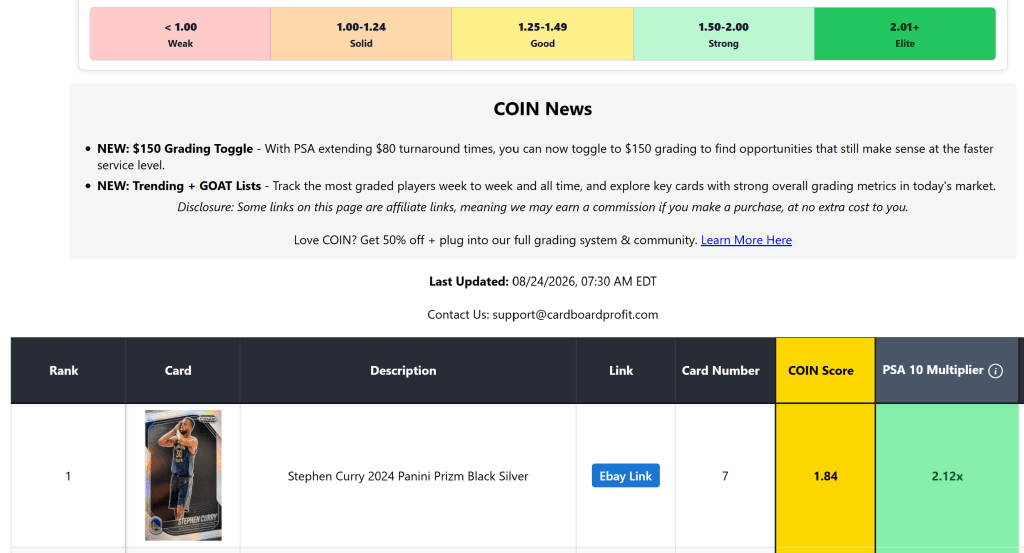
The data model, column by column
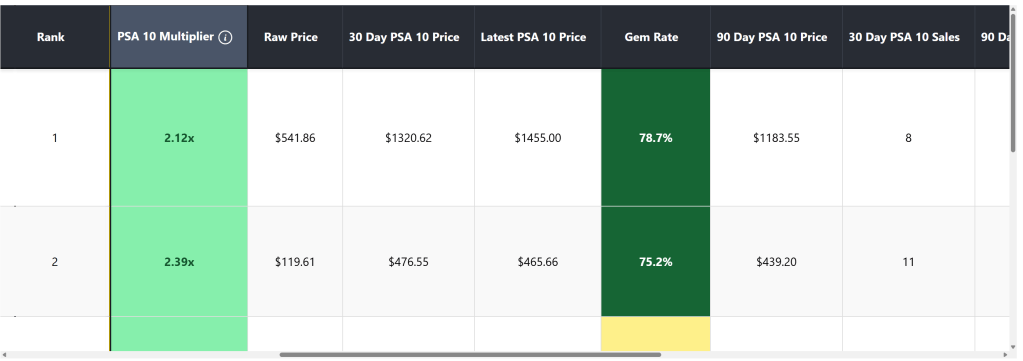
This is the substance of the product, so it is worth walking in full.
Identification
| Field | What it gives you |
| Rank | Position under your current sort, defaulting to COIN Score |
| Card | Card image where available |
| Description | Player, year, product, set, card type |
| Card Number | Number within the set |
Pricing
| Field | What it gives you |
| Raw Price | Average recent selling price ungraded |
| 30 Day PSA 10 Price | Average PSA 10 sale price over 30 days |
| 90 Day PSA 10 Price | Same over 90 days, for the longer trend |
| Latest PSA 10 Price | Most recent single PSA 10 sale, for direction |
| 30 Day PSA 9 Price | Average PSA 9 sale price, explicitly framed as the downside case |
The two-window structure on PSA 10 pricing is the right call. A 30-day average catches momentum, a 90-day average catches the base rate, and the divergence between them is itself a signal. The inclusion of a latest-sale field alongside averages lets you see whether a card is moving away from its own mean.
Including PSA 9 pricing is the more meaningful choice. Most grading calculators model only the upside case. COIN frames PSA 10 price as the upside and PSA 9 price as the downside, which is how the decision should actually be structured, since the modal outcome on a submission is frequently a 9.
Grading probability and supply
| Field | What it gives you |
| Gem Rate | Share of submitted copies receiving PSA 10 |
| PSA 9 Rate | Share receiving PSA 9 |
| PSA 10 Pop | Total copies graded PSA 10 |
| PSA 9 Pop | Total copies graded PSA 9 |
| Total Pop | Total copies submitted to PSA |
COIN’s reasoning on gem rate is that a higher rate often signals a more cleanly manufactured print run, which means a better shot at a 10. That is directionally sound for modern product where print quality varies materially by set.
It is also where a careful reader should slow down, and we cover that in the limitations section below.
Economics
| Field | What it gives you |
| Grading Fee | Estimated PSA fee, auto-adjusting to the card’s PSA 10 value since PSA tiers by declared value |
| PSA 10 Multiplier | 30 Day PSA 10 Price divided by (Raw Price plus Grading Fee) |
| PSA 10 Margin | 30 Day PSA 10 Price minus (Raw Price plus Grading Fee) |
The auto-tiering grading fee is a small feature that solves a real annoyance. PSA’s fee schedule is value-banded, so a static fee assumption breaks the moment a card crosses a tier. Having the fee move with the card’s PSA 10 value keeps the multiplier honest at the boundaries.
Risk
| Field | What it gives you |
| Volatility Score | Proprietary measure of PSA 10 price fluctuation over time |
| 30 / 90 Day PSA 10 Sales | Recorded PSA 10 sales counts in each window |
These two columns are the most underrated part of the product.
Volatility as an explicit column is rare in this category. Most tools give you a return figure with no dispersion around it, which quietly treats a stable blue chip and a spiking rookie as equivalent opportunities. A separate volatility read lets you sort for stability instead of raw upside.
The sales-count columns do the same job for liquidity. A high multiplier on a card with almost no PSA 10 sales in ninety days is not an opportunity, it is a trap, because the exit does not exist at the price the math assumes. COIN flags that these counts are indicative rather than complete, since no data source captures every transaction.
The COIN Score
The COIN Score is a single composite that folds price trends, gem rate, market demand, and the rest of the key data points into one comparable number. COIN’s own analogy is WAR in baseball: many inputs distilled to one figure so you can assess a card at a glance. Higher is better.
The published bands:
| Score | Reading |
| Below 1.00 | Weak |
| 1.00 to 1.24 | Solid |
| 1.25 to 1.49 | Good |
| 1.50 to 2.00 | Strong |
| 2.01 and up | Elite |
COIN tells users to lead with this number and describes it as a cheat code for grading, on the argument that it saves you from analyzing multiple metrics manually.
The composite is a defensible piece of design. Grading decisions genuinely are multivariate, and a screener that ranks on price alone will hand you illiquid junk. Folding gem rate, fees, liquidity, and trend into the sort order is better than sorting on multiplier.
But the WAR comparison cuts against the product in a way worth stating plainly. WAR is auditable. The formulas are public, the components are separable, and reasonable people argue about the replacement-level baseline precisely because they can see it. The COIN Score is closed. You are given a number, a set of bands, and a list of inputs, but not the weights. You cannot tell whether a 1.60 is being driven by a thin-margin card with an exceptional gem rate or a wide-margin card with mediocre everything else.
For most users running volume, that is an acceptable trade for speed. For anyone building a documented, repeatable investment process, an unauditable ranking metric is a real constraint, and the underlying columns matter more than the composite.
What the vendor’s best practices reveal
COIN publishes ten best practices. Read as documentation they are helpful. Read as a map of the tool’s edges they are more useful still.
Lead with the COIN Score. The intended workflow is score-first, not research-first.
Filter and sort to your budget and strategy. Filtering runs on price, gem rate, population counts and more, so you can constrain to your capital and risk tolerance. This is where the tool becomes personal rather than generic.
It is a snapshot, not a forecast. COIN states plainly that no tool predicts the future and that prices and gem rates fluctuate. It also flags that grading turnaround affects when you get cards back.
Parallels often carry the upside. Because the volume filter screens out thin-traded cards, numbered parallels and refractors of a well-ranked base card frequently will not appear even when they represent the better play. COIN’s guidance is to treat a strong base-card rank as a pointer toward its parallels and to check the data yourself. This is an explicit acknowledgment that the highest-upside opportunities sit outside the screen.
Sport lists are looser than Top 200. Different filters, different cards, more anomalies.
Double-check sales data. One-off high sales and temporary spikes still get through. Verify against eBay sold listings before buying.
Time the market, not just the card. Seasonal trends matter, and newly released product sees the first PSA 10s to hit the market sell at a premium before values settle as supply builds. Speed to market is part of the return on new releases.
Condition is still yours to judge. Surface scratches, print lines, centering, and edge wear are not in the model. Inspect under proper lighting, use magnification, consider pre-grading.
It is built for speed, not endless analysis. The tool is designed to produce a decision in seconds.
Revisit regularly. The best plays change week to week.
Taken together: COIN screens the market, and you supply condition assessment, comp verification, timing judgment, and parallel research. The vendor says so directly. That honesty is a mark in its favor, and it is also an accurate description of how much work remains after the tool finishes.
Limitations and open questions
These are our assessments, not the vendor’s.
Data sources are undisclosed. COIN says it aggregates from multiple sources. It does not say which. For raw prices in particular this matters enormously: an average built from eBay sold listings behaves differently from one built from a marketplace with different fee structures and buyer mix. Without source disclosure you cannot assess whether raw comps reflect the market you actually buy in, whether auction and fixed-price sales are blended, or how outliers are trimmed. For a tool asking you to commit capital on its numbers, this is the most significant transparency gap in the product.
Gem rate is a population statistic, not a probability. This is the subtlest issue and the one most likely to cost users money. Gem rate as defined is the share of submitted copies that received a PSA 10, derived from population data. Submitted copies are not a random sample. Submitters pre-screen and send their best copies. Cards are cracked and resubmitted, which inflates the numerator over time. High-value cards get submitted at a different rate than low-value ones. The result is that a population-derived gem rate systematically overstates the odds for a card you sourced without pre-screening, and understates the gap between a sharp eye and an average one. The metric is still useful as a relative signal of print quality across cards. It is not a probability you should apply directly to your own submission.
The margin figure is gross. PSA 10 Margin is explicitly defined as expected gross profit: PSA 10 price minus raw price and grading fee. It does not carry marketplace commission, which on major platforms runs in the low-teens as a percentage of sale, nor shipping in either direction, nor insurance, nor sales tax on the purchase side, nor the cost of capital tied up through turnaround. Net margin is materially below the displayed figure, and the gap widens on lower-priced cards where fixed costs dominate. Users should apply their own haircut before treating the column as profit.
No probability-weighted expected value. COIN gives you gem rate, PSA 9 rate, PSA 10 price, and PSA 9 price. The building blocks for a proper expected value calculation are all present, but the synthesis is only available inside the opaque COIN Score. There is no visible column that weights outcomes by their likelihood and nets out cost. Sophisticated users can compute it from the exposed fields. Most will not.
PSA only. Every metric in the product is PSA-denominated. There is no modeling of BGS, SGC, CGC, TAG, or any other grader. For a US modern flipper that reflects where the liquidity is. For anyone whose strategy involves cross-grading, alternative slabs, or non-PSA registry play, the tool simply does not cover the decision.
Modern only, by design. The dataset skews heavily to recent years. Vintage and condition-scarcity investing sit outside its scope entirely, and the volume filter that makes the tool work for modern would exclude most vintage regardless. This is a correct scoping decision by the vendor and a hard boundary for the reader.
The screen excludes the best plays. By COIN’s own account, volume filtering removes low-liquidity cards, and parallels of ranked cards often carry more upside than the base cards that appear. The tool is optimized for repeatable, findable, mid-liquidity opportunities. If your edge comes from finding what other people cannot, the screen is working against you by construction.
Pricing. COIN is $49.99 per month.
Turnaround mismatch. COIN refreshes multiple times daily. PSA turnaround runs weeks to months depending on tier. You are making a months-out decision on same-day data. The vendor flags this under market timing, and it is a structural feature of the whole raw-to-graded trade rather than a COIN defect, but it does bound how much precision the freshness of the data is actually buying you.
What people are saying
We are going to be direct about this, because it is the section most product reviews quietly fabricate.
There is no independent third-party coverage of COIN that we could locate. No hobby-press reviews, no forum threads of substance, no video reviews, no app store ratings, no aggregator listings. As of this writing the tool has effectively no public review footprint.
The social proof that does exist belongs to a different product. Cardboard Profit’s site features member testimonials, but they are for the Ignite membership community, not for COIN. Those testimonials are income claims, including a member citing close to a 40% return year to date since joining and praise for the weekly coaching calls, and they run under a disclaimer stating that these are individual results, are not guaranteed, and vary based on effort, decisions, and market conditions. The company’s own testimonial collection page is JavaScript-gated and did not render for us.
Why this matters for a buyer. An absence of reviews is not evidence of a bad product. COIN launched in 2025, it is sold through a niche education funnel rather than an app store, and low-profile tools in small categories routinely have no review trail. But it does mean you have no independent verification of the two things that determine whether the tool works: data accuracy and data freshness. Every claim about the quality of the underlying numbers currently rests on the vendor’s word.
What we would want to see before treating the numbers as reliable. Spot-check a sample of ranked cards against eBay sold listings for raw and PSA 10 prices on the same day. Compare the displayed gem rate and populations against the PSA population report directly. Repeat after a week to confirm the refresh cadence. COIN’s own documentation tells you to verify sales data, so this is running the vendor’s advice as an acceptance test.
If you have run COIN and are willing to share observations on data accuracy, we would like to hear from you. Independent verification is the missing piece in this category generally, not just for this tool.
Competitive context
The grading-ROI category has filled out quickly, though most of it clusters in Pokemon rather than sports.
Flipr operates the closest analogous model in Pokemon, offering a free PSA profit calculator, submission tracker, and marketplace arbitrage scanner. It publishes what COIN does not: it states that it pulls Near Mint listings from the TCGPlayer marketplace API every 30 minutes, compares against current PSA 10 comp data, and ranks by expected profit after grading fees and a 13% marketplace cut. It also carries submission countdown tracking and cert lookup. The transparency on source and refresh interval, and the explicit netting of marketplace fees, are both things COIN would benefit from adopting.
PokemonPriceTracker runs a PSA ROI calculator with PSA 10 probability data and offers programmatic API access to values, ROI calculations, and probability figures.
General ROI calculators across the collectibles space handle the arithmetic but not the screening. They answer “is this card worth grading,” which is a different and easier question than “which cards on the market right now are worth grading.”
COIN’s differentiated position is the combination of sports focus, continuous ranking across a broad universe rather than single-card lookup, and the inclusion of liquidity and volatility columns. That combination is genuinely uncommon. Its weakest position relative to the field is disclosure: competitors naming their data source and refresh interval, and netting marketplace fees into displayed returns, are setting a bar COIN has not met.
Who this is for
Strong fit
- Active modern PSA submitters running regular volume who want research time cut from hours to seconds
- Flippers who buy raw at shows and online and need a fast, mobile-accessible shortlist
- Anyone currently making grading decisions on instinct or on a single price comparison, who would be better served by a multi-factor screen
- Users who will actually run the vendor’s advice: verify comps, inspect condition, check parallels
Poor fit
- Vintage and condition-scarcity investors. The dataset is not built for you and the volume filter would exclude your universe regardless.
- Anyone grading with BGS, SGC, CGC, or TAG. The tool models one grader.
- Investors who need auditable methodology for a documented process. The core ranking metric is closed and the data sources are unnamed.
- Anyone looking for a condition assessment or pre-grading tool. COIN ranks opportunities and explicitly leaves condition to you.
- Buyers expecting the displayed margin to be take-home profit. It is gross, before fees.
Verdict
COIN does one job and does it competently: it turns the raw-to-PSA-10 screening problem into a sorted list that refreshes through the day. The column design shows real practitioner judgment, particularly the inclusion of PSA 9 pricing as a downside case, sales counts as a liquidity check, and a standalone volatility read. Very few tools in this category model risk at all.
The documentation is unusually honest. A vendor that tells you its rankings do not predict the future, that its own data should be verified against eBay, that the best opportunities may sit outside its screen, and that a creased card is worthless regardless of rank, is not overselling.
The reservations are about verifiability rather than design. Undisclosed data sources, a closed ranking formula, a gross rather than net margin figure, and a gem rate that a careful reader should not mistake for a personal probability all mean the numbers deserve independent spot-checking before you size positions against them. The absence of any third-party review footprint compounds that.
For a high-volume modern PSA flipper, COIN is a plausible time-saver worth testing against your own comp checks. For the research-driven investor, it is a screening input, not an analytical platform, and the underlying columns are more valuable than the score on top of them.
Methodology and disclosures
Sources. This review is based on COIN’s published FAQ and best-practices documentation, the Cardboard Profit website, and the publisher’s author biography.
Unverified vendor claims. The patent-pending status, the aggregation of data from multiple sources, and the multiple-times-daily refresh cadence are all stated by the publisher and were not independently confirmed.
Not investment advice. Grading outcomes and card values are uncertain. Nothing here is a recommendation to buy, grade, or sell any card.
Corrections. If you are the publisher and any description here is inaccurate, or if you are a user with hands-on data, contact us and we will update the review.






Leave a Reply