
Most card apps want to tell you what your cards are worth. SetScribe would like to start with a more basic question: what do you actually own, and what are you still chasing?
It is a collection and checklist manager for sports cards, built by a self-described lifelong collector, and it runs on iPhone, Android and the web with your stuff synced across all three. It has a scanner, eBay sold lookups, want lists, and a share link that turns your binder into a gallery. Plus, unusually for this corner of the hobby, it published its own accuracy test. We read it. Here is what we found.
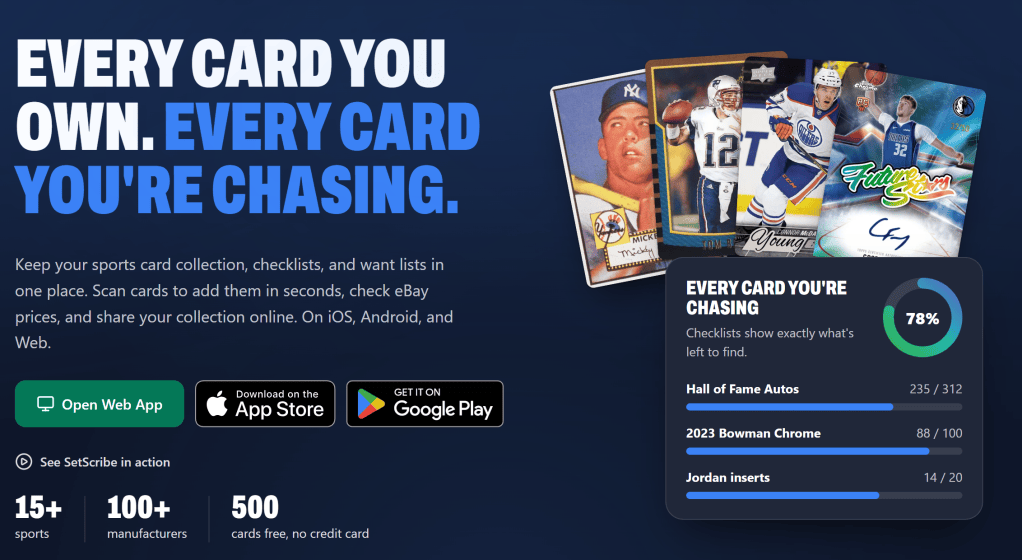
What it does
SetScribe is a catalog first and everything else second. You add cards by scanning with your phone camera, uploading a photo, typing them in, or importing a spreadsheet. The spreadsheet route is the quiet hero: map your columns from Excel or Google Sheets, and the only required field is a player’s first name. If you have a decade of cards logged in a spreadsheet, you are not starting over.
From there you can build set checklists with progress tracking, keep a want list for the cards you are hunting, and pull up recent eBay sold prices on a card. Share your collection by link and anyone can browse it without an account.
The AI scanner is optional and can be switched off per device, which is a nice touch if you prefer to catalog by hand.
What genuinely works
The receipts on accuracy. SetScribe’s own page reports that, in a test run in October 2026 on 1,000 cards across multiple sports plus non-sport cards, the scanner got 94 percent of card details right when given front and back photos, and 91 percent with the front alone (source: SetScribe AI accuracy page, setscribe.com/ai, October 2026). The test was run by the company, not an outside party, so treat it as a promising claim rather than a verdict. But most apps in this space say “highly accurate” and leave it there. Publishing a breakdown is a good habit.
It shows you where it stumbles. The same page lists the weak spots. Year was the most commonly missed detail at 83 percent correct, parallels came in at 87 percent, and inserts at 90 percent (same source and date). Those are exactly the fields collectors care about most, and it is refreshing to see a vendor say so.
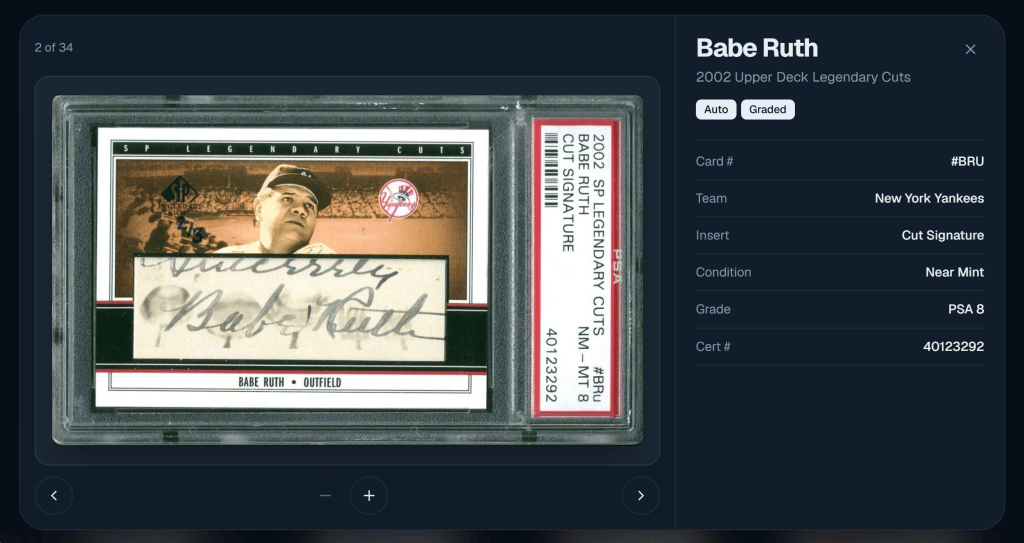
Graded slabs are a strong suit. On the same test, the scanner read grading company, grade and cert number correctly every time (same source and date). If you collect slabs, that is the part of cataloging that is most tedious to type.
The free tier is real. The free plan covers up to 500 cards plus a handful of checklists and AI lookups, with no credit card needed. The paid plan costs far less than most card-pricing subscriptions and raises the limits rather than unlocking the basics.
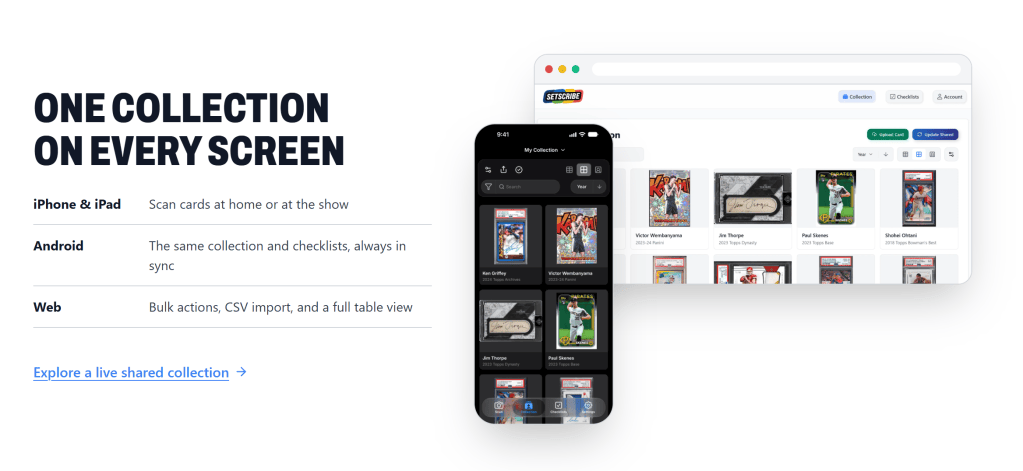
Where we’d push back
Pricing data is narrow. The FAQ says eBay price lookups cover baseball, football, basketball, hockey and soccer. If you collect wrestling, racing or golf, you can catalog freely but should not expect a price. The site also does not say how far back its sold-sale lookups go or how cards are matched to listings, so this is a convenience feature, not a comps engine.
The free tier has real ceilings. Five checklists and a small number of AI searches will run out quickly for anyone building multiple sets. The site never defines what counts as an “AI search,” so we cannot tell you whether scans eat into that allowance.
Some numbers do not line up. The home page touts more than 15 sports, while the accuracy page says 10 plus non-sport. It is probably a counting difference, but it is the kind of thing a tidy product page should reconcile.
Light on who is behind it. The about page reads as a one-person passion project. There is no launch date, no company name and no changelog that we could find. That is not disqualifying, but if your collection is valuable, you will want to use the data export and keep your own backup.
Who this is for
Set builders and checklist chasers are the sweet spot. If you want to know which 14 cards stand between you and a finished set, this is built for you.
Casual collectors with a few hundred cards will fit comfortably in the free tier and get a tidy gallery to show off.
Spreadsheet veterans get the easiest on-ramp thanks to the import tool.
It is not the right pick for investors who need deep sold-comp analysis, population data or grading ROI math. SetScribe is a catalog with a price glance, not a trading desk.
Bottom line
SetScribe is modest in its ambitions and refreshingly open about its flaws. It will not tell you when to buy or sell, but it will tell you what you own, what you are missing, and roughly how well its scanner can be trusted. For a free place to start, that is a strong pitch.
Our take: a solid pick for set builders and tidy-minded collectors. Try it with a small batch of cards, check the scans against your own eyes, and see if the checklist view clicks.
Try it at setscribe.com.








Leave a Reply