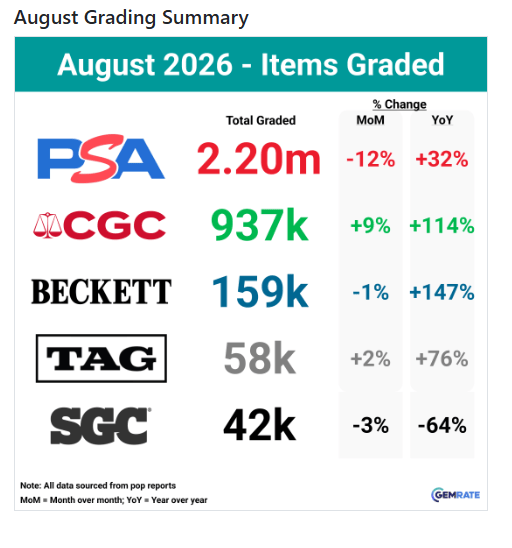
Every few weeks, the same chorus resurfaces somewhere in hobby media: the sports card market has peaked, the boom is fading, collectors are pulling back. It’s an understandable instinct — after a multi-year run like this one, skepticism is healthy. But instinct isn’t data, and the data GemRate published this week in its August 2026 grading recap tells a very different story: grading demand — arguably the single best real-time proxy for how much fresh capital and attention is flowing into the hobby — remains at or near all-time highs. There is no slowdown. There’s a calendar effect, and there’s a strategic repositioning at one grading company. Neither is the same thing as a cooling market.
The headline number, in context
GemRate’s August tally: 3.40 million cards graded across the five major companies it tracks (PSA, CGC, Beckett/BGS, TAG, and SGC), down 6% from July and up 47% from August 2025. On the surface, a 6% monthly decline sounds like the first crack in the growth story. It isn’t. August had 21 business days versus July’s 22 — and on a per-business-day basis, the decline shrinks to roughly 1%, which is statistical noise, not a trend. (Source: GemRate, “August 2026 Grading Recap,” published Sept. 1, 2026.)
Zoom out to the full spring-and-summer run and the picture gets even clearer:
| Month (2026) | Total Graded | MoM Change | YoY Change | Notes |
|---|---|---|---|---|
| May | 2.95M | ↓ vs. April | ↑ 20% | First dip below 3M since early spring |
| June | 3.50M | ↑ 19% | ↑ 65% | All-time record; four of five graders hit new highs |
| July | 3.61M | ↑ 3% | ↑ 49% | New all-time record |
| August | 3.40M | ↓ 6% | ↑ 47% | Second-highest month on record; down only ~1% per business day |
(Sources: GemRate May, June, July, and August 2026 Grading Recaps.)
Four straight months of year-over-year growth in the high-double-digit percentages, with two outright records in that span and the “worst” month of the four still landing as the second-highest grading volume ever tracked. That’s not the shape of a slowdown. That’s the shape of a market taking a breath at a very high altitude.
The stronger signal: demand is moving upmarket, not away
The more interesting data point isn’t the topline number — it’s where the volume is coming from. PSA, the market’s largest grader by a wide margin, posted its June record while its lowest-cost Value tier remained closed to new submissions (a pause we covered in this week’s daily brief, tied to backlog management). In other words: PSA hit an all-time high using only its pricier service levels. As one industry analysis of the August data put it, “the volume is coming from higher-value submissions, not from bulk. The industry is not just busier — the mix has shifted upmarket.” (Source: The Card Shop Finder, “Card Grading in August 2026.”)
That distinction matters enormously for anyone trying to read the health of the market. A slowdown would show up as collectors grading fewer cards, or shifting toward the cheapest possible tier to save money. Instead, the data shows the opposite: collectors paying more, and grading more, even with the most accessible entry point temporarily closed. That’s a demand signal, not a retreat.
Broad-based growth, not one company’s story
Skeptics could reasonably ask whether this is just a PSA story, propped up by one company’s backlog dynamics. It isn’t. Growth in August was broad-based across nearly every major grader, year-over-year:
- CGC: up 114% YoY, a record month, with continued momentum from new licensing and encasement partnerships
- Beckett/BGS: up 147% YoY, its fastest growth rate among the majors
- TAG: up 76% YoY, another record month for the AI-assisted newer entrant
- PSA: up 32% YoY, still growing even against its own enormous prior-year base
(Source: GemRate, “August 2026 Grading Recap.”)
Four independent companies, four different business models, all posting substantial year-over-year growth in the same month. That kind of breadth is much harder to wave away as a single-company anomaly.
The one real exception — and why it isn’t bearish
The honest counterpoint in the data is SGC, down 64% year-over-year in August. Read in isolation, that number looks like exactly the kind of demand collapse a slowdown thesis would predict. It isn’t that, either. SGC’s decline is a deliberate strategic choice by parent company Collectors, which has been repositioning SGC away from mega-scale competition with PSA and toward a smaller, vintage-focused “boutique” grading brand — a shift that included leadership changes and staff being redeployed toward PSA’s own operations, as trade coverage reported earlier this year. That’s a supply-side corporate decision, not collectors losing interest in getting cards graded. Lump SGC’s decline in with genuine demand weakness and you’d be badly misreading the data.
What this means for the Aristocrat Strategy investor
Sustained, broad-based grading volume matters beyond the grading companies themselves. Every graded card is a new, authenticated, liquid unit of supply entering the market — the raw material that makes a scarcity-and-quality-driven collecting strategy work in the first place. A genuine slowdown would show up first and most clearly right here, in submission volume, well before it showed up in headline auction results or retail sentiment. Four months of near-record-to-record activity, growth spread across essentially every major grader, and a demand mix that’s shifting toward higher-value submissions rather than away from the hobby altogether — that is about as clear a signal as this market produces that the growth story remains structurally intact, not a late-cycle sugar high.
None of this means every corner of the hobby is healthy in equal measure — the “junk wax 2.0” oversupply concerns around modern base-card printing that we’ve flagged before are a real and separate risk, and grading capacity constraints remain a genuine operational bottleneck worth watching closely in the months ahead. But conflating a one-fewer-business-day calendar effect, or one company’s deliberate strategic pivot, with a market-wide slowdown is simply not what the numbers show. The grading data says the boom is still running.
This is independent market analysis produced by CardVestr. All statistics are date-stamped and sourced to third-party reporting as cited throughout; CardVestr does not verify third-party data independently and avoids citing specific dollar figures for this reason. This is not investment advice — collectors and investors should do their own research before making buying or selling decisions.
Sources:
- GemRate — August 2026 Grading Recap
- GemRate — July 2026 Grading Recap
- GemRate — June 2026 Grading Recap
- GemRate — May 2026 Grading Recap
- Sports Illustrated Collectibles — “July Card Grading Hits Another Record as Beckett and CGC Keep Surging”
- The Card Shop Finder — “Card Grading in August 2026: PSA, CGC, SGC, TAG, and BGS Compared”






Leave a Reply