
For a hobby built on nostalgia, the sports card market has gotten remarkably serious about its spreadsheets. Grading backlogs make headlines, six-figure rookie patch autos headline marquee auctions, and a growing class of collectors now talk about their PC (personal collection) the way a retail investor talks about a brokerage account. What’s been missing is the back office to match — and that’s the gap a small, focused platform called Viewible is quietly trying to fill.
Viewible bills itself as an AI-powered collectibles tracking app built for “collectors, dealers, & investors,” and after spending time in its feature set, that framing feels earned. This isn’t another card-scanning app chasing checklist completion. It’s a profit-and-loss engine for people who buy, hold, grade, and flip cardboard for a living — or are starting to treat the hobby like one.
The pitch: stop guessing, start knowing your numbers
The core idea behind Viewible is refreshingly unglamorous: most collectors have no real idea what they’re actually making. Grading fees get forgotten, shipping and platform fees eat into margins quietly, and by the time tax season rolls around, reconstructing a card’s true cost basis from a shoebox of receipts and a half-updated spreadsheet is its own special kind of nightmare. Viewible’s whole reason for being is closing that gap — as the company puts it, the goal is to let collectors “make every decision with clarity and purpose.”
That shows up most clearly in how the app handles cost basis. Every acquisition — the card itself, the grading fee, the extra shipping, the supplies — gets logged against that specific card, so the profit number a user sees at the end isn’t a rough guess. It’s a real one.
The features that stand out
Full cost-basis and profit tracking. Rather than treating a card as a single purchase price, Viewible builds out the entire cost stack around it — acquisition cost, grading, shipping, and fees — so profit calculations reflect what a sale actually nets, not just the sticker-price spread.
Direct eBay integration. Given how much of the secondary market still runs through eBay, Viewible’s ability to automatically sync sales data, marketplace fees, and shipping costs is a genuinely useful piece of plumbing. It’s the difference between a tracking app and a tracking app you’ll actually keep updated.
A smart pricing calculator. Instead of listing a card and hoping, users can work backward from a target profit to figure out what a card needs to sell for — a small feature that quietly reframes pricing as a decision rather than a guess.
Budget and KPI tools. Viewible extends past single-card math into portfolio-level thinking, with budget tracking and performance indicators aimed at collectors and dealers who are managing a business, not just a stack of cards.
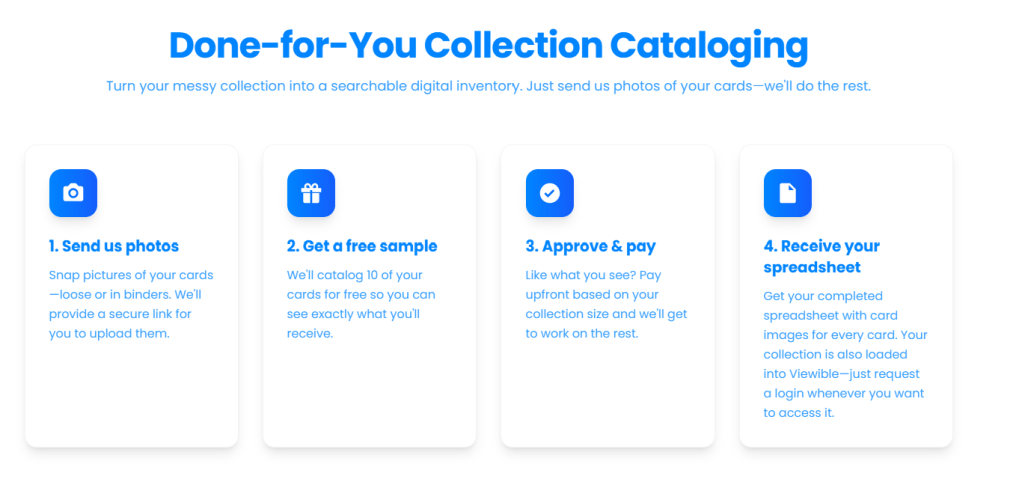
A done-for-you cataloging option. For anyone sitting on a backlog of ungraded and unsorted inventory, Viewible offers a service where users submit photos and get cards identified and loaded into the platform with images attached — a meaningful shortcut past the most tedious part of getting organized.
Export tools built for tax season. Clean Excel and CSV exports, designed to be handed to an accountant rather than reverse-engineered by one, address a real pain point for anyone who has ever tried to explain a year of card flips to a tax preparer.
Spreadsheet import. For the collectors who’ve already been tracking things their own way, Viewible doesn’t ask them to start from zero — existing spreadsheet data can be brought in rather than re-keyed by hand.
Available where collectors actually work. Viewible ships as both a web app and a native iOS app, which matters for a hobby that happens as much at kitchen tables and card shows as it does at a desk.
Who it’s for
Viewible isn’t trying to be a price guide or a grading company or a marketplace — the space is already crowded with tools for finding a card’s value or where to sell it. Its lane is narrower and, frankly, more useful for anyone treating cards as an asset class: the accounting layer. That makes it most compelling for the collector who’s graduated from casual buying to running something closer to a small business — tracking a real portfolio, submitting real grading volume, and needing real numbers when tax season arrives.
The bottom line
The card market’s growing pains this year — grading backlogs, shifting turnaround times, a hierarchy of graders being rewritten in real time — are really all symptoms of the same thing: a hobby that scaled faster than its infrastructure. Viewible is a bet that the same is true on the collector’s side of the ledger, and that the next wave of serious buyers will want the same clarity on their own numbers that they now expect from the market itself. With an accessible entry point — core features are free to try, with no card required, and a modestly priced premium tier for power users — it’s a low-friction way to find out whether your card business is actually a business.
Visit today: https://viewible.co/






Leave a Reply