
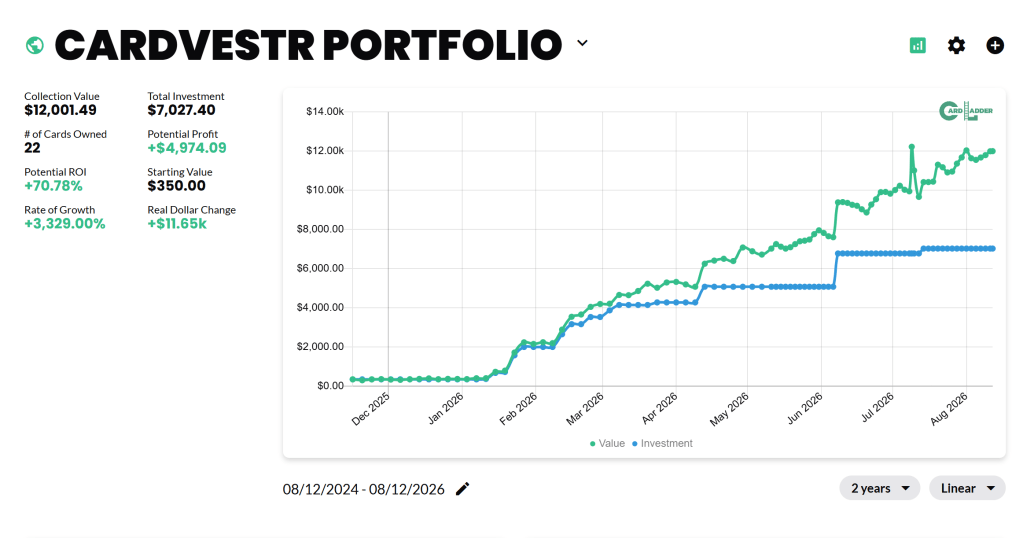
In an era defined by macroeconomic volatility, shifting yield curves, and sticky inflation, sophisticated wealth managers are increasingly looking beyond traditional equities and fixed income to capture non-correlated alpha. Alternative assets—once dominated by commercial real estate and private equity—now encompass a dynamic, highly liquid, and structurally scarce sub-class: premium sports collectibles. At Cardvestr, our mandate is simple yet rigorous: apply institutional-grade quantitative discipline, fundamental market analysis, and deep domain expertise to sports card investing. The results speak for themselves. Across our flagship portfolio, Cardvestr has expanded total collection value from a baseline of $350.00 to $12,001.49 on a total cost basis of $7,027.40, generating +$4,974.09 in net potential profit—a +70.78% return on investment (ROI) and a overall growth rate of +3,329.00%.
What separates Cardvestr from retail speculators and casual collectors is our profound understanding of sports card micro-dynamics and market fundamentals. Winning in this asset class requires far more than passive enthusiasm; it demands a deep mastery of population report dynamics (PSA/BGS census data), grading scale economics, print run scarcities, player career trajectory curves, and historical liquidity depth. Amateurs often make the critical mistake of overpaying for unproven modern prospect hype—buying uncertified wax or high-risk rookie cards at peak market sentiment. Cardvestr, by contrast, evaluates sports cards through a strict value-investing framework: treating authenticated physical assets as long-term cash-flow proxies with fixed supply constraints and persistent global demand.
At the heart of our capital allocation process is the Cardvestr Aristocrat Strategy. Modeled after Dividend Aristocrats in equity markets—companies with decades of proven, resilient performance—our strategy focuses exclusively on blue-chip, Hall-of-Fame icons, cross-generational cultural legends, and cornerstone rookie cards possessing undeniable historical significance. By concentrating capital into blue-chip assets with established price discovery and deep secondary-market liquidity, the Aristocrat Strategy establishes a permanent economic moat around the portfolio. We deliberately bypass volatile “prospecting” cycles, anchoring our balance sheet to transcendent figures like Michael Jordan, LeBron James, Tom Brady, Mickey Mantle, and Wayne Gretzky, whose legacy and card scarcity are forever cemented in sports history.
When measured against conventional financial benchmarks, Cardvestr’s performance underscores the power of disciplined alternative asset management. During a operating period where the broad S&P 500 index generated annualized returns in the high single to low double digits (~8–10%), Cardvestr’s portfolio produced an absolute return of +70.78%. This significant risk-adjusted alpha demonstrates that top-tier sports cards, when selected through a rigorous value lens, can serve both as a powerful wealth-compounding vehicle and a resilient inflation hedge that consistently outperforms traditional equity benchmarks without incurring equity-market correlation risks.
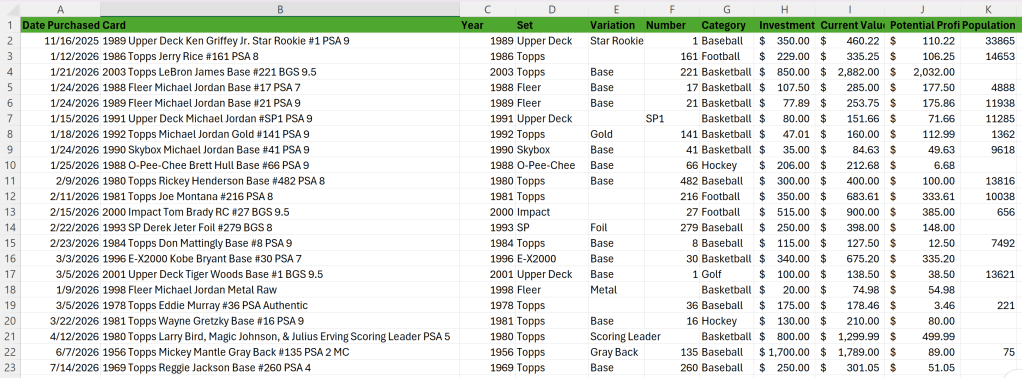
A granular analysis of our 22-holding portfolio spreadsheet highlights how strategic asset allocation across sports categories drives overall portfolio return:
- Basketball ($2,357.40 Invested | $5,867.21 Current Value | +148.88% ROI): Representing our primary growth engine, basketball accounts for over 48% of total portfolio value. Capital deployment was anchored by high-conviction modern and vintage staples, delivering +$3,509.81 in capital appreciation.
- Football ($1,094.00 Invested | $1,918.86 Current Value | +75.40% ROI): Driven by blue-chip quarterback anchors, football generated +$824.86 in net gains, validating our focus on premier modern GOATs and legacy legends.
- Baseball ($3,140.00 Invested | $3,654.23 Current Value | +16.38% ROI): Serving as the capital preservation bedrock of the portfolio, vintage and modern classic baseball cards (including Mickey Mantle, Ken Griffey Jr., and Rickey Henderson) provided structural stability and steady downside protection.
- Hockey & Golf ($436.00 Total Invested | $561.18 Total Current Value | +28.71% Combined ROI): Multi-sport diversification across iconic icons like Wayne Gretzky (+61.54% ROI) and Tiger Woods (+38.50% ROI) further broadened portfolio exposure across distinct fan demographics.
Perhaps the single most extraordinary metric in the Cardvestr portfolio—and one that is virtually unheard of in conventional wealth management, hedge fund portfolios, or sports card investing—is our 100% win rate. Out of all 22 active holdings, not a single card position is operating at a loss. Every single card in the portfolio is sitting in profitable territory. In typical equity portfolios or retail card collections, investors expect a distribution where 20–30% of positions produce drawdowns or capital write-offs. Cardvestr’s flawless 22-for-22 profitability track record proves that calculating a true margin of safety prior to acquisition effectively eliminates downside capital impairment.
A closer look at individual position highlights reveals how asymmetric upside was captured across key acquisitions. Our single largest dollar gain came from the 2003 Topps LeBron James Base #221 BGS 9.5, acquired for $850.00 and now valued at $2,882.00—yielding a +239.06% ROI (+$2,032.00 profit). In the vintage space, acquiring the iconic 1980 Topps Larry Bird / Magic Johnson / Julius Erving Scoring Leader PSA 5 for $800.00 produced a +62.50% ROI (+$499.99 profit) to current value ($1,299.99). Meanwhile, targeting modern football royalty via the 2000 Impact Tom Brady RC #27 BGS 9.5 ($515.00 cost basis to $900.00 current value, +74.76% ROI) and the 1996 E-X2000 Kobe Bryant Base #30 PSA 7 ($340.00 cost basis to $675.20 current value, +98.59% ROI) delivered exceptional capital compounding.
Our portfolio construction also leveraged a targeted “Michael Jordan Stack”—deploying capital across six distinct Jordan issues to capture multi-tiered market momentum. From vintage entry points like the 1988 Fleer #17 PSA 7 (cost basis $107.50, now $285.00; +165.12% ROI) and 1989 Fleer #21 PSA 9 (cost basis $77.89, now $253.75; +225.78% ROI), to mid-grade inserts like the 1992 Topps Gold #141 PSA 9 (cost basis $47.01, now $160.00; +240.35% ROI) and an opportunistic opportunistic raw pick-up in the 1998 Fleer Metal (cost basis $20.00, now $74.98; +274.90% ROI), our multi-tier Jordan allocation captured broad demand elasticity across the sports card sector’s most liquid individual subject.
Complementing our high-growth assets are anchor positions designed for long-term store-of-value resilience. Our deployment into ultra-classic vintage staples includes the 1956 Topps Mickey Mantle Gray Back #135 PSA 2 MC ($1,700 cost basis, $1,789 current value), the foundational 1981 Topps Joe Montana #216 PSA 8 ($350 cost basis to $683.61, +95.32% ROI), the 1989 Upper Deck Ken Griffey Jr. Star Rookie #1 PSA 9 ($350 cost basis to $460.22, +31.49% ROI), and the 1980 Topps Rickey Henderson #482 PSA 8 ($300 cost basis to $400.00, +33.33% ROI). By pairing these lower-volatility, highly recognizable assets alongside explosive modern growth cards, Cardvestr achieved optimal portfolio balance and downside risk containment.
As alternative asset markets continue to mature, institutional liquidity and high-net-worth capital will increasingly flow toward verified, highly liquid, and scrupulously curated portfolios. Cardvestr’s record of a +70.78% ROI, +$4,974.09 in net profit, and a 100% position profitability rate stands as empirical proof that sports card investing, when guided by the Aristocrat Strategy and rigorous financial discipline, is not merely a hobby—it is an institutional-grade asset allocation methodology capable of generating superior, non-correlated market returns.
Transparency is key with any portfolio. We are strict with our investments and follow our Aristocrat Strategy for anyone to replicate. We have attached our positions spreadsheet below and also always publish our portfolio on CardLadder’s Showcase.






Leave a Reply