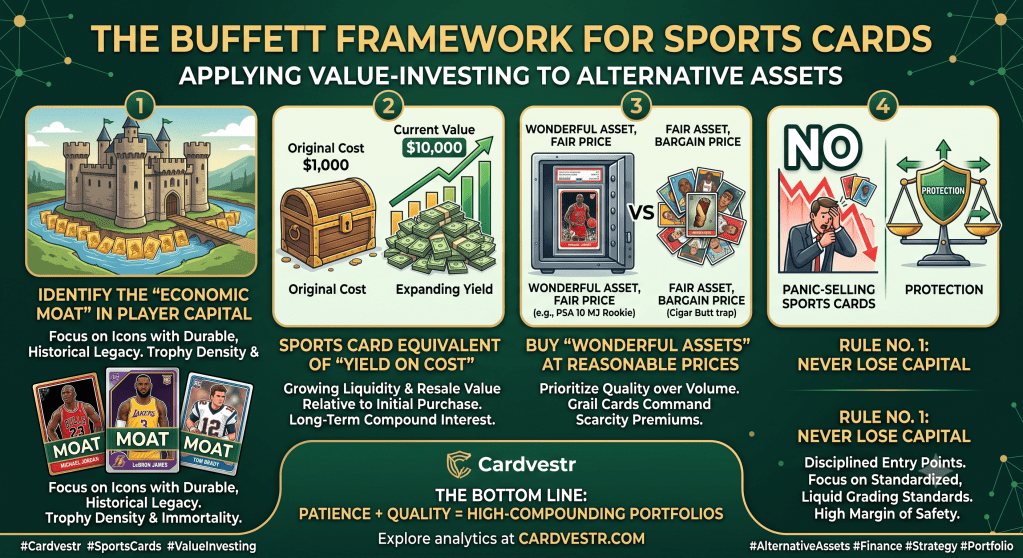
If you ask traditional investors about Warren Buffett, they’ll tell you about his legendary holdings in Coca-Cola, American Express, and Apple. They’ll point to his preference for simple, highly profitable businesses with wide economic moats and predictable cash flows.
What most alternative investors overlook, however, is that the core tenets of Warren Buffett’s strategy apply directly to sports cards.
While a sports card doesn’t pay a quarterly cash dividend into your bank account, high-conviction sports card portfolios generate an equivalent phenomenon: Asset Value Compounding and Secondary Market Yield on Cost.
At Cardvestr, we apply the “Buffett Blueprint” to alternative asset management. Here is how investors can use value-investing principles to build a resilient, high-performing sports card portfolio.
1. Identify the “Economic Moat” in Player Capital
Buffett famously avoids fad stocks, preferring companies with deep competitive moats that protect them from disruption. In sports cards, a player’s “moat” is built on historical immortality, trophy density, and cultural permanence.
- Low-Moat Assets: Modern prospect cards or short-term breakout players. Their value is driven purely by short-term hype, making them vulnerable to injuries, performance dips, or over-issuance.
- High-Moat Assets: GOAT-tier icons (Michael Jordan, LeBron James, Lionel Messi, Tom Brady, Wayne Gretzky). Their achievements are locked into sports history. Their total card population in key rookie grades is fixed and cannot be diluted by future releases.
Cardvestr Principle: Never build an income or growth strategy on fragile moats. Allocate the core of your portfolio to assets where future demand is mathematically guaranteed by legacy.
2. The Sports Card Equivalent of “Yield on Cost”
Buffett purchased Berkshire’s stake in Coca-Cola for $1.3 billion in 1994. Today, Berkshire receives over $700 million annually in cash dividends from that single position—a mind-boggling 50%+ annual yield on his original cost basis.
In sports cards, Yield on Cost represents the expanding liquidity and price floor of a scarce card relative to your initial purchase price.
Consider a high-grade 1996 Topps Chrome Kobe Bryant Rookie PSA 9 or 10 bought a decade ago. As global demand for ultra-grail sports collectibles expanded, the asset’s baseline value didn’t just track inflation—it multiplied. For collectors and funds that hold blue-chip assets long enough, the asset becomes a highly liquid line of collateral that far outstrips the initial capital deployed.
3. Buy “Wonderful Assets at Reasonable Prices” (Not Bargain-Bin Trash)
Early in his career, Buffett practiced “cigar butt” investing—buying deeply distressed, cheap stocks hoping for one last profitable puff. He later abandoned this in favor of Charlie Munger’s advice: “It’s far better to buy a wonderful company at a fair price than a fair company at a wonderful price.”
The sports card market is littered with “cigar butts”—ultra-cheap raw cards or obscure inserts that look like bargains but lack fundamental collector demand.
- The Cigar Butt Trap: Buying 100 low-grade or mid-tier raw rookie cards of unproven prospects because they are “cheap.”
- The Buffett Approach: Buying one iconic, PSA 10/BGS 9.5 low-pop grail card of a generational athlete at a fair valuation.
The high-quality card will consistently command a scarcity premium and outpace the market over a multi-year horizon.
4. Rule No. 1: Never Lose Money. Rule No. 2: Never Forget Rule No. 1.
Buffett places capital preservation above aggressive speculation. In alternative assets, losing capital happens when investors chase short-term hype cycles, overpay during panic-driven bull runs, or buy over-graded, low-quality cards.
How Cardvestr Protects Capital:
- Focus on Standardized Liquidity: Stick to liquid, highly recognized grading standards (PSA, BGS, SGC) with clear population reports.
- Disciplined Entry Points: Acquire assets during seasonal lulls (e.g., buying football grails in April or basketball grails in August) when market sentiment is quiet.
- Patience over Velocity: As Buffett says, “The stock market is a device for transferring money from the impatient to the patient.” The exact same logic applies to sports cards.
💡 The Bottom Line
You don’t need to day-trade sports cards or flip wax boxes every week to generate substantial returns in alternative assets.
By adopting a Warren Buffett mindset—focusing on quality, scarcity, economic moats, and ultra-long holding periods—investors can transform a chaotic hobby into a disciplined, high-compounding alternative asset portfolio.
Are you building your card portfolio for short-term flips or multi-decade compounding?
Explore market analytics, portfolio tracking, and institutional-grade sports card research at Cardvestr.com.
#Cardvestr #SportsCards #AlternativeAssets #ValueInvesting #WarrenBuffett #InvestingStrategy #PrivateWealth #Finance #TradingCards #PortfolioManagement #AssetAllocation







Leave a Reply