
Legendecks Wants to Be Your Collection’s Advisor, and It Already Speaks Fluent Hobby
The pre-launch app reads a card’s grade from one photo, runs the grade-or-sell math for you, and serves up a morning brief of moves. Best part? It promises never to tell you to sell your PC.
Every collector knows the feeling. There’s a stack of raw cards on the desk, a nagging question about which ones are actually worth grading, and a spreadsheet you swore you’d keep updated this time. Spoiler: you didn’t.
Legendecks wants to fix all of that at once. The app isn’t live yet. It’s running a waitlist and letting collectors in a batch at a time. But the team has put up a clickable, ten-chapter walkthrough of real screens, and we spent some quality time poking around. Short version: we’re into it.
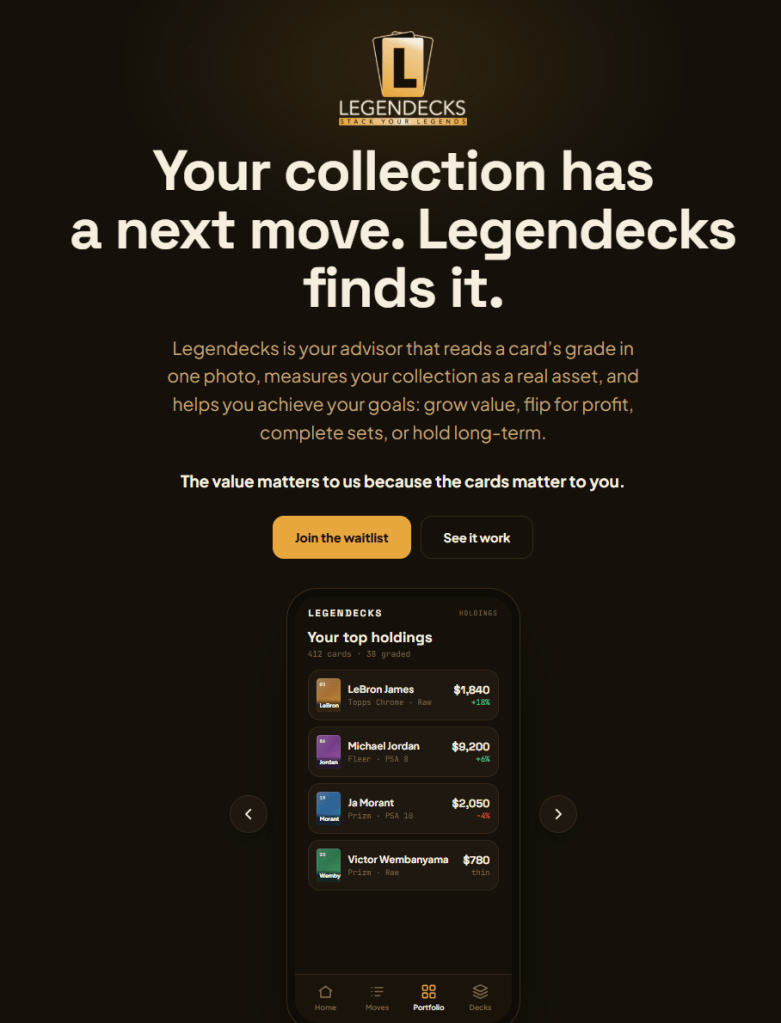
Not another tracker. An advisor.
The hobby has no shortage of apps that tell you what your cards are worth. Legendecks is aiming one step further. Its own tagline sums it up nicely: “You know what your collection is worth. Legendecks shows you what it could be.”
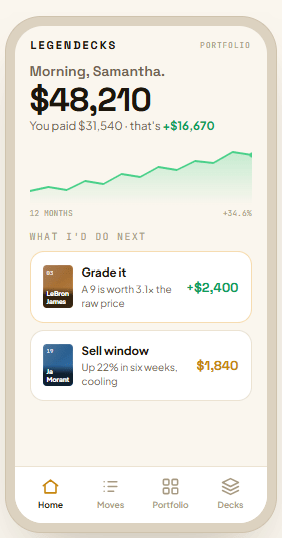
That’s the shift. Instead of a static price list, Legendecks treats your collection like a real portfolio with a real strategy behind it. It tracks cost basis, value, and performance over time. Then it does the part most tools skip: it tells you what to do next, and why.
And crucially, “what to do next” depends on who you are. A set builder, a flipper, and a long-term holder need completely different advice. Legendecks is built around that idea from the very first screen.
The feature tour
It starts with why you collect
Onboarding asks one simple question: what are you collecting for? Grow value, flip for profit, complete sets, or hold long-term. Every recommendation after that bends to your answer.
There’s also a grail planner. Name the card you’ve always wanted, and Legendecks works backwards to show how far away it is and which moves could get you there. In the demo, it even routes around cards you’ve flagged as untouchable. More on that below.
One photo, a real grade read
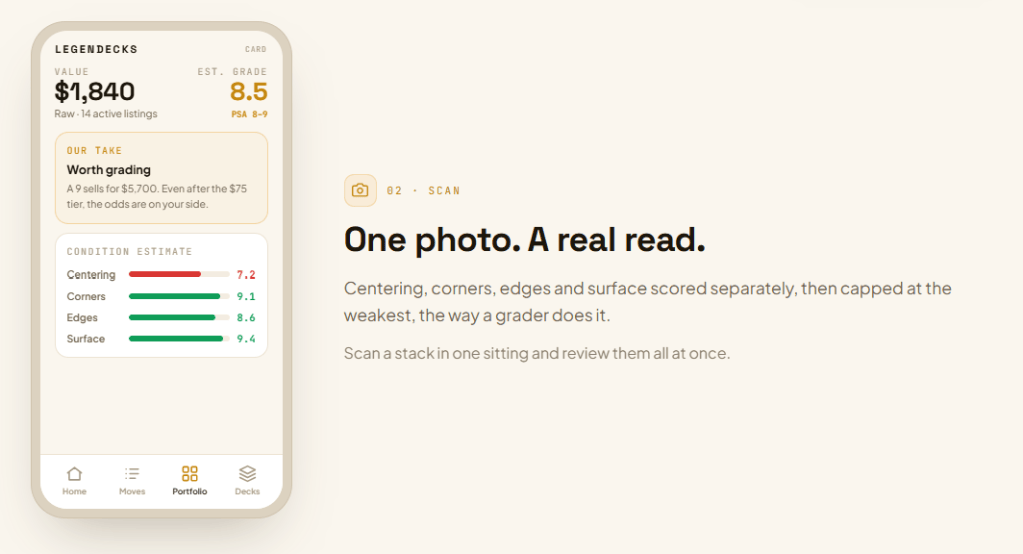
This is the headline feature, and it’s a good one. Snap a card and Legendecks scores centering, corners, edges, and surface separately. Then it caps the estimate at the weakest area, the way an actual grader would.
The walkthrough shows it reading both the front and back, calling out left-to-right and top-to-bottom centering splits, and flagging specifics like soft whitening on a back corner. You can also scan a whole stack in one sitting and review everything at once. Anyone who has squinted at corners under a desk lamp at midnight will appreciate that.
Your moves, every morning
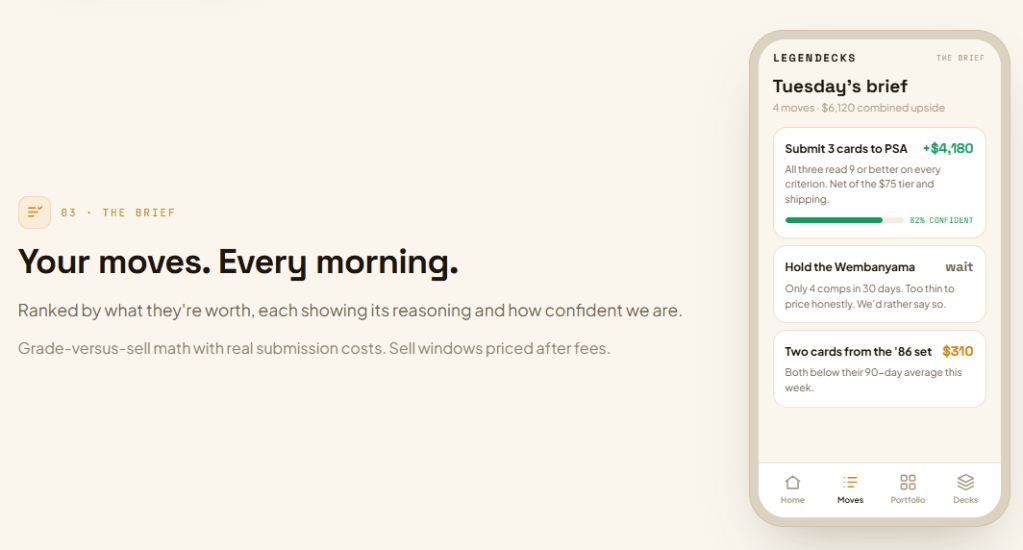
The daily brief is where Legendecks really earns the “advisor” label. Each morning it serves up a ranked list of moves, sorted by potential upside. Every move shows its reasoning and a confidence score.
The math is the practical kind. Grade-versus-sell calculations factor in real submission costs. Sell windows are priced after fees. Even better, when there isn’t enough sales data to price a card honestly, the brief simply says so instead of guessing. We love a tool that knows when to say “wait.”
Watch the set fill in
Set builders, this one’s for you. Legendecks shows what’s missing, what closing the gap costs today, and which of those missing cards just dipped below their 90-day average.
Adding cards is fast by design. You pick the set once, then type card numbers and tap. The team says you can log forty cards in about two minutes, which we’ll happily put to the test.
Play out the what-ifs
The walkthrough also includes a scenario mode. Want to see what happens if you sell a few rookies, grade one card, and hold everything else? Run it and see the impact on your books. Nothing is recorded until you confirm, so you can try as many versions as you like.
Share cards that look sharp
Finally, there’s a share feature that turns any card into a clean, postable image. You choose exactly which blocks appear on it, like value or the grade breakdown. Want just the photo and the name? Switch the rest off.
What has us excited
It respects the PC
Here’s the detail that won us over. Legendecks lets you mark any card as “keep,” and from then on it never shows up in a sell suggestion. Ever. It still counts toward your collection’s value, but the app stops treating it as inventory.
That sounds small. It isn’t. Most portfolio logic assumes every asset is for sale at the right price. Collectors know that’s not true. Nobody should get a push notification telling them to flip the first card their dad gave them, and Legendecks is clearly built by people who get that.
The same thinking shows up elsewhere. Finishing a set is tracked and celebrated like a gain, even in weeks when it costs you money. And if you’re chasing a player you love rather than a return, you can follow them and get pinged when their cards move so you can buy more, not cash out.
The trust principles are baked in
Legendecks lays out four commitments on its site, and they read like a checklist of everything collectors worry about with advice tools:
- Measured, or it says so. Values come from real listings. When there are too few to be sure, the app flags it rather than inventing a number.
- Grader-neutral. PSA, BGS, and SGC are priced side by side, and Legendecks takes no cut of your grading.
- Advisor, not broker. It never takes a cut of a sale, so the advice has nothing riding on it.
- Your cost basis stays private. What you paid and what you’ve made are never published or shared, even on a public profile.
That “advisor, not broker” line is a big deal. When a tool earns money every time you sell, it’s fair to wonder whose interests the advice serves. Legendecks is taking that question off the table from day one.
We also appreciated the small touches of data hygiene. The walkthrough shows the app setting aside bulk-lot listings so a filler price never drags down a card’s value. And the site is upfront that its values are based on median eBay asking prices, which typically run above final sale prices. That kind of candor is refreshing in a hobby full of optimistic comps.
What we’ll be watching at launch
Everything we’ve seen so far comes from the landing page and the guided walkthrough, not a hands-on test with our own cards. So when the doors open, a few things are at the top of our list. How well does the one-photo grade read hold up on real-world phone shots and tricky surfaces? How deep does sport and category coverage go beyond basketball, which dominates the demo? And what will pricing look like? The team hasn’t shared that yet.
Those are launch-day questions, not red flags. The foundation here is genuinely thoughtful.
The bottom line
Legendecks is one of the most collector-minded tools we’ve seen in a while. It combines AI-assisted grade estimates, portfolio-style tracking, and a daily advisor brief, and it wraps all of it in a philosophy that puts the collector’s goals first. The “keep” flag alone tells you a lot about who this is being built for.
Want in early? You can join the waitlist or click through the full walkthrough without installing a thing. We’ll be back with a hands-on review once we get our cards in front of it.






Leave a comment