Every collector knows the feeling. You are standing in front of a dealer’s showcase or scrolling through late-night eBay listings, staring at a card with an asking price that feels like pure fiction. In a market flooded with speculative sticker prices and cluttered marketplaces, figuring out genuine market value can feel like a full-time job.
Enter CardGauge, a web-based scanner and collection utility that cuts through the noise. Built by collectors for collectors, CardGauge focuses on one foundational principle: completed sales matter, asking prices do not.
Two-Sided Scanning That Actually Gets Parallels Right
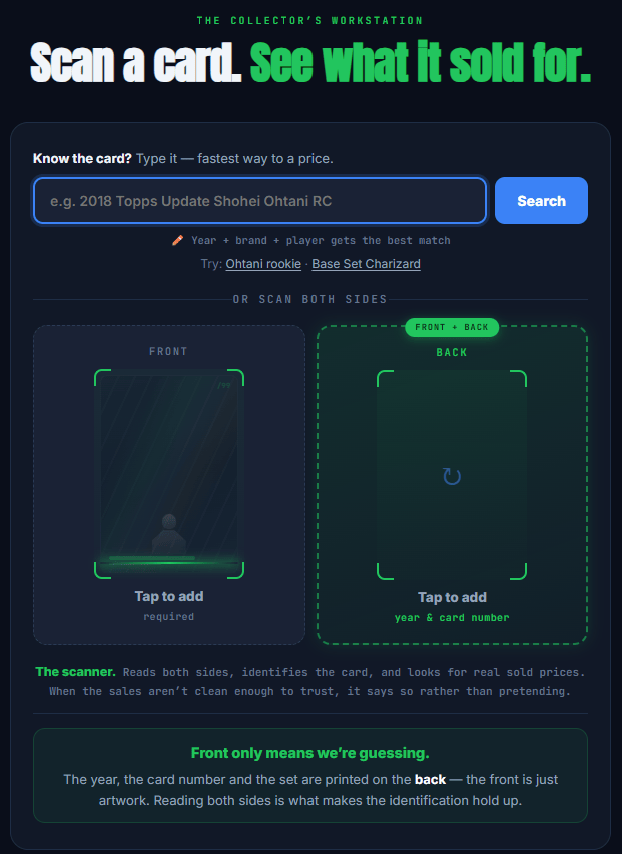
Most modern card-scanning apps make a fundamental mistake: they only look at the front of the card. While the front gives you eye-catching artwork, the critical details live on the back. Card numbers, copyright years, production codes, and set variations are almost always tucked away on the reverse side.
CardGauge asks for scans of both sides, and that small extra step pays massive dividends. By reading the back, the platform avoids confusing base cards with tough parallels, short prints, or vintage reprints. Even better, it handles graded slabs directly from the label.
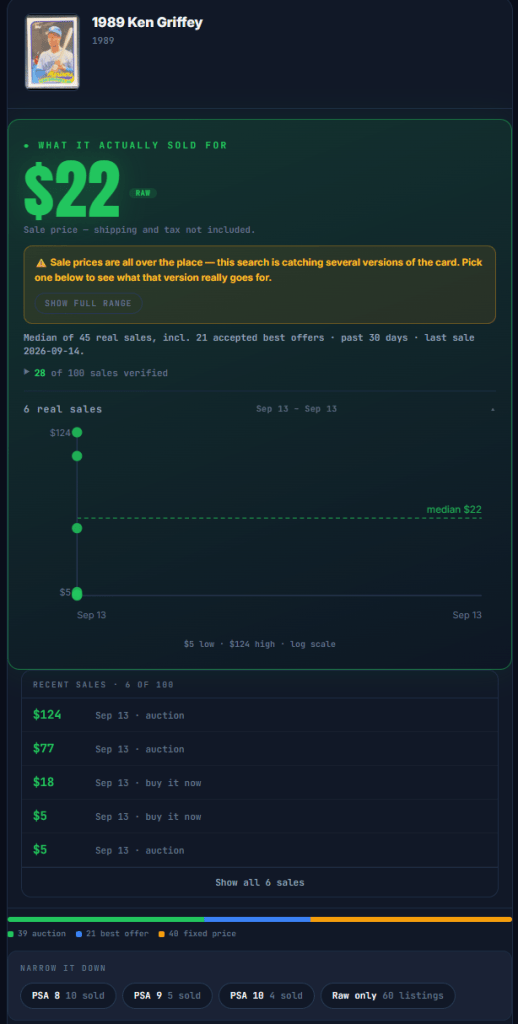
The system also displays remarkable honesty. If an automated search pulls in conflicting data, like a mix of refractors and base cards that would distort the true average, CardGauge withholds the figure and alerts you rather than spitting out a confident, incorrect number.
The Features That Make It Tick
CardGauge delivers a tight, utility-first suite of tools built specifically for the hobby workflow:
- Accepted Best Offer Transparency: Traditional marketplace completed listings often obscure the actual number when a seller accepts a best offer. CardGauge surfaces the actual completed transaction numbers so you see what money changed hands.
- The “Should You Grade It?” Calculator: Instead of giving you an over-optimistic projection based on an elusive PSA 10, CardGauge defaults to the math on a realistic PSA 9. It stacks recent raw sales and grading fees against realistic graded comps to show whether submitting the card is genuinely profitable.
- Digital Binder with Nightly Repricing: Collectors can save cards into a digital binder that automatically updates its valuations every night. It supports bulk imports too, allowing you to paste lists of hundreds of cards at once instead of scanning them individually.
- Card Show Log: Built specifically for showroom floors where convention hall Wi-Fi tends to disappear, the Card Show Log lets you track what you picked up, log what you spent at each table, and review your cumulative total instantly.
- Set Building Checklists: When organizing sets, the platform automatically groups your cards and outputs a clear list of missing card numbers and names rather than an ambiguous percentage bar.
- Dedicated Mobile Shortcut: Through its streamlined mobile scanner URL, you get an ultra-fast, minimal interface designed to live on your phone’s home screen for rapid scanning at shows or trade nights.
CardGauge vs. Traditional Hobby Scanners
| Feature | CardGauge | Standard Scanner Apps |
| Scan Architecture | Front and back dual scanning | Front-only visual match |
| Comp Data | Completed sales including accepted offers | Asking prices and filtered sales |
| Grading Analysis | Realistic PSA 9 breakeven math | Best-case PSA 10 theoretical projections |
| Data Integrity | Flags dirty data and mixed variants | Averages dissimilar cards into one false comp |
| Showroom Readiness | Offline-capable show log and rapid scanner | Heavy native apps requiring strong cell signal |
The Verdict
CardGauge hits the sweet spot for collectors who value analytical accuracy over bloated marketplace social feeds. By ditching speculative asking prices, acknowledging the reality of card variations with two-sided scanning, and providing practical grade-margin tools, it functions as a sharp, reliable companion for every trade night and card show run.
Visit CardGauge today: https://www.cardgauge.com/





Leave a comment