
The self-described “Collector’s Command Center” is swinging at five different products at once. The surprising part? Most of the swings connect.
There’s a particular kind of tab chaos that every serious collector knows. Checklist site in one tab. Price comparison in another. A prospect list you keep in Notes for some reason. A spreadsheet you swore you’d update. Somewhere in there, a photo of a card you meant to look up three weeks ago.
HobbyMonitor’s entire pitch is that all of that collapses into one place. It’s an ambitious bet, and after spending real time inside it, we came away more impressed than we expected.
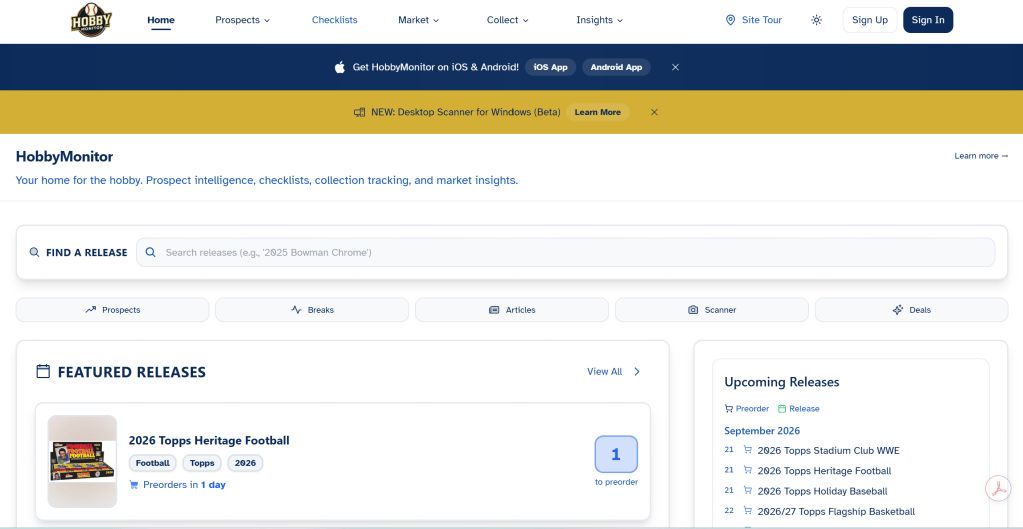
So what is this thing?
HobbyMonitor (hobbymonitor.com, iOS, and Android) bundles five products under one login:
An AI card scanner. Snap a photo, get a grade estimate, condition read, and pricing. The site’s own framing is “professional analysis, zero expertise required.”
Release checklists. This is the quiet workhorse. The homepage calendar we pulled on September 20 ran deep into December 2026, covering Topps Chrome Star Wars, Bowman Football, Panini Noir Basketball, Topps Allen & Ginter, a Formula 1 Chrome set, and an MLB x KAWS crossover that we are still processing emotionally. HobbyMonitor’s About page claims a checklist database in the hundreds of thousands of cards across 500+ sets.
A prospect market tracker. Per the About page, 2,000+ MLB prospects with Bowman pricing, market trends, community ratings, and fair value scores refreshed twice weekly. You can rate prospects, build a watchlist, and follow the board.
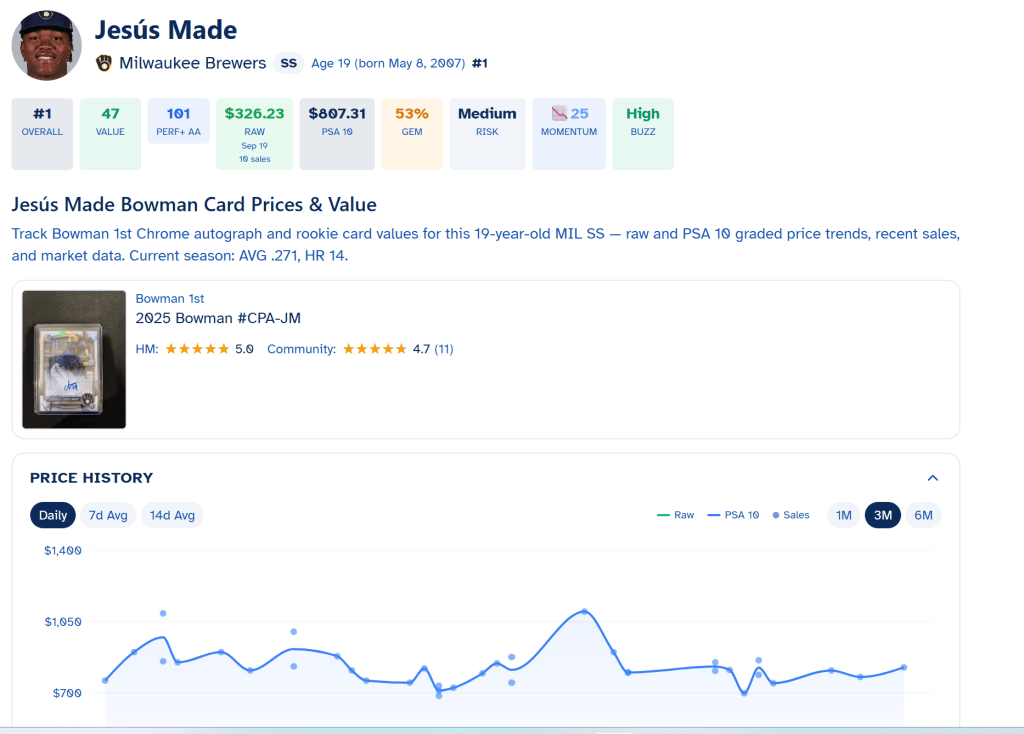
Collection tracking. Multiple collections, public or private depending on tier, with export on paid plans.
An editorial arm. The Insights section is publishing actual content, not filler. Recent pieces included a September callup board, a Bowman Chrome top-chases guide, and a full parallel cheat sheet with price multipliers.
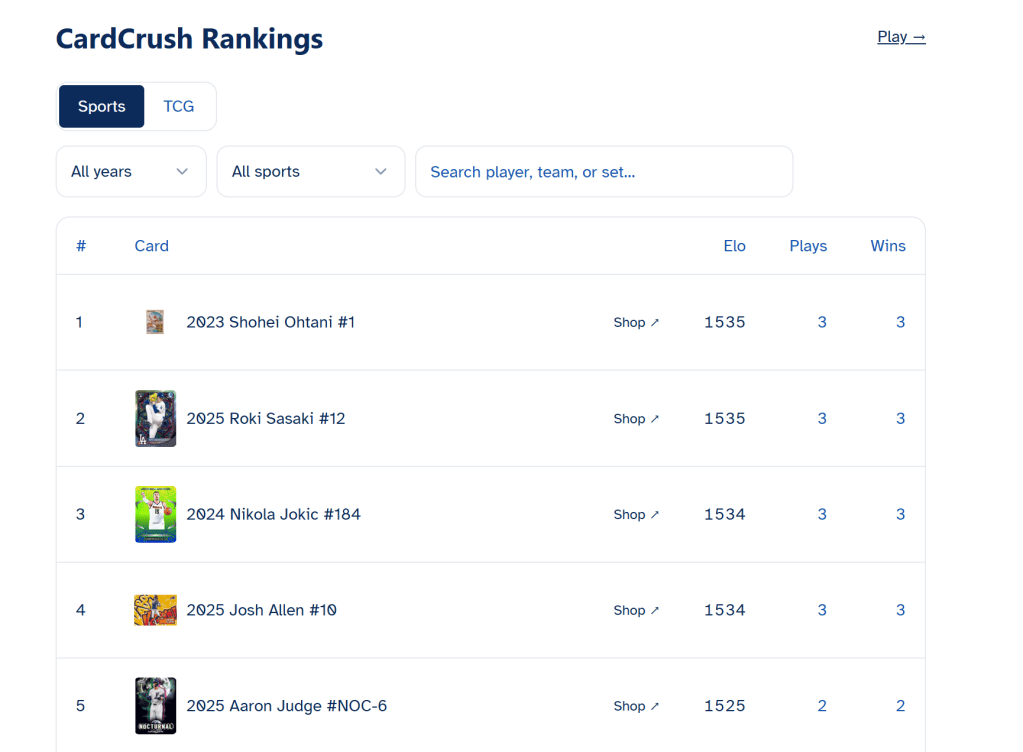
Oh, and there’s also a breaks section, a deals page, a shop, and games. The surface area here is enormous.
What genuinely works
The checklist and release calendar is worth the visit by itself. It’s clean, it’s forward-looking, and it’s free. No account required to browse. In a hobby where release information is scattered across a dozen manufacturer pages and forum threads, having a single sortable calendar is a legitimately useful utility.
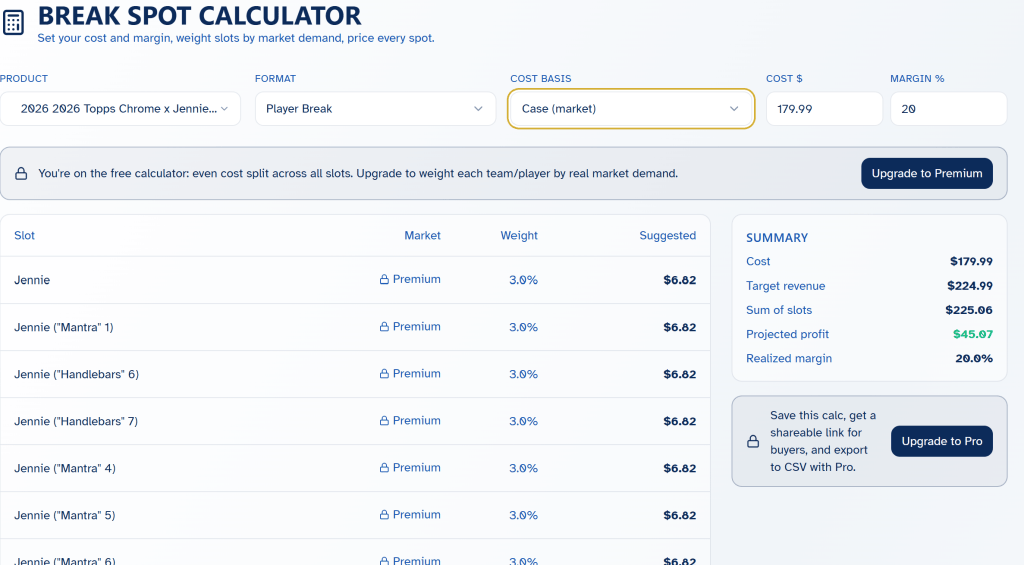
The prospect tracker is the differentiator. Every card app has a scanner now. Almost none of them have a dedicated Bowman prospect layer with community ratings, watchlists, and a twice-weekly refresh cadence. If you play the prospecting game, this is the part of HobbyMonitor you’ll actually open daily. It’s also the piece that would be hardest for a competitor to copy quickly, which says something about where the team is putting its effort.
Cross-platform on one subscription. Web, iOS, and Android, same plan. That sounds basic until you remember how many hobby tools still make you choose. Scanning cards at a show on your phone and then doing the analysis on a laptop at home is the correct workflow, and HobbyMonitor supports it.
The free tier is more generous than it looks. Scans and research credits are capped tight at five a month, which is a taste rather than a meal. But checklists, articles, and prospect market data are open. That’s a confident product decision: give away the reference layer, charge for the compute.
Transparency on monetization. The affiliate disclosure (eBay Partner Network among others) sits right in the footer, and the free tier runs ads with paid tiers removing them. No games, no burying it.
Where we’d push back
Fair is fair, and a review that only nods along isn’t a review.
The social proof numbers don’t agree with each other. On the About page as of September 20, 2026, the trust section says “Join over 4,000 collectors.” The closing call to action further down the same page says “Join 1,300+ collectors.” Both can’t be current. This is almost certainly a stale CTA that nobody swept after a growth milestone, but it’s the kind of thing a skeptical collector notices immediately, and it’s a five-minute fix.
The review base is thin. The About page cites a 5.0 App Store rating from nine ratings. A perfect score is nice. Nine ratings is not yet a signal. Treat it as early days rather than validation.
“PSA-style grade estimate” is the claim we’d want independently tested. This isn’t a knock on HobbyMonitor specifically, it’s the open question hanging over every AI grading tool in the hobby right now. Centering and obvious surface damage are tractable from a photo. Print lines, subtle edge wear, and the gap between an 8 and a 9 are a different problem, and that gap is where the money lives. We’d treat any scanner output as a triage signal for what’s worth submitting, not as a pre-grade.
Collection caps will bind on real collections. The paid tiers top out in the low four figures of cards. Plenty for a focused PC or a prospect portfolio. Not enough for anyone sitting on boxes of inventory or running a table at shows.
Breadth carries risk. Scanner, checklists, prospects, collection tracking, editorial, breaks, deals, shop, games. That’s a lot of product for what appears to be a small operation. The upside is genuine convenience. The risk is that a few of those surfaces go quietly stale while the team focuses on the ones people actually use. We’d rather see three excellent things than nine adequate ones, and to their credit, the three that matter most (checklists, prospects, scanner) do look like the ones getting the attention.
Who this is actually for
This is a modern and prospecting product, and it’s unapologetic about it. Bowman firsts, release calendars, parallel multipliers, callup boards. If your collecting life runs on wax and prospect speculation, HobbyMonitor is built for your exact brain.
If you’re a high-grade vintage buyer, the fit is partial. The checklist database and calendar won’t help you much with pre-1980 material, and the prospect tracker is irrelevant to a T206 or a ’53 Topps run. The scanner and collection tracking still apply, but you’re using a fraction of what you’d be paying for.
On price, both paid tiers land in territory that’s easy to justify against a single grading submission, and annual billing knocks off 17% on the mid tier and 20% on the top tier. The free plan asks for an email and no card, so the cost of finding out is zero.
Bottom line
HobbyMonitor is doing the hard, unglamorous work of being useful. The release calendar is a genuine public good. The prospect tracker is a real differentiator that competitors haven’t matched. The mobile and web parity is the right call. And the product is clearly shipping, with recently updated releases dated within days of our visit.
We’d love to see the AI grading claims put to an independent test, the marketing copy reconciled, and a higher collection ceiling for power users. None of that dents the core: this is a thoughtfully built platform that respects how collectors actually spend their time.
Verdict: worth a free account today. If you prospect, it’s worth a paid one.
Visit HobbyMonitor today: https://www.hobbymonitor.com/




Leave a comment