The name undersells it. The actual product is a comp engine with an alarm bolted on, and the comp methodology is the most disciplined we’ve seen from a tool this size.
Let’s clear up the naming problem first, because CardboardSniper has to do it on its own FAQ.
This is not eSnipe. It does not place last-second bids. The site is refreshingly blunt about the distinction: auction snipers help you win a listing you already found, while CardboardSniper is trying to solve the earlier and harder problem of finding the underpriced listing at all.
That’s a better product than the name suggests, and once you understand what it’s actually doing, the whole thing clicks.
What it does
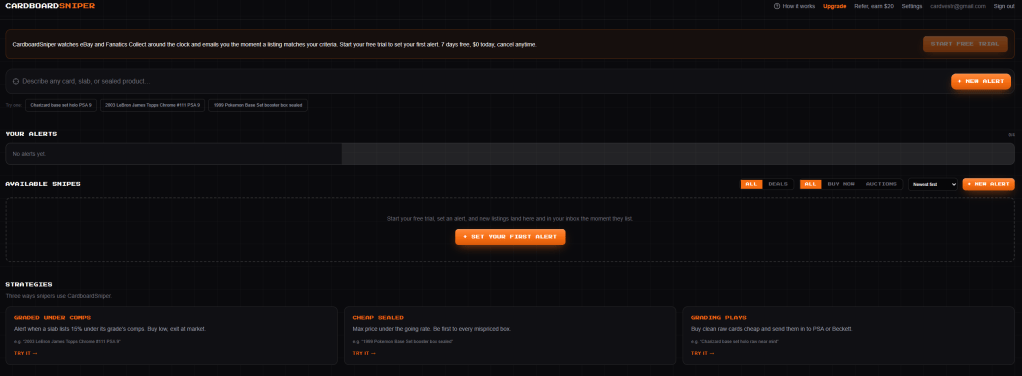
You describe a card. Plain English works, or you can paste an eBay or TCGplayer link, or punch in a cert number off a PSA, BGS, CGC, or SGC slab. CardboardSniper pins that alert to one exact card, then watches eBay and Fanatics Collect continuously. When a new listing appears and prices below your threshold against sold comps, you get an email within minutes.
You then go buy it on eBay. CardboardSniper never touches the transaction, holds no inventory, and takes no cut. It finds things and tells you.
Each alert carries its own deal bar. You set how far under market a listing has to be before it’s worth pinging you, whether you want every match or only genuine deals, a max price, and whether to include auctions or Buy It Now only.
There’s also a private Discord included on every tier, running pre-built alerts on 586 of the hobby’s most-watched cards across eight niche channels. No setup required. When one of them lists below comp, the channel fires with the price, the comp, and the link.
What genuinely works
The comp methodology is the story here, and it’s excellent. Fair value is the average of the last three sane recorded sales for that exact card, in that exact grade, from that exact grading company. Outliers are trimmed before averaging. A PSA 8 is priced against PSA 8 sales. A BGS 9.5 against BGS 9.5 sales. Raw against raw. Parallels and refractors are separated so a base card never gets priced against its refractor.
If you’ve spent any time watching hobby tools quietly cross grades to fill a data gap, you know how unusual this is. CardboardSniper’s own “how we price” page calls out exactly why they don’t: crossing grades produces confident numbers that are simply wrong.
And they refuse to show a number when they don’t have one. This is the single most impressive decision on the site. If a card has no recent sales in the listed grade, the alert still fires but shows no verdict. No interpolation from a neighboring grade, no model output dressed up as a comp. Their stated reasoning is that one misleading verdict costs more trust than a hundred correct ones earn.
That’s a real product principle, and it costs them something to hold. Most tools would rather show a soft estimate than an empty field, because an empty field looks like the product failed. Choosing the honest blank is a decision made by someone who actually cares whether the number is right.
The “what we are not” section is unusually clear. Not a marketplace. Not an auction sniper. Doesn’t buy, sell, or intermediate. Every purchase happens under eBay’s or Fanatics Collect’s own buyer protections, from the same listing page you’d have found yourself. In a category full of tools that blur what they actually do, this reads as confidence.
Cert-number alert creation is a smart touch. Punching a cert off a slab and having the system build a grade-matched alert from it removes exactly the friction that makes people give up on saved searches.
The Discord is real value at the entry tier. Pre-armed alerts on hundreds of major cards, included on every plan, means you get something useful on day one even before you’ve figured out your own searches.
Where we’d push back
The tier information doesn’t match across the site. As of September 21, 2026, the homepage pricing section lists four plans: Collector, Sniper, Sniper Room, and Dealer, with the top tier tracking 12 searches. The About page lists only three, omits Sniper Room entirely, and describes the top tier as tracking 10 searches with priority checking. Somebody shipped a new tier and didn’t sweep the secondary pages. Small fix, but on a subscription product the pricing page is the one page that has to be right everywhere.
You’re buying searches, not alerts. “Unlimited alerts” appears on every tier, which sounds generous until you notice the actual meter is tracked searches, and the entry tier runs two. If you’re working a want list of any real length, you’re either moving up tiers or buying add-on searches, which are priced per search with the rate stepping down as you climb. The economics are reasonable. The framing is slightly more generous than the substance, and collectors should do that math before subscribing.
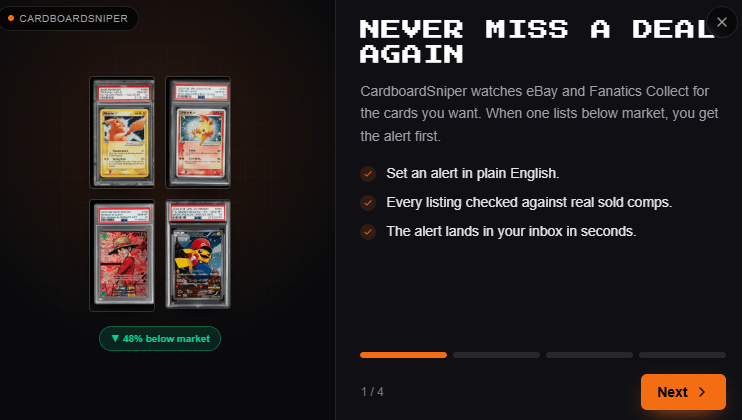
Every showcased win is high-end Pokemon. The hero examples are Charizard, Lugia, and Mario Pikachu slabs. Great cards, eye-catching savings, and entirely Pokemon. The FAQ is clear the tool covers sports, raw, and sealed, but the proof on display skews hard to one category. Sports collectors are being asked to take the crossover on faith.
The data sources aren’t named. The methodology page says comps draw on “recorded sales across major marketplaces and auction results.” For a product whose entire value proposition is comp accuracy, that’s the one place we’d want specificity. Which marketplaces, and how far back, materially changes what the number means.
Three sales is a thin sample by design. It keeps the number current, which is the right instinct for a fast-moving market. But on a volatile modern card, three sales can swing meaningfully week to week, and the deal threshold you set is calculated against that moving base. Worth understanding rather than treating the verdict as gospel.
Light on operator transparency. No company entity, no named team, and support runs through an email on an entirely different domain. None of that is disqualifying, and the About page promises replies come from a person. But on a recurring subscription, a bit more about who’s behind it would go a long way.
Who this is for
Flippers and active buyers get the most. If your model depends on buying below market and you’re on eBay daily anyway, this is a straightforward efficiency play against the top tiers.
Raw-to-graded arbitrage players should look closely. One of the site’s own use cases is alerting on clean raw copies of cards whose graded comps run hot, then capturing the grading spread. That’s a real strategy and this is a sensible way to automate the hunting half of it.
For the high-grade vintage buyer, the fit is interesting and complicated. In principle a below-market alert engine is more valuable on vintage than on modern, because vintage comps are comparatively stable and genuine seller mispricings do happen. In practice, the refuse-to-guess rule is going to fire often on low-population vintage grails, because those grades simply don’t produce three recent sales. You’d be paying for an alarm that frequently rings without a verdict attached. Still useful, since knowing a listing exists is most of the battle, but go in expecting it.
Bottom line
CardboardSniper is doing something we don’t say often: it’s being honest about a number when honesty is inconvenient. The grade-matched comp discipline and the willingness to show nothing rather than something wrong are worth more than any feature on the page.
Clean up the tier inconsistency, name the data sources, and show some sports-side wins, and this is an easy recommendation. Even as it stands, the free trial costs nothing to run and the methodology page alone is worth reading whether or not you subscribe.
Verdict: strong trial candidate, especially if you buy to flip. Check the search math against your want list before you commit.
Visit CardboardSniper today: https://cardboardsniper.com/





Leave a comment