Product analysis · September 2026
Nobody got into this hobby because they love typing.
And yet, if you sell cards at any real volume, a shocking percentage of your life is spent doing exactly that. Photographing a card under whatever lighting your kitchen offers. Cropping out the placemat. Rotating it because you shot it sideways. Squinting at a foil pattern trying to decide whether you’re looking at a Holo Silver or a Purple Shimmer. Then typing out a title that has to cram twelve attributes into eighty characters, and doing it again 400 more times.
Heystack, built by Michigan-based TCCentral, Inc., has looked at that entire miserable sequence and decided it should be a button.
We spent time going through the full product line. Here’s what’s actually going on.
What Heystack actually is
Call it an “AI card platform” and you’ll picture the wrong thing. This isn’t a scanning app that tells you what your card is worth. Heystack doesn’t care what your card is worth. Heystack cares about getting your card from physical object sitting in a box to live listing with a correct title as fast as mechanically possible.
The company describes its customers as consignment businesses, breakers, platforms, and dealers, and that tells you everything about the design philosophy. This is B2B infrastructure wearing a hobby-friendly hoodie.
The pipeline breaks into six moves: Capture → Crop → Rotate → Recognize → Title → List. Each one is a step you currently do by hand. Each one is a step Heystack automates and hands back to you as a configurable building block.
The listing endpoint is a direct eBay integration — one click to push an entire stack live. Everything else routes through CSV export, with Whatnot and Shopify appearing as supported destinations on the newer Store Connect product.
The hardware ladder
There are three ways into the system, and they map cleanly to three sizes of operation.
Your phone, free. Download the imaging app, get a free tier of 50 uploads a month into the cropping, rotation, identification, and listing system. Claim them again every 30 days. This is the tire-kicker path, and it costs nothing but your thumb.
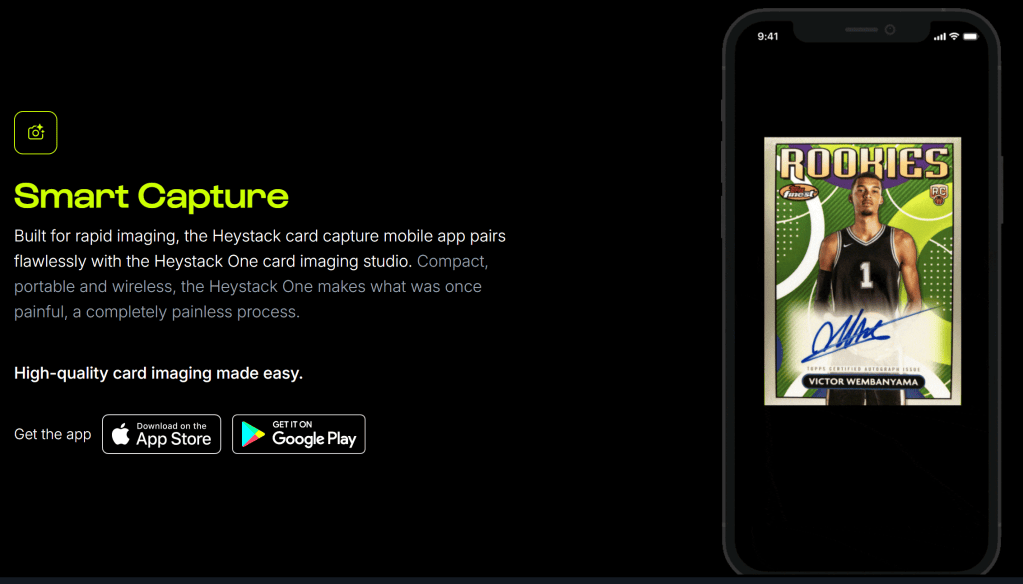
The Heystack One. A compact imaging studio — roughly 11 by 9 by 10 inches, two pounds, five-hour battery, Bluetooth shutter button, and a padded suction pedestal so you’re not manhandling a card into position. Your iPhone mounts on top and does the actual capturing. The pitch is controlled lighting: no glare, no shadows, no hunting for a window at 9pm. There’s even a fan-off “quiet mode,” which is a delightfully specific feature that tells you a real person complained about the noise.
Availability is the catch. Heystack says demand has outpaced supply, and the unit was previously restricted to qualifying businesses. It’s now purchasable as a bundle with credits, gated behind account creation and a webinar.
The RICOH fi-8170. For anyone whose problem is measured in thousands of cards, Heystack supports a straight-path document scanner that runs up to 100 cards per minute with its automatic document feeder, at up to 600 dpi. You install a Ricoh driver, install Heystack’s Scanner Connect client, and cards flow straight into the matching engine.
One important asterisk: Heystack lists the supported card type as top loader. You are feeding a document scanner’s ADF, so this is a solution for slabs and toploaded cards, not for running raw commons through a feeder and hoping for the best. Anyone imagining a bulk raw-card firehose should adjust expectations.
The credit model is worth noting for anyone doing unit economics: usage is purchased in credit packages, credits never expire, and there’s no forced subscription tier. Consumption pricing on a workflow tool is a founder-friendly choice — it scales with the customer’s actual volume instead of taxing their slow months.
“Others image match. We card match.”
This is Heystack’s own tagline, and it’s the most interesting technical claim on the site.
Per the company, recognition runs in three steps. Step one is image matching against their catalog — which they say is where competitors stop. Step two is a proprietary machine learning model comparing data points. Step three is, and we quote, “Secret Stuff.”
We’re going to gently flag that. A named third step with no explanation is either genuinely proprietary or a human in the loop, and in a hobby drowning in parallels, a human in the loop wouldn’t be a scandal — it’d be a smart product decision. Either way, “trust us” isn’t a technical spec, and any dealer evaluating this at scale should ask what step three does before signing anything.
The headline numbers, per Heystack’s own published figures as of September 2026: a card catalog north of 32 million entries, 98% match accuracy, and over 1.5 million cards listed through the platform.
That 98% deserves the standard scrutiny any vendor-reported accuracy figure deserves. Accuracy against what denominator? Modern parallels are the hard case, and vintage with condition-relevant variations is a different problem entirely. Nobody outside the company can audit it.
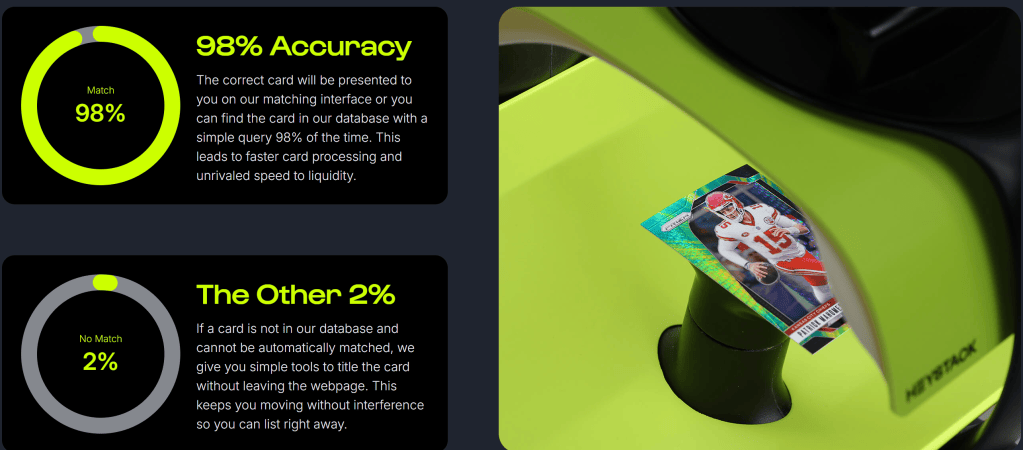
But here’s the thing we found more persuasive than the 98%: Heystack designed for the 2%. When a card can’t be matched, you get in-page titling tools so you can name it and keep moving without leaving the workflow. That’s a product team that understands throughput isn’t about a perfect model, it’s about never stopping the line. Most teams ship the accuracy stat and forget the failure path. This one didn’t.
The real moat isn’t the AI
Buried in the “Heystack Advantage” section is the part investors should actually underline.
Heystack employs a dedicated staff that tracks and prepares every new release for matching on or before official release day. They claim to have the insert universe fully mapped. And when a user reports a checklist error, the correction is permanent in the database.
Read that again. The defensible asset here isn’t a model — models commoditize fast, and every competitor in this space has access to the same computer vision toolkit. The defensible asset is a maintained, expert-curated catalog of 32 million cards that stays current with a release calendar that never sleeps, plus a user base that actively repairs it.
That’s an operations moat dressed as an AI moat. It’s expensive, it’s unglamorous, and it’s much harder to copy than a matching algorithm. If you’re doing diligence on this category, the question to ask isn’t “how good is the AI.” It’s “how many people maintain the catalog, and what happens when the release calendar doubles.”
Store Connect: the sleeper product
The newest piece is the one we’d watch most closely. Store Connect, onboarding hobby shops across the U.S. and Canada with a stated October 1, 2026 launch, turns a store’s walk-in buying process into a kiosk.
The flow: a seller walks in, signs up at the station with their phone number, gets a texted QR code, and starts dropping cards into the imaging station. The AI IDs and catalogs everything with no staff involvement. The store’s buyer reviews the whole catalog in an offer portal — from behind the counter or from home — and sets offers card by card. The seller accepts or declines by SMS, no app download.
Accepted cards arrive already imaged and identified, ready to push to eBay, Whatnot, or Shopify. It’s a counter-height kiosk with a permanently mounted iPhone, tools-free install, and store-branded screens throughout.
And then there’s the part that makes this a data company: declined offers don’t disappear. Heystack retains the seller’s contact info and full card imagery so the store can circle back when the market moves.
Think about what that accumulates. Every walk-in interaction, accepted or not, becomes a structured record of what cards exist, in what condition, in whose hands, at what asking price, in which geography. Across a network of shops, that’s a proprietary view of raw supply that no marketplace comp database can see, because it captures the cards that didn’t sell.
Founding partner stores listed include Mojobreak, Burbank Sportscards, Columbia Hobby, and Top Dog Cards.
Breaker Connect: the collector’s way in
If you’re a collector rather than a dealer, this is your entry point, and it’s free to start.
Join a break with a partner breaker, connect your Heystack account via your breaking-platform username, and your hits come back as studio-quality high-res images — typically within 24 hours of the break, sometimes faster. From there you can list straight to eBay, consign the cards with the breaker, submit them for grading through the breaker, sell them back to the breaker, or auto-generate social posts.
The strategic argument Heystack makes is about the release-day premium: hot new product commands its best price in a short window, and the friction of imaging and listing eats exactly that window. Compressing hit-to-listing from days to hours is a genuine edge.
The thing to think about clearly: consignment, grading, and buyback all route through the breaker. That’s convenient, and it also means one counterparty sits on every exit path for your hit. Convenience and best execution aren’t always the same trade. Know which one you’re choosing.
What Heystack doesn’t do
Honest gaps, because the site won’t list them:
- It doesn’t tell you what a card is worth. No pricing intelligence, no comps, no valuation layer. Heystack identifies and lists; pricing is on you. For a platform whose stated pillars include liquidity, that’s a conspicuous hole and an obvious roadmap direction.
- It’s eBay-centric. The one-click path is eBay. Everything else is CSV or, on Store Connect, a named integration. Single-channel dependency is a real risk for a business built on someone else’s marketplace.
- It’s not really a collector tool. If you own 300 cards you’ll never sell, there is nothing here for you beyond Breaker Connect. This is built for people moving volume.
- Hardware is supply-constrained. The Heystack One is gated behind webinars and qualification. That’s either genuine scarcity or careful demand management, and from outside you can’t tell which.
- No condition or centering assessment. Recognition tells you what the card is, not how nice it is. Grading screeners live in a different lane.
The bottom line
Heystack picked the least glamorous problem in the hobby and attacked it with unusual seriousness. There are no 1/1 chases here, no influencer energy, no token. Just a company that noticed dealers spend their most valuable hours doing data entry, and built a machine to take it away.
For dealers and consignors: if imaging and titling is your bottleneck, start with the free 50 uploads and a phone. The economics of the hardware only make sense once you’ve proven the workflow fits how you operate.
For breakers and break participants: Breaker Connect is free and solves a real timing problem. Just be deliberate about routing every exit through one counterparty.
For collectors: interesting to watch, mostly not for you yet.
For investors: the moat is the catalog and the release-day operation, not the model. The upside case is Store Connect quietly assembling a supply-side dataset nobody else has. The risk case is a workflow layer sitting on top of eBay’s rails, one API change away from a bad quarter. Both stories are live.
The hobby needs more companies solving boring problems. This is one of them.
Visit Haystack: https://heystack.tech/








Leave a comment