
The card market finally got a data layer that acts like it’s 2026. Here’s what it’s like to poke around Card Hedge AI.
Every few months a new card tool shows up promising to “fix pricing.” Most of them are a search box wearing a trench coat.
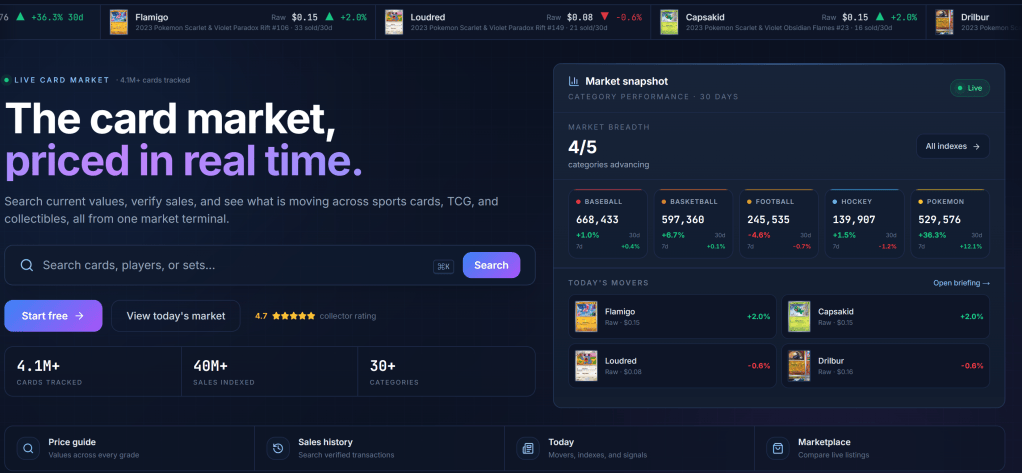
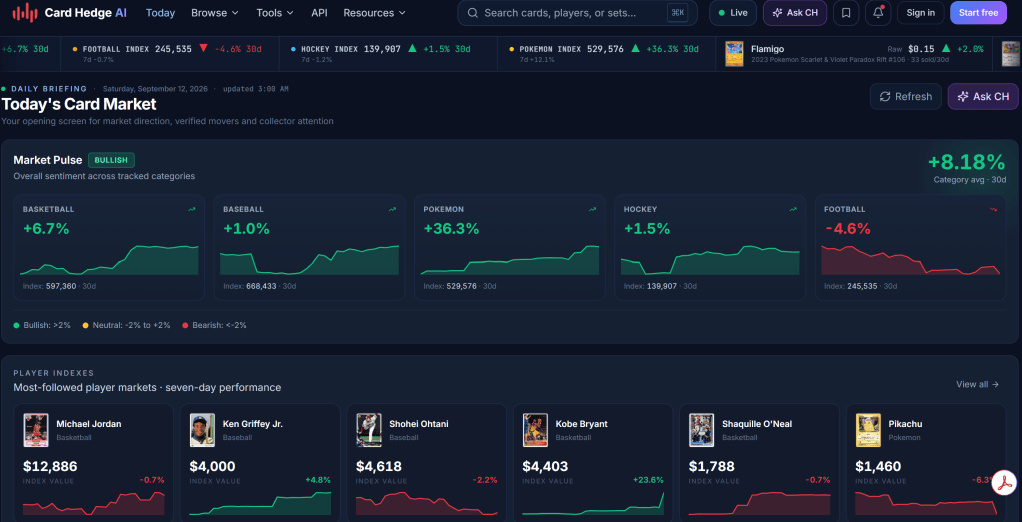
Card Hedge AI is not that. Load up ai.cardhedger.com and the thing greets you with a live market ticker, a category performance panel, a set of indexes, and a research assistant hovering in the corner waiting for you to ask it something. The tagline on the homepage — “The card market, priced in real time” — reads like marketing until you realize the page is genuinely laid out like a professional trading floor. Panels. Breadth indicators. A daily briefing. A developer API sitting right there in the main nav like it’s the most normal thing in the world.
It is a lot. In the best way.
The pitch: one workspace, thirty-plus categories
Card Hedge’s core claim is coverage. Per the site’s own numbers (as published on ai.cardhedger.com, September 2026): roughly 4.1 million cards tracked, 40 million-plus sales indexed, and 30-plus categories live — a figure that climbs to 38-plus on the API page.
And the category list is genuinely unhinged in the best way. Baseball, basketball, football, hockey. Fine. Then: Pokémon, Yu-Gi-Oh, Magic, One Piece, Lorcana, Digimon, Gundam, Flesh and Blood. Then it keeps going: Marvel, Star Wars, DC, Disney, Fortnite, Stranger Things, Garbage Pail Kids, Star Trek, and — we are not making this up — History & Politics.
Cricket is in there. Lacrosse is in there. Snowboarding is in there.
If you’ve ever tried to price a cross-category collection and ended up with four browser tabs and a spreadsheet you’re ashamed of, this is the part that’ll get you.
Four workflows, one screen
The site organizes itself around what it calls “four connected workflows,” and the structure holds up:
Price Guide. Values across every grade, drawing on live data the company says comes from eBay, Fanatics, Heritage, Goldin, and other major marketplaces. The grade-by-grade breakdown is the useful bit — a PSA 9 and a PSA 10 are different assets, and any tool that flattens them into one “value” is lying to you.
Sales History. Verified transactions you can search, which is the unglamorous foundation everything else sits on. Comps or it didn’t happen.
Today. A daily market briefing page with movers, indexes, and signals. This is the feature we’d personally check with coffee.
Portfolio Tracking. Add your cards, watch the value line move, see gains and losses in aggregate. Standard on paper, but it’s meaningfully better when it’s wired directly into the same pricing engine powering the rest of the platform instead of syncing from somewhere else.
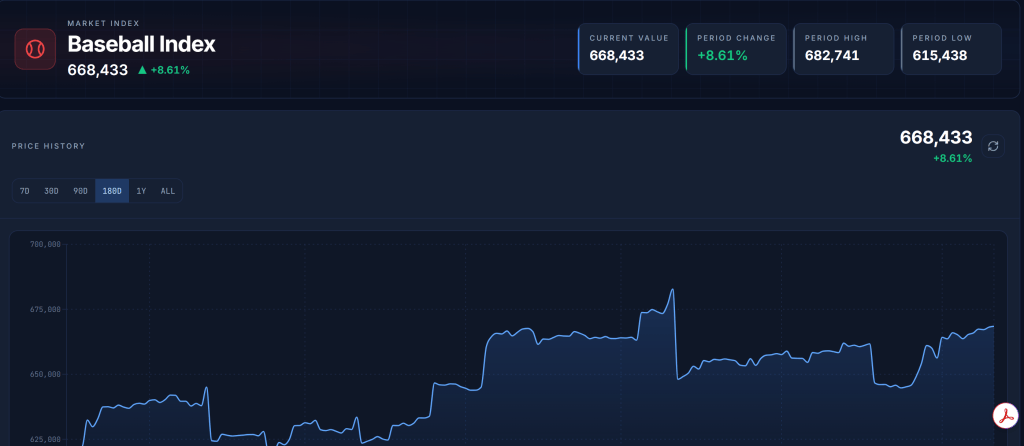
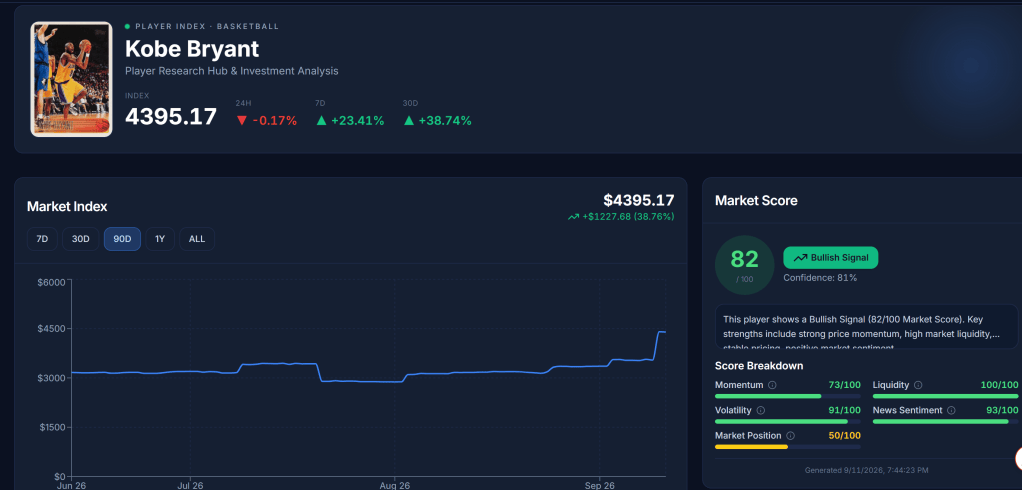
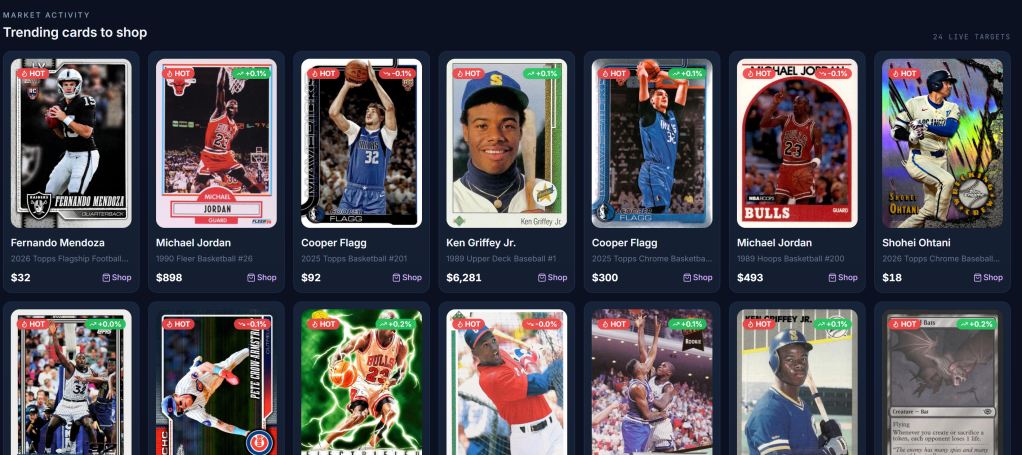
Sitting on top of all four: market indexes for major categories and a trending players view that tracks which player indexes are moving week over week. Treating a player as an index rather than a pile of individual cards is a genuinely nice conceptual move — it’s closer to how the market actually behaves.
“Ask CH” is the part that changes the workflow
The AI assistant — it goes by Ask CH — docks into the interface on basically every page, toggled with a keyboard shortcut. What makes it more than a chatbot bolted onto a database is that it’s page-aware. The panel literally says “Page context synced” and offers suggested research prompts flagged “Uses this page.”
So you’re on a price guide entry, you open the assistant, and it already knows what you’re looking at. “Search cards, verify recent sales, and investigate price movement without leaving this page” is how the site frames it, and that last clause is the whole value proposition. The friction in card research has never been a lack of data. It’s been the tab-switching.
The platform’s user guide also documents a dedicated AI Chat Expert section alongside a Card Compare tool for side-by-side analysis, plus onboarding that walks you through the whole stack in twenty short sections with a progress tracker. Someone over there cares about documentation, which in this hobby is roughly as rare as a centered 1986 Fleer.
Point your phone at a slab
The computer vision stack is where this gets fun.
Upload or photograph a card and Card Hedge says its custom-trained vision model identifies it in under a second, using a visual k-nearest-neighbor search across the full database. It works on raw cards, graded slabs, and partial images.
The slab handling is the standout: the system is built to detect the grading company — PSA, BGS, SGC, or CGC — read the grade off the label, and pull the cert number straight from the image. Once it’s identified, you get the full payload back: current market price, price history, population data, set details, comps.
The use cases Card Hedge lists for this are the obvious good ones — bulk-scanning a collection for valuations, auto-filling marketplace listings from a photo, inventory management, checking whether a table price at a show is fair, and running grading ROI math by pairing a card ID with a target grade.
Snap a card at a show, get comps before the seller finishes his sentence. That’s the dream and it’s shipping.
The sleeper feature: they’ll just sell you the pipes
Here’s the part most collectors will scroll past and every builder should not.
Card Hedge runs a full developer platform on the same infrastructure that powers the consumer app. REST plus JSON, Bearer token auth, an OpenAPI 3.0 spec, and endpoints covering pricing by grade, image identification, card search with fuzzy matching, certification lookup across the four major graders, model-based price estimation when comps are thin, and market analytics.
That price estimation endpoint deserves a callout. Modeling a value when recent comps are sparse is the hardest problem in card pricing and the one most guides quietly punt on.
Then there’s the agent tooling, which is the most 2026 thing on the site. Card Hedge publishes a hosted MCP endpoint — add one URL to your config and Claude Desktop, Claude Code, or Cursor can query live card data directly. They also document OpenAI Custom GPT Actions, LangChain and LangGraph tool wrappers, and Vercel AI SDK integration with copy-paste tool definitions.
Translation: if you’ve been sitting on an idea for a card app and stalling because you’d have to spend six months building a data pipeline first — that excuse is gone. Card Hedge is openly pitching itself as the bootstrap layer for other people’s startups, and full app access is bundled with API plans.
That’s a smart place to stand. The winner in card data probably isn’t the prettiest front end. It’s whoever ends up underneath everyone else’s product.
A couple of things we’d want verified
We’d want to see the freshness and accuracy of the pricing engine tested against known sales over time — that’s the only test that matters for a price guide, and it’s one nobody can run from a homepage.
We’d also note that the published stats aren’t perfectly consistent across the site: the homepage lists 4.1 million cards and 40 million sales indexed, while the developer section shows 3.7 million cards and describes 40 million sales as a weekly figure. Category counts drift between 30-plus and 38-plus depending on the page. These are almost certainly panels updating on different schedules rather than anything sinister, but if you’re evaluating the API for a commercial build, get the current numbers in writing.
Access runs on a subscription with a seven-day free trial, cancel anytime. There are iOS and Android apps too.
The bottom line
Card Hedge AI is one of the more ambitious swings anyone has taken at the hobby’s data problem, and the ambition mostly lands. The interface treats collectors like people capable of reading a chart. The page-aware assistant removes the single most annoying part of card research. The vision model turns a phone camera into a price checker. And the API quietly positions the whole thing as infrastructure rather than just another destination site.
Is it more platform than a casual collector needs? Probably. If you own forty cards and know exactly what they are, this is a lot of machinery for your life.
But if you’re managing a real collection across multiple categories, tracking what’s moving week to week, or building something on top of card data — this is the kind of tool that makes the old way feel ridiculous.
Visit Card Hedge AI today: https://ai.cardhedger.com/







Leave a Reply