
The data from these charts makes a compelling case: sometimes the “lower” grade on the label is the superior engine for growth. We just officially added the 2009 Topps Stephen Curry #321 PSA 7 to the Cardvestr portfolio for $1,400, and while the grade might surprise some, the math behind it is undeniable.
Here is the breakdown of why this specific slab is the “alpha” play for our basketball holdings.
The Anatomy of the Acquisition: Why the PSA 7 is Our “Alpha”
In the world of sports card investing, the common reflex is to always chase the highest grade your budget allows. However, the Cardvestr strategy is built on data, not just “Gem Mint” labels. When we looked at the landscape for the Curry #321, we had three distinct paths: the PSA 6, the BGS 8, and the PSA 7.
Here is why the PSA 7 won.
1. Explosive Growth: +190.55% ROI
The primary driver for this acquisition is the sheer velocity of the PSA 7 market. Looking at the 2-year Card Ladder chart, the PSA 7 has seen a staggering +190.55% rate of growth.
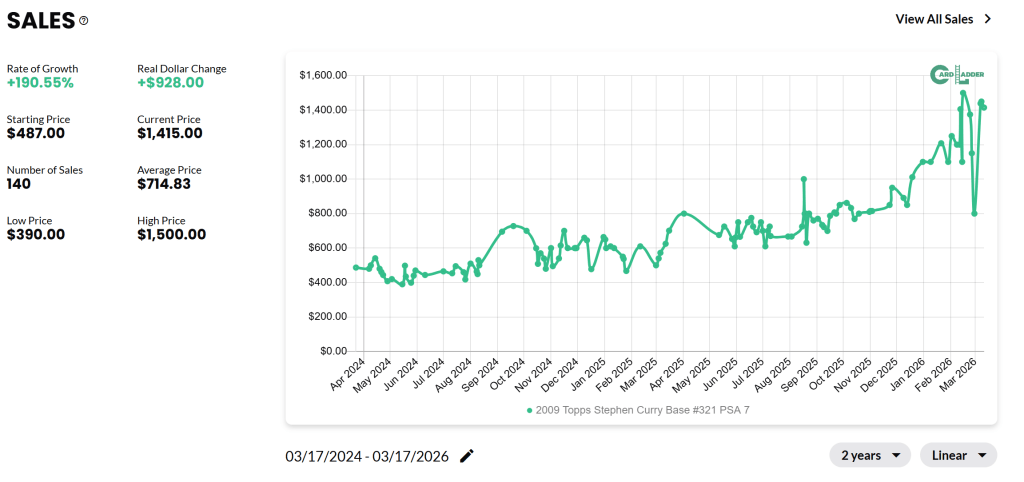
- Starting Price (Apr 2024): $487.00
- Current Market Price: $1,415.00
- Real Dollar Change: +$928.00
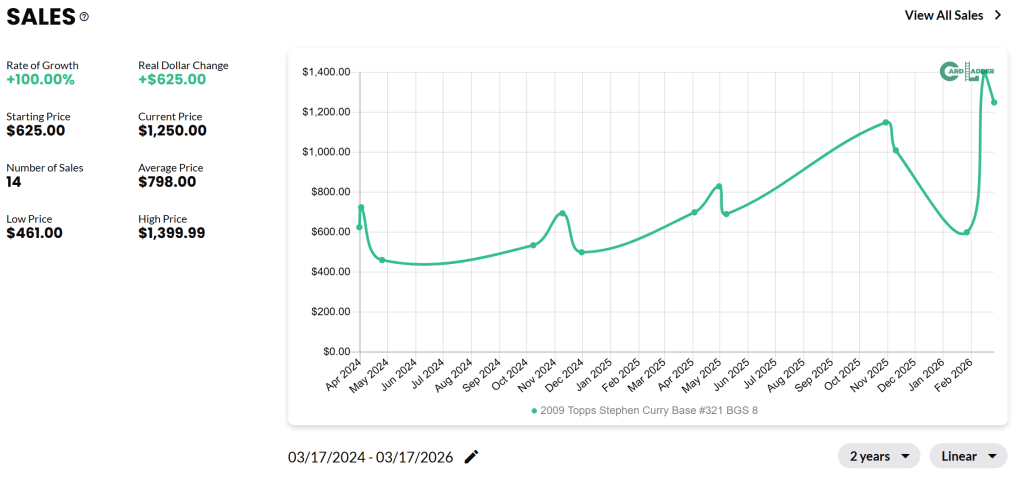
Compare this to the BGS 8. Despite being a technically higher numeric grade, the BGS 8 “only” saw a +100% growth rate over the same period. While doubling your money is great, leaving an extra 90% of growth on the table is not the Cardvestr way.
2. Liquidity: The Power of 140 Sales
Growth percentage is meaningless if you can’t exit the position when you want to.
- PSA 7 Volume: 140 sales over the last 2 years.
- BGS 8 Volume: Only 14 sales in the same window.
The PSA 7 is a high-traffic asset. With 10x the sales volume of the BGS 8, it represents a highly liquid “Blue Chip.” In a market downturn or a sudden surge, the PSA 7 moves instantly. The BGS 8 is a “sleepy” asset by comparison.
3. PSA 7 vs. BGS 8: The “Label Premium”
The most fascinating part of this data is the price inversion. Our second graph shows the BGS 8 currently valued at $1,250, while the PSA 7 is commanding $1,415.
Even though the BGS 8 is “cheaper” and technically a “better” grade, the market clearly values the PSA 7 more. Collectors and investors are paying a premium for the PSA brand and the specific stability of the 7-grade tier. We aren’t buying the card in a vacuum; we are buying the market’s preference, and the market prefers the PSA 7.
4. Why Not the PSA 6?
While the PSA 6 is an even more “affordable” entry point, it lacks the psychological “floor” that the 7 provides. The PSA 7 is often viewed as the “collector’s grade”—it’s the point where the card still has great eye appeal but remains accessible. As the chart shows, the 7 has hit a “high price” of $1,500, showing that it has the legs to keep climbing toward that $2k mark.
The Bottom Line
We acquired this Curry #321 for $1,400, which is slightly under the current market average of $1,415.
By prioritizing Rate of Growth (+190%) and Liquidity (140 sales) over a higher numeric grade (BGS 8) or a cheaper entry (PSA 6), we’ve added a cornerstone basketball asset that isn’t just a piece of history—it’s a high-performance engine for the portfolio.
The Cardvestr Portfolio: Data over Labels.


 CardVestr
Leave a comment