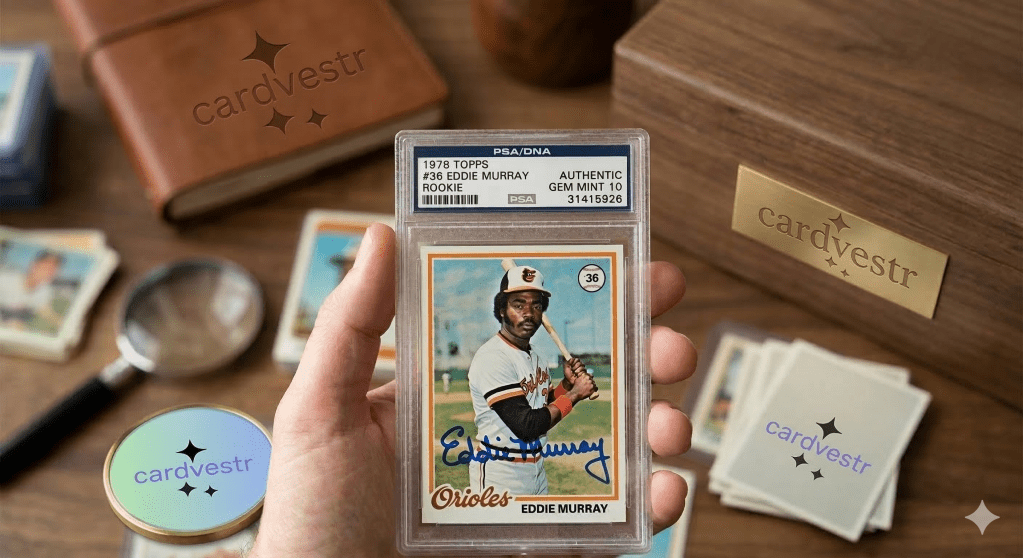
At Cardvestr, our strategy is built on the intersection of historical significance and market efficiency. While the hobby often chases the “flavor of the month” prospect, we prefer to anchor our portfolio with Hall of Fame royalty.
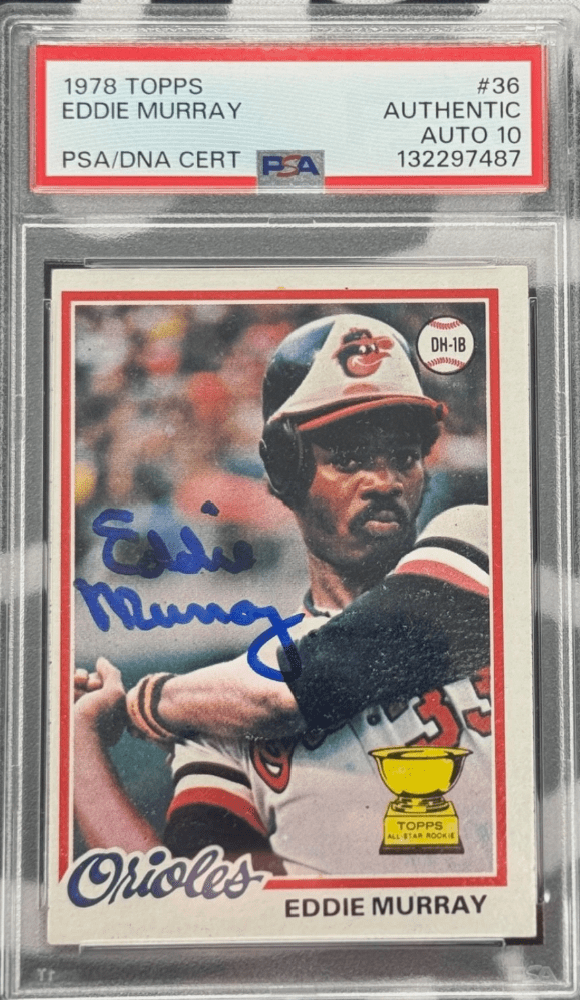
Today, we are excited to announce the latest addition to the Cardvestr portfolio: the 1978 Topps Eddie Murray Rookie #36 (Signed, PSA 10 Auto).
The Asset: Why Eddie Murray?
In the world of baseball history, Eddie Murray is the definition of “Blue Chip.” He is one of only seven players in the history of the game to record both 3,000 hits and 500 home runs. Think about that—he sits at a table with names like Aaron, Mays, and Pujols.
The 1978 Topps #36 is his only recognized rookie card. It is the undisputed king of the 1978 set. While modern cards rely on artificial scarcity (parallels and 1/1s), the value of a Murray rookie is driven by 45+ years of sustained greatness and a dwindling supply of high-quality examples.
The Buy: Market Efficiency in Action
We acquired this piece for $175. In a market where a PSA 9 (unsigned) carries a four-figure price tag and a PSA 10 (unsigned) is a $40,000+ “whale” asset, we saw a massive value gap in the signed market.
Our Breakdown:
- The Card: 1978 Topps #36 (Orioles)
- The Signature: PSA/DNA Certified 10 (Gem Mint Auto)
- Purchase Price: $175
By targeting a PSA 10 Auto on an “Authentic” slab, we are essentially buying the man and the moment. This card presents beautifully, featuring Murray’s iconic early-career signature in a perfect, bold strike. For $175, we have secured a centerpiece Hall of Fame rookie that carries significantly less downside risk than a modern “ultra-modern” prospect at the same price point.
Strategy Alignment: Why This Fits Cardvestr
- Lower Volatility: Hall of Fame rookies do not “strike out.” Murray’s legacy is cemented; there is no risk of a career-ending injury or a slump affecting his long-term value.
- The “Dual-Grade” Pivot: As we’ve recently expanded our strategy to include BGS and diverse grading tiers, this purchase highlights our commitment to “eye appeal” and “signature quality” over just a numerical card grade.
- Liquidity: Eddie Murray has a massive, multi-generational fan base (especially in Baltimore). Signed rookies are highly liquid assets that perform well in both private sales and major auction houses.
The Bottom Line
Steady Eddie earned his nickname through consistency. At Cardvestr, we aim for the same. Adding a perfect 10-grade signature of one of the greatest switch-hitters to ever play the game for under $200 isn’t just a “collectible” move—it’s a calculated investment.



 CardVestr
Leave a comment