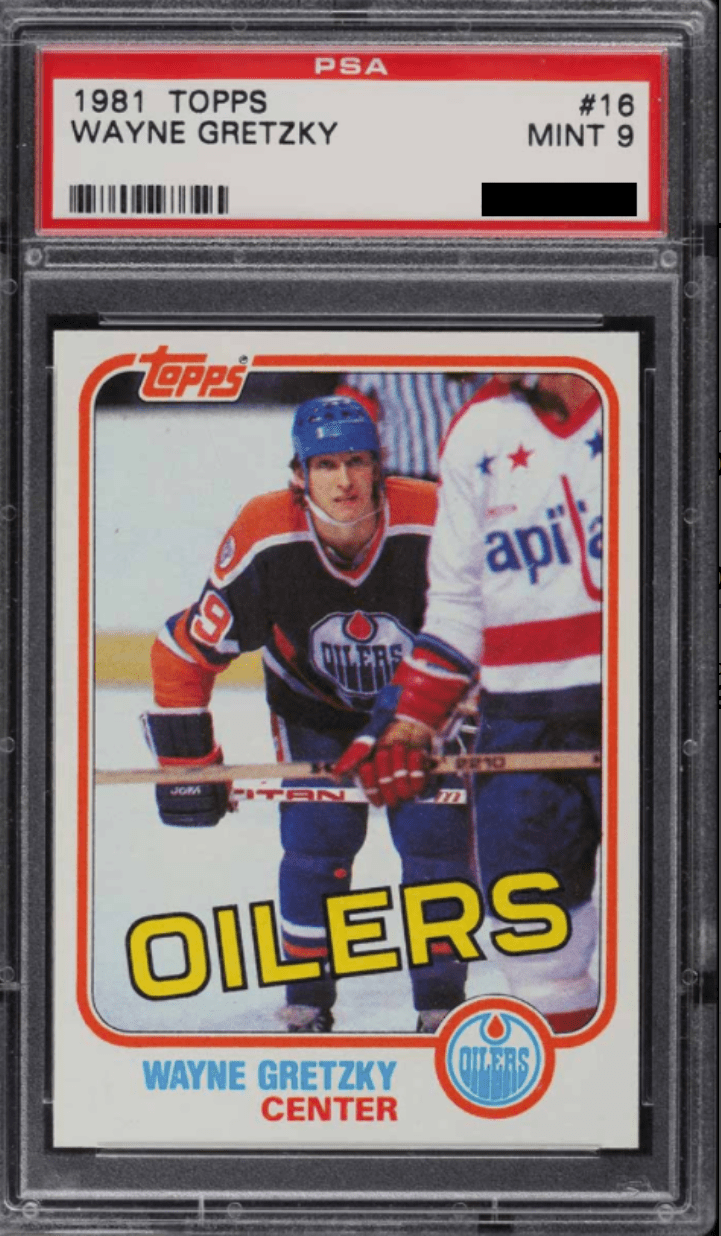
Why the 1981 Topps Wayne Gretzky PSA 9 is Our Newest “Blue Chip Aristocrat” Acquisition
In the world of FinTech, we look for assets with proven track records, high liquidity, and clear upside. When we apply that same rigor to the Cardvestr portfolio, few names carry the “Triple-A” rating of Wayne Gretzky.
While everyone chases the “Great One’s” 1979 rookie card, savvy investors know that early-career Gretzky cards offer a more accessible—and often more volatile—growth curve. I recently acquired the 1981-82 Topps #16 Wayne Gretzky in a PSA 9 Mint grade for $145.
The Thesis: Stability + Scarcity
At Cardvestr, our “Blue Chip Aristocrat” strategy requires a minimum 25% growth rate over two years. The 1981 Topps Gretzky hasn’t just met that; it has crushed it with a 77.9% return since March 2024.
This card represents Gretzky at the height of his powers, and in a PSA 9, you are holding a “Mint” piece of history that is significantly rarer than the lower-grade copies that flood the market.
The Data Doesn’t Lie
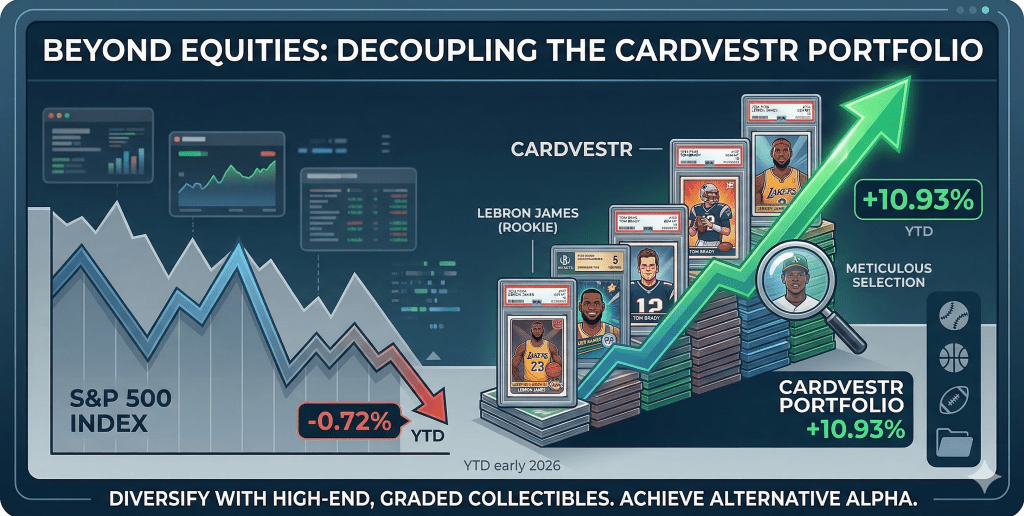
- Performance: A real dollar change of +$63.73 on a sub-$100 starting price. That’s the kind of ROI that beats the S&P 500 while being a lot more fun to look at.
- Liquidity: With 154 sales tracked over the last two years, this card is the “Blue Chip” equivalent of a high-volume stock. We value the ability to enter and exit positions without fighting for a buyer.
- Portfolio Balance: As we look to diversify our holdings beyond basketball and football, hockey offers a unique value proposition. Gretzky is the ultimate hedge—he is the undisputed GOAT of his sport, ensuring long-term demand regardless of market cycles.
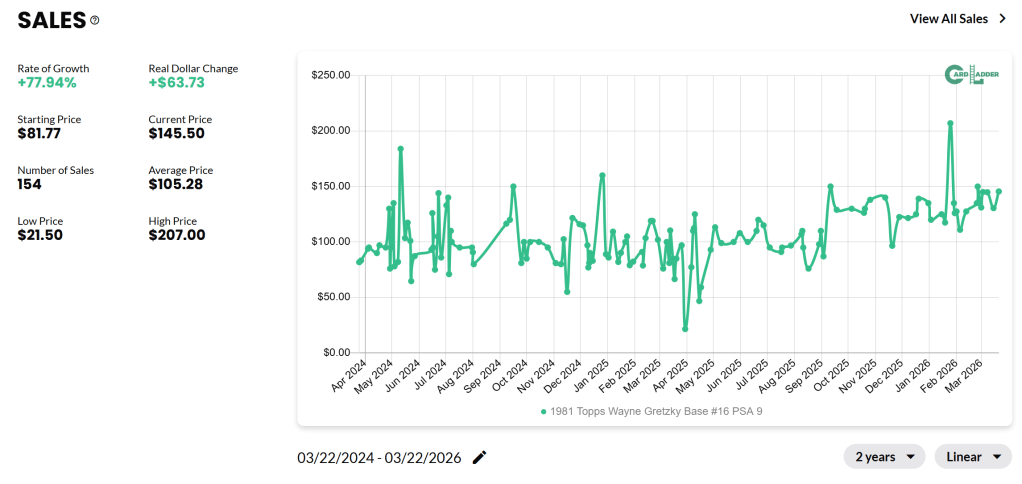
This is a clinical “Blue Chip Aristocrat” play. The data from Card Ladder tells a compelling story that aligns perfectly with the strategy we’ve built for Cardvestr.
Looking at the performance from March 2024 to March 2026, this cad is a textbook example of why we prioritize liquidity and historical HOF performance.
- The “Aristocrat” Growth Metric: Our internal benchmark is a 25% growth rate over two years. This card hasn’t just cleared that bar; it’s sprinted past it with a +77.94% Rate of Growth. That is an incredible alpha for a non-rookie vintage card.
- Liquidity Check: With 154 sales in the last 24 months, this card is incredibly liquid. We aren’t looking at “ghost” valuations based on one lucky auction; we’re seeing a sale roughly every 4–5 days. If we ever need to exit this position to fund a larger whale, we can move it in 24 hours.
- The “April 2025” Opportunity: Notice that massive valley where prices dipped toward $21.50. While that looks like a crash, the rapid recovery suggests it was a market outlier (likely a poorly listed auction or a mislabeled “buy it now”). The fact that the floor has reset much higher—averaging around $145.50 now—shows the market has matured and found a new support level.
- Momentum Analysis: Look at the “higher highs” established starting in late 2025. We saw a peak of $207.00 in February 2026. The current price of $145.50 represents a healthy pullback from that peak, offering us a safer entry point before the next leg up.
The Verdict
We are entering the market for a PSA 9 copy at the current support level of $145.00 – $150.00. By adding this card, we strengthen our vintage hockey floor and continue to build a portfolio rooted in data, not just nostalgia.
Stay Disciplined. Stay Aristocratic.



 CardVestr
Leave a comment