For decades, the sports card hobby has leaned on three familiar pillars: grade, scarcity, and recent sale price. If a card was rare, graded high, and showed a strong comp, it was assumed to be valuable.
The problem? None of those metrics answer the most important investor question:
If I need to sell this card tomorrow, can I actually do it — and at a fair price?
That gap is exactly what the SLAM Score, recently introduced by Mantel and highlighted in a Yahoo Sports feature, is designed to fill.
The SLAM Score reframes sports cards not just as collectibles, but as financial instruments with varying levels of liquidity. And if it gains traction, it could quietly reshape how serious collectors, dealers, and investors operate.
What Is the SLAM Score?
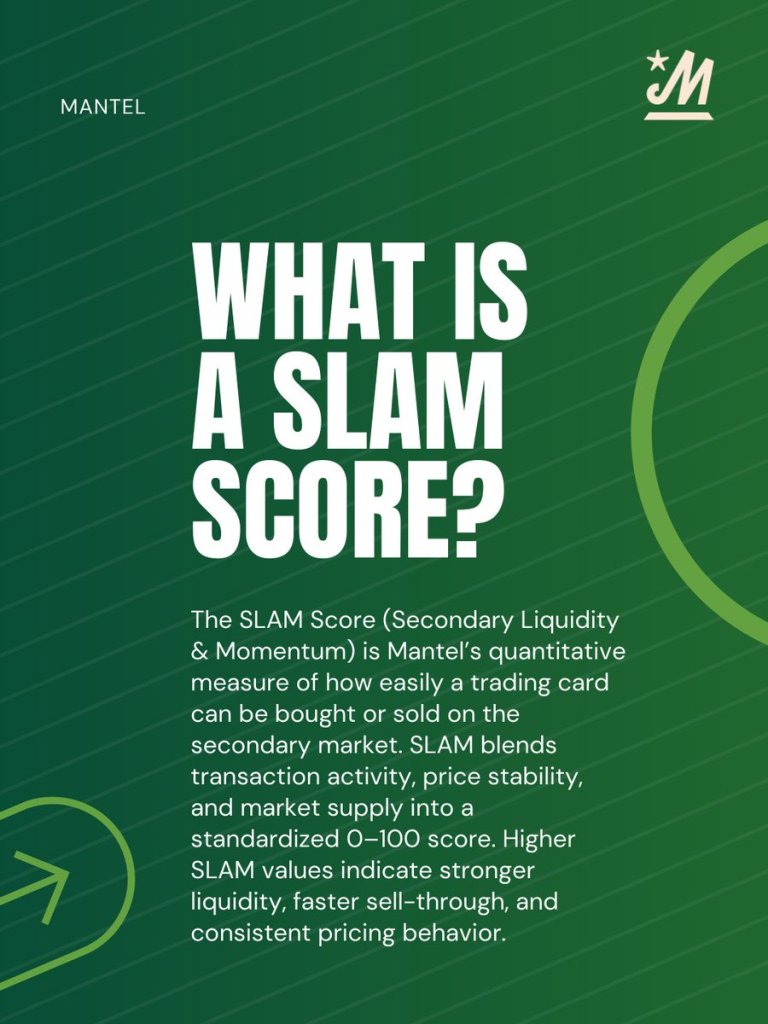
The SLAM Score is a 0–100 index intended to measure how close a card is to functioning as currency within the hobby.
In simple terms, it answers three questions:
- Does this card actually trade?
- Does it trade consistently?
- Can it be sold without dramatic price swings?
A high SLAM Score doesn’t mean a card is rare or flashy. It means the market around it is active, predictable, and liquid.
General Score Ranges
- 90–100: Highly liquid, cash‑like cards with deep, consistent markets
- 50–89: Solid cards with regular buyers but narrower demand
- Below 50: Thin markets, sporadic sales, or speculative pricing
This immediately challenges one of the hobby’s oldest assumptions: high price does not automatically equal high quality investment.
What SLAM Actually Measures
Unlike traditional price guides, SLAM focuses on behavior, not hype.
1. Trade Frequency
Cards that change hands regularly score higher than cards that sit listed for months. A steady stream of transactions matters more than a single record sale.
2. Price Consistency
SLAM penalizes volatility. A card that sells five times in a tight range is more valuable (from a liquidity standpoint) than one that spikes once and then disappears.
3. Market Depth
If there are multiple buyers and sellers at any given time, SLAM rewards that depth. One‑of‑one cards and ultra‑rare short prints often suffer here — not because they’re bad cards, but because there’s no real market to support them.
In short: SLAM measures reliability, not excitement.
Why the SLAM Score Matters Right Now
The timing of SLAM isn’t accidental.
The sports card market has matured. Easy money, pandemic speculation, and blind grading premiums have largely washed out. What’s left is a hobby increasingly split between collectors and investors.
Investors need better tools — and SLAM speaks directly to that need.
Liquidity Is the Missing Metric
Grading tells you condition.
Pricing tells you history.
SLAM tells you exit risk.
That’s a critical distinction for anyone running cards like a portfolio instead of a display case.
How SLAM Could Change the Sports Card Industry
1. Smarter Buying Decisions
SLAM encourages investors to prioritize:
- Cards with steady transaction volume
- Established player demand
- Manageable population sizes
This naturally favors flagship rookies, iconic sets, and widely collected players over novelty cards and artificial scarcity.
2. Pressure on Speculative Cards
Cards that rely on:
- One big auction result
- Manufactured rarity
- Short‑term hype cycles
will struggle under a liquidity‑based system. SLAM doesn’t kill these cards — but it exposes the risk.
3. Dealer and Shop Inventory Shifts
Dealers don’t want money trapped in cases.
As SLAM data becomes visible, expect shops to stock more high‑velocity inventory and fewer slow‑moving lottery cards. That shift alone could influence pricing floors across the hobby.
4. Platform and Pricing Algorithm Integration
If SLAM integrates into marketplaces, portfolio trackers, or pricing tools, it becomes more than a score — it becomes infrastructure.
Filters, alerts, and dynamic pricing based on liquidity would fundamentally change how collectors search, buy, and sell.
What SLAM Means for CardVestr Investors
At CardVestr, the goal has always been to treat sports cards like a long‑term, diversified investment portfolio — not a guessing game.
SLAM aligns naturally with that philosophy.
Tactical Takeaways
- High SLAM + stable pricing = core holdings
- Low SLAM + high price = speculative position, size accordingly
- Rising SLAM scores may signal improving market confidence
SLAM doesn’t replace fundamentals. It enhances them.
Final Thoughts: A More Mature Hobby
The SLAM Score represents a quiet but important evolution.
It shifts the hobby away from:
- bragging rights
- one‑off record sales
- artificial scarcity
and toward:
- liquidity
- consistency
- real market demand
For collectors, it’s another lens.
For investors, it’s overdue.
If SLAM gains adoption, the sports card market becomes less emotional, more disciplined, and ultimately more sustainable.
That’s a good thing — especially for those who plan to be here long term.
Follow CardVestr for data‑driven insights, portfolio strategy, and long‑term thinking in sports card investing.


 CardVestr
Leave a comment