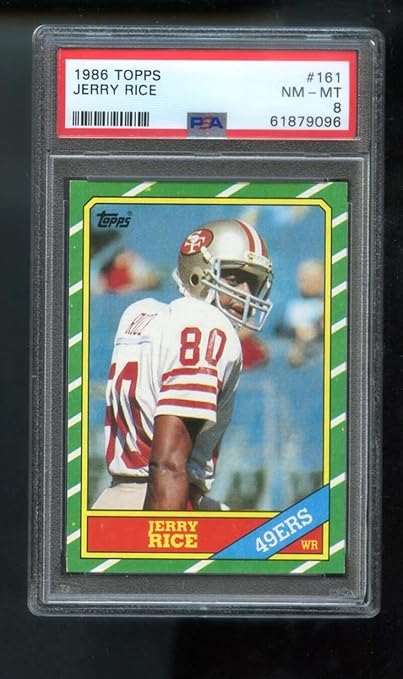
We are writing today to announce a foundational addition to the CardVestr portfolio. Following our systematic screening process outlined in our launch post, we have acquired a PSA 8 (Near Mint-Mint) example of the 1986 Topps Jerry Rice rookie card (#161).
In the world of Dividend Growth Investing, there are certain companies with “wide moats”—competitive advantages so strong that they are nearly impossible to unseat (think Coca-Cola or Johnson & Johnson). In the sports card world, Jerry Rice is the ultimate wide-moat athlete.
We have tried to systematize our process as much as possible to reduce the impact of errors of omission (missing out on obvious legends because they seem “boring”) as well as errors of commission (chasing volatile prospects).
Here is a detailed look at why this card passed our Aristocrat Screen and how we approached the acquisition financially.
The Aristocrat Screen: Why Jerry Rice?
Before capital is deployed, every asset must pass our rigorous checklist. Jerry Rice is practically the prototype for a Sports Card Aristocrat.
1. The Legacy Test (10+ Years of Dominance)
Jerry Rice isn’t just a Hall of Famer; he is arguably the greatest football player of all time. He holds virtually every significant receiving record (receptions, yards, touchdowns), many by an insurmountable margin. His career “earnings” are settled law. There is zero speculation regarding his legacy.
2. The “Condition Sensitivity” Factor
The 1986 Topps football set is notorious among collectors for its green borders, which show the slightest wear or chipping instantly. Finding high-grade examples is incredibly difficult. This inherent difficulty adds a layer of scarcity even to lower grades.
3. Population Stability & Liquidity (The “Dividend”)
While the total population of graded Jerry Rice rookies is high, the demand is perpetual. It is one of the most liquid cards in the hobby.
- PSA 8 Total Pop: ~14,000(Approximate count as of Jan 2026)
- The “Yield”: Despite the high count, these cards trade daily. The “absorption rate” is massive. This high liquidity acts as our “dividend”—we know we can exit this position into a strong market at almost any time.
Financial Discipline: Why the PSA 8?
Our strategy includes strict financial guardrails, most notably a $2,000 hard cap on any single card acquisition.
Many investors chase the PSA 9 or PSA 10 grades for ultimate scarcity. However, a PSA 9 Jerry Rice currently trades well above our $2,000 limit. To chase a PSA 9, we would have to break our own rules, exposing the portfolio to overly concentrated risk.
By targeting the PSA 8 (Near Mint-Mint), we achieve the following:
- Acquire an Investment-Grade Asset: A PSA 8 is a beautiful card that presents very well.
- Maintain Diversification: The lower cost basis allows us to deploy remaining capital into other sectors (basketball or baseball Aristocrats) rather than tying up our entire month’s budget in one NFL card.
- Margin of Safety: We are buying a high-quality example of an immortal player at a price point that historically recovers quickly from market downturns.
The Acquisition Details (Transparency Report)
We monitor the market patiently, looking for examples with strong “eye appeal” (centering and color) that are trading at or slightly below market averages. We do not FOMO (Fear Of Missing Out) into overpaying.
The “Aristocrat” Scorecard
1. Legacy & Moat (10/10)
This card represents the “ground floor” of the greatest wide receiver in NFL history. Unlike modern QBs whose values fluctuate with every playoff game, Rice’s career is “settled law.” The 1986 Topps set is his only recognized mainstream rookie card, giving this asset a “monopoly” on his rookie demand.
2. Valuation & Yield (Strong Buy)
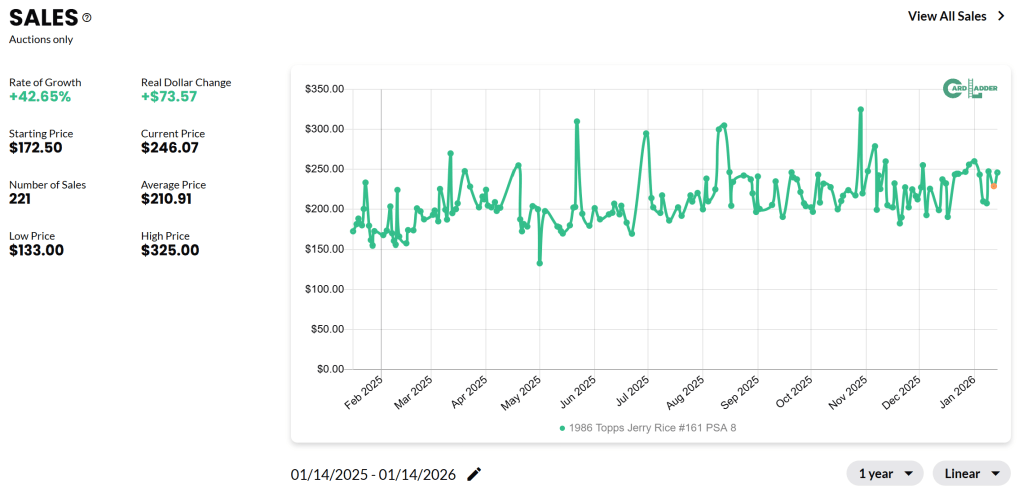
- Price Point: The card is currently trading in the $230–$250 range.
- Margin of Safety: This is exceptionally accessible for a GOAT-tier rookie. Compared to a Michael Jordan PSA 8 (~$6,000+), the Rice PSA 8 is arguably undervalued.
- Liquidity: The data shows consistent daily sales. This is a “high-yield” asset in terms of liquidity—you can convert it to cash instantly, which is a key requirement for our “Blue Chip” portfolio.
3. Population Health (Stable)
- Total PSA 8 Pop: ~14,650
- Growth Rate: The population is mature. While the total count is high, the “Pop Growth” is less than 2% annually. This indicates the market is not being flooded with new supply; most copies are already graded and locked in collections.
- The “Green Border” Factor: The 1986 Topps set is notoriously condition-sensitive (chipping on the green borders). A PSA 8 is a respectable “investment grade” because PSA 9s and 10s are exponentially harder to hit.
The Verdict: CERTIFIED ARISTOCRAT
This card perfectly fits the CardVestr strategy. It offers a low entry cost (well under our $2,000 limit), massive historical significance, and a stable floor. It is the “Coca-Cola” of football cards—boring, reliable, and essential for any serious portfolio.
Looking Ahead
This Jerry Rice PSA 8 now serves as one of the anchors of our football allocation. It is a low-volatility, high-liquidity asset that we plan to hold for the long term as it continues its slow, steady historical appreciation.
As always, you can track this card and our entire portfolio’s real-time performance on our Card Ladder Showcase link here.
Total January spend: $579 to date.
Disclaimer: This post is for informational purposes only and documents our own investing strategy. It is not financial advice. We are not responsible for any losses incurred from sports card investing.



 CardVestr
Leave a comment