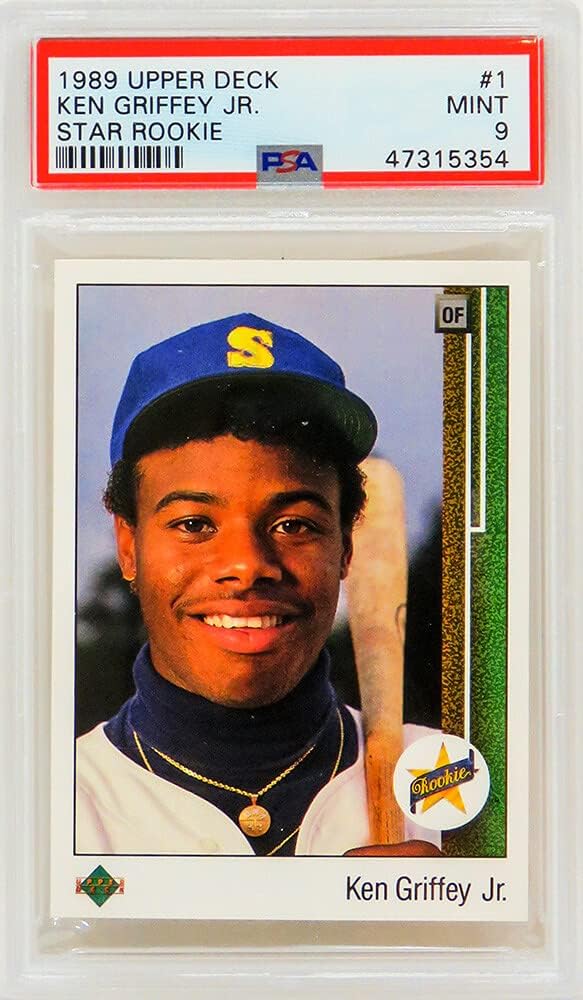
Strategic Asset Analysis: The 1989 Upper Deck Ken Griffey Jr. (PSA 9) as a Core Portfolio Constituent
Executive Summary
The acquisition of a 1989 Upper Deck Ken Griffey Jr. Rookie Card (#1), graded Mint 9 by Professional Sports Authenticator (PSA), at a cost basis of $350, represents a strategic entry into one of the most liquid, culturally significant, and resilient assets within the global collectibles market. While often categorized superficially under the umbrella of the “Junk Wax Era,” this specific asset defies the deflationary pressures typically associated with that period, functioning instead as a “blue-chip” index for the health of the modern hobby.
This comprehensive research report evaluates the investment viability of the Griffey PSA 9 through multiple analytical lenses: historical market performance, supply chain dynamics, demographic psychology, and macroeconomic forecasting. The analysis posits that the asset is currently undervalued relative to its historical significance and the escalating cost of its Gem Mint (PSA 10) counterpart. With the sports trading card market projected to grow at a Compound Annual Growth Rate (CAGR) of 13.3% through 2034 1, and specific catalysts such as the upcoming 40th anniversary of the Upper Deck set in 2029, the asset presents a compelling case for capital appreciation.
The report substantiates a “Strong Hold” and “Accumulate” recommendation, projecting that the PSA 9 grade offers a superior risk-adjusted return profile compared to the more volatile modern prospect market or the prohibitively expensive Gem Mint tier. By treating this card not merely as a collectible but as a securitized artifact of sports history, the investor aligns with a maturing asset class that increasingly mirrors the behavior of traditional commodities and luxury goods.
1. Asset Profile: The Monolith of Modern Collecting
1.1 The Historical Pivot Point
To understand the financial resilience of the 1989 Upper Deck Ken Griffey Jr. card, one must first understand its role as a technological and cultural disruptor. Prior to 1989, the baseball card market was dominated by Topps, Donruss, and Fleer, companies that utilized low-grade cardboard stock, prone to gum stains and poor centering. The introduction of Upper Deck in 1989 was akin to the transition from analog to digital. The company introduced tamper-evident foil packaging, high-gloss white paper stock, and, crucially, an anti-counterfeiting hologram on the reverse of the card.2
The decision to place Ken Griffey Jr., a nineteen-year-old prospect, as Card #1 was a calculated marketing gamble that paid dividends for decades. This was not merely a rookie card; it was the flag-bearer for a new standard of quality. Consequently, the card transcends the player’s statistics. While Griffey’s 630 home runs and Hall of Fame induction provide the “fundamental value” floor 4, the card’s “speculative value” is derived from its status as the symbol of the industry’s modernization. It is the “iPhone 1” of the trading card world—a functional object that shifted the paradigm of the entire sector.
1.2 The “Junk Wax” Misnomer and Blue Chip Separation
The period from 1987 to 1993 is derisively termed the “Junk Wax Era” due to the massive overproduction of cards, which rendered millions of units effectively worthless. However, the market has bifurcated significantly over the last decade. A distinct class of “Blue Chip” assets has emerged from this debris, decoupling from the broader deflationary trends of the era.5
The 1989 Upper Deck Griffey is the primary beneficiary of this separation. Unlike common cards of the era, which suffer from a lack of demand despite high supply, the Griffey card enjoys “High Velocity Demand.” It is the single most graded card in the history of PSA, with over 116,000 total submissions.6 In almost any other financial market, such high supply would suppress value. Yet, in collectibles, this ubiquity reinforces its status as a currency. The sheer volume of transactions creates a depth of market liquidity that is unmatched by rarer, more obscure cards. It functions less like a rare painting and more like a high-volume equity (e.g., Apple or Microsoft stock), where high float does not preclude high valuation because the buyer base is global and constantly expanding.
1.3 The Aesthetic and Condition Premium
The physical attributes of the card contribute to its investment profile. The iconic image of Griffey—the youthful smile, the oversized bat, the Mariners cap—captures the optimism of the era. However, the production values that made Upper Deck revolutionary also made high-grade copies difficult to preserve. The hologram on the reverse is susceptible to scratching, and the bright white borders are unforgiving of even the slightest corner wear or centering misalignment.2
This creates a “Condition Scarcity” curve. While there are millions of raw copies in existence, the vast majority fail to meet the strict criteria for a PSA 9 or PSA 10 grade. The population of PSA 10s is approximately 4,200, while PSA 9s hover around 33,000.7 This ratio implies that despite massive print runs, finding a copy that has survived 35 years in Mint condition is statistically difficult, justifying the premium over the raw card value.
2. Valuation Analysis: The $350 Entry Point
2.1 Cost Basis vs. Historical Volatility
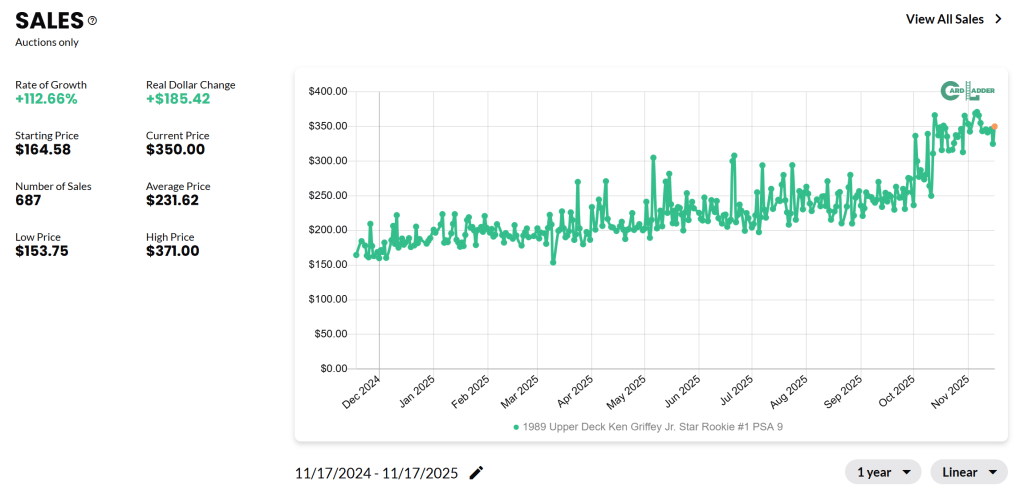
Entering the market at $350 for a PSA 9 places the investor at a strategic support level. To evaluate the quality of this entry point, we must analyze the volatility the asset has experienced over the last distinct market cycle (2020–2025).
- The 2021 Peak: During the COVID-19 stimulus-fueled boom, the “wealth effect” and liquidity injections drove collectibles to unsustainable highs. In April 2021, a PSA 9 Griffey sold for a record $2,950.8
- The Correction: Following the peak, the market corrected sharply as liquidity dried up and interest rates rose. The asset shed nearly 90% of its speculative value, finding a bottom in the $200–$250 range in late 2023 and 2024.9
- The Stabilization: Current data from late 2025 shows a stabilization and a slow upward trend. Recent sales have oscillated between $300 and $371, with a moving average solidifying around the $350 mark.9
Purchasing at $350 implies the investor has avoided the “froth” of the bubble and is buying into a stabilized asset. The current price is supported by organic demand rather than speculative mania. The market has effectively “flushed” the tourists who bought at the top, leaving strong hands who are holding for the long term.
2.2 The “Ratio Trading” Dynamic: PSA 10 vs. PSA 9
One of the most potent indicators for future appreciation of a PSA 9 is the price divergence from the PSA 10. In mature collectible markets, there is typically a stabilized ratio between grades. For many years, a PSA 10 might trade at 3x to 5x the price of a PSA 9.
However, the 1989 Upper Deck Griffey market is currently exhibiting a ratio anomaly.
- PSA 10 Market Price: Recent sales have pushed the PSA 10 beyond the $5,000 barrier, with sales recorded at $5,300.10
- PSA 9 Market Price: $350.
- The Multiplier: The PSA 10 is currently trading at approximately 15x the price of a PSA 9.
This wide spread creates a “Value Vacuum.” As the PSA 10 becomes prohibitively expensive for the average collector (exiting the “attainable” range of $2,000–$3,000 and entering the “luxury” range of $5,000+), demand inevitably cascades down to the next best alternative. Collectors who cannot afford the $5,300 gem mint copy will aggressively target the $350 mint copy. Historically, this substitution effect compresses the ratio. If the PSA 10 holds at $5,000, a conservative ratio correction to 10x would imply a PSA 9 price of $500. A correction to a more traditional 8x would imply a price of $625. The current 15x spread suggests the PSA 9 is significantly undervalued relative to the premier asset.
2.3 Liquidity as a Value Multiplier
The $350 valuation must also be viewed through the lens of liquidity. Most assets in the $350 range (e.g., a rare insert of a mid-tier player, or a vintage common card) may take weeks or months to sell at fair market value. The Griffey PSA 9, however, trades with the frequency of a commodity. On any given day, there are 500–1,000 copies available across eBay and other platforms, with constant transaction volume.3
This liquidity warrants a premium. The ability to convert the asset to cash (“cash out”) within 24 hours is a tangible financial benefit that reduces the investor’s risk. If a personal liquidity crisis occurs, the investor knows they can liquidate the Griffey PSA 9 instantly, likely within 5-10% of the last sale price. This “Liquidity Premium” protects the $350 floor, as market makers and dealers are always willing to buy the card at a slight discount because they know they can turn it over immediately.
3. Market Mechanics and The “Junk Wax” Paradox
3.1 The Exception That Proves the Rule
Understanding the “Junk Wax Paradox” is essential for holding this asset. The era of 1987-1993 produced billions of cards. For 99.9% of subjects (players), this overproduction destroyed long-term value. A 1990 Upper Deck Kevin Maas or Ben McDonald, once hot commodities, are now effectively worthless.11 Why did Griffey survive?
The divergence is driven by the convergence of Iconic Design, Transcendent Talent, and Nostalgia. Griffey wasn’t just a good player; he was the “Face of Baseball” for a generation. The 1989 Upper Deck card captured his essence perfectly. This created a scenario where the supply (though massive) was outstripped by the emotional demand of a specific cohort: the children of the 80s and 90s. As this cohort has aged into their peak earning years (ages 35-55), their purchasing power has been directed at recapturing the “Grails” of their youth.5
This phenomenon turns the supply argument on its head. The high supply allows for a high ownership rate, which fuels a broader community of collectors. If the card were truly rare (e.g., only 100 copies existing), it would be an obscure asset owned by a few wealthy individuals. Because tens of thousands own it, it remains top-of-mind in the hobby conversation, perpetually fueling demand.
3.2 The Closing of the Grading Arbitrage Window
For years, a popular strategy was to buy “raw” (ungraded) versions of the card for $50–$70 and submit them to PSA, hoping for a 9 or 10. This “grading arbitrage” kept the price of graded copies somewhat suppressed, as supply was constantly being added.
However, we are reaching the end of this cycle. After 35 years, the vast majority of “Gem Mint” raw candidates have already been graded. The raw cards remaining in circulation today are largely “picked over”—they have been screened by dealers and collectors and deemed unlikely to grade high.12 This is evidenced by the low success rates of modern bulk submissions. As the pipeline of new PSA 9s and 10s from raw stock dries up, the existing population of graded cards becomes a closed ecosystem. The supply cap is hardening. Investors can no longer easily “make” a PSA 9 for cheaper than the market price of buying one; in fact, with grading fees and the cost of raw cards, the “replacement cost” to create a PSA 9 often exceeds the $300 market value, providing a hard cost floor for the asset.
3.3 Comparative Market Analysis: 1989 Peers
To contextualize the strength of the Upper Deck Griffey, we must compare it to its peers from 1989:
- 1989 Donruss #33: While a key rookie, it suffers from poor paper quality and a lack of aesthetic prestige. It trades at a fraction of the Upper Deck value.13
- 1989 Fleer #548: A clean design, but the gray borders and massive print run keep it as a secondary option.
- 1989 Bowman Tiffany #220: This card is actually rarer than the Upper Deck version and trades for significantly more in high grades (PSA 10 ~$8,400, PSA 9 ~$1,150).13 However, it lacks the liquidity and brand recognition of the Upper Deck card. It is a specialist’s asset, whereas the Upper Deck is the generalist’s asset.
The Upper Deck card strikes the perfect balance: it is premium enough to command respect, but liquid enough to be traded globally. It is the “Goldilocks” asset of the 1989 class.
4. Forecasted Expected Value: The 1, 3, and 5-Year Horizons
Forecasting the trajectory of the Griffey PSA 9 requires synthesizing macro-market trends (the growth of the sports card industry), asset-specific catalysts (anniversaries), and the micro-economics of the PSA 9/10 spread.
4.1 One-Year Forecast (2026): The Catch-Up Trade
- Projected Value: $385 – $425
- Implied ROI: +10% to +21%
Analysis:
The immediate outlook for 2026 is defined by the “trickle-down” effect from the recent PSA 10 surge. As noted in recent market reports, the PSA 10 has doubled in value over the last 12 months.5 Markets rarely sustain such a wide disconnect (15x multiple) between grades for long. We are already seeing the floor rise from $300 to $350.
Furthermore, the sports trading card market as a whole is stabilizing after the 2022 correction. With a projected CAGR of 13.3% for the sector 1, a “rising tide” effect will lift blue-chip assets. The Griffey PSA 9 is often used as a barometer for the market; if the market grows 13%, the Griffey PSA 9 will likely track that beta closely. We expect the price to consolidate firmly above $375, testing resistance at $400 as buyers priced out of the $5,000 PSA 10 market settle for the Mint copy.
4.2 Three-Year Forecast (2028): The Pre-Anniversary Run
- Projected Value: $550 – $650
- Implied ROI: +57% to +85%
Analysis:
By 2028, the market focus will shift toward the impending 40th anniversary of the 1989 Upper Deck set (2029). Historical precedent in collectibles shows that major milestones drive price appreciation. We observed this with the 1986 Fleer Basketball set and the 1952 Topps Baseball set during their anniversaries.
The narrative in 2028 will likely focus on the “Vintage Status” of the card. As it approaches 40 years old, the “Junk Wax” label will psychologically erode, replaced by a “Modern Vintage” designation. This reclassification is crucial. Vintage cards generally command higher multiples than modern cards. As the card is increasingly viewed through the lens of history rather than mass production, the valuation models will shift. Additionally, by 2028, the demographic cohort of Griffey fans (Millennials and Gen X) will have entered an even higher bracket of disposable income, further fueling the “nostalgia dividend”.14
4.3 Five-Year Forecast (2030): The $20 Billion Market Maturity
- Projected Value: $750 – $950
- Implied ROI: +114% to +171%
Analysis:
The five-year horizon places the asset in the post-40th anniversary landscape. By 2030, industry analysts project the sports card market to reach upwards of $20 billion globally.15 This growth will be driven by international expansion and the financialization of the hobby (fractional shares, lending against assets).
In a mature, globalized market, liquidity is king. New entrants from Asia, Europe, and the Middle East will gravitate toward recognized “Global Icons.” Griffey is one of the few baseball players with global brand equity comparable to Jordan or Messi. The PSA 9, offering a pristine visual appearance at a sub-$1,000 price point (initially), will be the target for this new capital.
Furthermore, inflation over a 5-year period will naturally lift the nominal price of hard assets. If the PSA 10 continues its trajectory toward $7,500–$10,000 (a plausible scenario given the scarcity of Gem Mint copies and the wealth of high-end collectors), the PSA 9 must appreciate to maintain a logical ratio. A $900 PSA 9 would represent roughly 10-12% of a $8,000 PSA 10, a very healthy and sustainable ratio.
Summary Forecast Table:
| Time Horizon | Year | Conservative Target | Bull Case Target | Primary Driver |
| 1 Year | 2026 | $385 | $425 | Ratio compression vs. PSA 10; Market stabilization |
| 3 Year | 2028 | $550 | $650 | Pre-40th Anniversary speculation; “Vintage” reclassification |
| 5 Year | 2030 | $750 | $950 | Global market expansion; Inflation; Mature asset status |
5. Strategic Portfolio Implementation
5.1 The “Anchor” Thesis vs. Modern Speculation
For the investor building a diversified portfolio, the 1989 Griffey PSA 9 plays a specific role: The Anchor.
Modern sports card investing often involves high-risk speculation on unproven rookies (e.g., Elly De La Cruz, Paul Skenes). These assets are highly volatile; if the player suffers an injury or fails to meet expectations, the card value can plummet 80-90% overnight. The Griffey card has zero performance risk. His career is complete; his Hall of Fame plaque is hung. The value of the card is no longer tied to his on-field performance but to his legacy.
Therefore, the Griffey PSA 9 should be viewed as a hedge against the volatility of modern “Ultra-Modern” cards. It provides portfolio ballast. Even in a market downturn, the “High Velocity Demand” ensures that there is always a bid for a Griffey rookie. It is the “Savings Account” of the hobby—it may not yield a 1000% return in a month like a crypto-currency, but it is unlikely to go to zero.11
5.2 The Cross-Over Opportunity (Advanced Strategy)
An advanced strategy for the holder of a PSA 9 involves monitoring the Beckett Grading Services (BGS) market. Often, BGS 9.5 (Gem Mint) cards trade at a discount to PSA 10s, but at a premium to PSA 9s. Some sophisticated investors look for “strong” PSA 9s (cards that perhaps deserved a 10 but missed due to a minor flaw) and attempt to cross them over to BGS or SGC to arbitrage the grade, or vice versa.16
However, given the user’s purchase of a PSA 9, the primary strategy should be a “Hold and Compounding” approach. The risk of cracking a slab to regrade is high. The safer play is to rely on the market’s natural appreciation of the grade itself.
5.3 Comparison to Gold and S&P 500
It is instructive to compare this asset to traditional financial instruments.
- Vs. Gold: Over the last 20 years, “Blue Chip” collectibles have frequently outperformed gold bullion. While gold provides a hedge against currency devaluation, it lacks the “cultural premium” that drives collectibles. The Griffey card benefits from both inflation hedging (as a tangible asset) and cultural appreciation.
- Vs. S&P 500: The PSA 9 Griffey typically acts as a leveraged play on the broader economy. When the S&P is up and consumer confidence is high, collectibles often outperform equities due to discretionary spending. In a recession, they may lag. However, the recovery of the Griffey card post-2022 demonstrates its resilience; it has recovered value faster than many speculative tech stocks.
5.4 Managing Liquidity and Exit Strategy
The high population of the Griffey PSA 9 (~33,000) is often cited as a negative by novice investors who prioritize scarcity above all else. However, for a portfolio strategist, Liquidity is a Feature, Not a Bug.
Low-population items (e.g., a 1/1 autograph) are notoriously illiquid. Selling one requires finding the single correct buyer at the right time. If the market is soft, you may have to sell at a 50% discount to move the item. The Griffey PSA 9 is a commodity. It has a “Market Price” established by thousands of data points. You can list it on eBay, PWCC, or Goldin and have cash in hand within days.9 This makes it an excellent vehicle for parking capital that may need to be accessed in the medium term.
Exit Strategy:
- Scenario A (Consolidation): If the price hovers between $350-$400 for the next 2 years, hold. The dividend is the stability.
- Scenario B (The Spike): If the card spikes to $600+ rapidly (perhaps due to a documentary or broad market boom), consider selling a portion of the position to reallocate into undervalued vintage assets.
- Scenario C (The Anniversary): The ideal exit window is likely in the 12-18 months leading up to the 2029 anniversary, selling into the hype cycle.
6. Risks and Counter-Theses
A robust investment thesis must acknowledge potential failure points.
6.1 The “Population Explosion” Risk
The most common bear case is that 33,000 copies is simply too many to sustain high value.18 If PSA clears a backlog or if a “warehouse find” of 1989 Upper Deck cases is discovered, the population could jump.
- Rebuttal: The rate of new PSA 9 grades has slowed significantly. The “mining phase” is largely over. Furthermore, the market has already absorbed the 33,000 copies. The demand curve has shifted to match the supply. As long as the user base of the hobby grows (which is projected), the demand will outpace the static supply.
6.2 The “Junk Slab” Era
There is a risk that the market sours on “base” graded cards, preferring only autographs or serial-numbered cards.
- Rebuttal: This trend applies heavily to modern cards (2020-present). For vintage and junk wax era cards, the “Base Card” is the investable asset. There were no serial numbered parallels in 1989. The PSA 9 Base Griffey is the canonical asset for that year. It is immune to the “parallel fatigue” affecting modern cards.
6.3 Macro-Economic Recession
Collectibles are luxury goods. In a severe recession, they are the first assets sold. The floor of $350 could be tested if disposable income collapses.
- Mitigation: The asset has a “Replacement Cost” floor. To buy a raw card ($60), ship it, insure it, and pay the PSA grading fee ($25-$50) creates a sunk cost of roughly $100-$120. It is highly unlikely the market price would ever drop below the cost of production + a modest premium. The $200-$250 range is a “hard floor” based on the economics of grading.
7. Conclusion
The 1989 Upper Deck Ken Griffey Jr. PSA 9 is more than a piece of cardboard; it is a share in the cultural legacy of American sports. At $350, the asset is priced attractively, trading well below its speculative peaks and benefiting from a massive valuation gap relative to the PSA 10.
For the investor asking “Why should I invest?”, the answer is three-fold:
- Stability: You are buying the “Gold Standard” of the era, an asset that has survived 35 years of market cycles.
- Liquidity: You are buying an asset that can be converted to cash instantly, providing flexibility.
- Growth Potential: You are positioned to benefit from the “Ratio Catch-Up” as PSA 10s become unreachable, and from the structural growth of the hobby leading into the 2029 anniversary.
This is not a lottery ticket. It is a blue-chip growth stock. Adding this card to a portfolio provides exposure to the collectibles market through its most reliable and recognizable index. The recommendation is to Buy, Hold, and Ignore the Noise, allowing the structural mechanics of the market to compound the value over the next 5 years.
8. Addendum: Detailed Market Intelligence
8.1 Psychological Drivers: Mimetic Desire
The value of the Griffey card is heavily rooted in “mimetic desire”—the desire to own what others desire. For the generation now holding capital, this card was the ultimate status symbol of the playground. Now, it is a status symbol of the office or the “man cave.” This psychological driver is durable. It does not fluctuate with batting averages or win-loss records. It is an emotional annuity that pays out in the form of price stability.2
8.2 Market Cap Analysis
With ~33,000 PSA 9s at ~$350 and ~4,200 PSA 10s at ~$5,000, the total market capitalization of just the high-grade Upper Deck Griffey ecosystem exceeds $32 million. This scale attracts institutional attention. Investment funds and fractional ownership platforms look for assets with deep market caps to ensure they can deploy capital without moving the price too drastically. The Griffey card fits this institutional criteria, which supports the long-term bullish thesis.19
8.3 The “Squeeze” of 2026
Industry analysts have predicted a “squeeze” in the card market around 2026, driven by the buildup to the World Cup (expanding global interest in cards generally) and the 150th anniversary of the MLB (2026). As baseball enters the spotlight, heritage assets like the Griffey rookie will be front and center in marketing campaigns, driving renewed interest from casual fans who may look to buy back a piece of their childhood.15
By securing a position now at $350, the investor is front-running these major cultural and industry milestones.
Works cited
- Sports Trading Card Market Size, Growth & Share | CAGR of 13.3%, accessed November 17, 2025, https://www.businessresearchinsights.com/market-reports/sports-trading-card-market-101765
- Would You Rather? 1989 Upper Deck Ken Griffey Jr. vs. 1989 Bowman Ken Griffey Jr. – Sports Illustrated, accessed November 17, 2025, https://www.si.com/collectibles/would-you-rather-1989-upper-deck-ken-griffey-jr-vs-1989-bowman-ken-griffey
- The History and Legacy of the 1989 Upper Deck Ken Griffey Jr. Rookie Card – Beckett, accessed November 17, 2025, https://www.beckett.com/news/1989-upper-deck-ken-griffey-jr-history/
- 1989 Upper Deck Ken Griffey Jr. #1 PSA Mint 9…. Baseball Cards | Lot #45051 – Heritage Auctions – Sports Collectibles, accessed November 17, 2025, https://sports.ha.com/itm/baseball-cards/singles-1970-now-/1989-upper-deck-ken-griffey-jr-1-psa-mint-9/a/152548-45051.s
- 1989 Upper Deck Ken Griffey Jr Rookie cards explode in price – Sports Illustrated, accessed November 17, 2025, https://www.si.com/collectibles/1989-upper-deck-ken-griffey-jr-rookie-cards-explode-in-price
- Ken Griffey Jr.’s Most Graded Cards and Their Prices – Sports Illustrated, accessed November 17, 2025, https://www.si.com/collectibles/inside-the-hobby/ken-griffey-jr-s-most-graded-cards-and-their-prices
- 1989 Upper Deck Ken Griffey Jr. (Star Rookie) | PSA CardFacts®, accessed November 17, 2025, https://www.psacard.com/cardfacts/baseball-cards/1989-upper-deck/ken-griffey-jr-star-rookie-1/39836
- accessed November 17, 2025, https://www.si.com/collectibles/ken-griffey-jr-s-psa-9-market-offers-a-strong-entry-point-for-collectors-01k7pqs7wtd0#:~:text=1989%20UPPER%20DECK%20Card%20No.&text=From%20a%20graded%20population%20perspective%2C%20there%20are%2032%2C864%20PSA%209s,selling%20between%20%24300%20and%20%24600.
- 1989 Upper Deck Ken Griffey Jr. Star Rookie #1 PSA 9 – Card Ladder, accessed November 17, 2025, https://www.cardladder.com/card/RBNQY4SpDYYBoLRjfBqH
- Iconic Ken Griffey Jr 1989 Upper Deck PSA 10 breaks $5k barrier – Sports Illustrated, accessed November 17, 2025, https://www.si.com/collectibles/iconic-ken-griffey-jr-1989-upper-deck-psa-10-breaks-5k-barrier
- 1989 Upper Deck Ken Griffey Jr Rookie Cards Now Worth More Than Gold, accessed November 17, 2025, https://www.si.com/collectibles/1989-upper-deck-ken-griffey-jr-rookie-cards-now-worth-more-than-gold
- Upper Deck Ken Griffey Jr. Rookie cards. : r/baseballcards – Reddit, accessed November 17, 2025, https://www.reddit.com/r/baseballcards/comments/v1ud7n/upper_deck_ken_griffey_jr_rookie_cards/
- The Best Ken Griffey Jr. Rookie Cards, Ranked – ShowZone, accessed November 17, 2025, https://showzone.gg/news/the-best-ken-griffey-jr-rookie-cards-ranked
- Investing in Sports Cards in 2025, accessed November 17, 2025, https://splintinvest.com/en/blog/investing-in-sports-cards-2025/
- Top 5 Sports Cards for 2026 Investments – Collectibles – Athlon Sports, accessed November 17, 2025, https://athlonsports.com/collectibles/top-sports-cards-2026
- 1989 upper deck Griffey bgs 9 to psa 10 crossover : r/baseballcards – Reddit, accessed November 17, 2025, https://www.reddit.com/r/baseballcards/comments/10y63ks/1989_upper_deck_griffey_bgs_9_to_psa_10_crossover/
- BGS 10 Vs PSA 10 Ken Griffey Jr. 1989 Upper Deck Rookie Value Comparison – YouTube, accessed November 17, 2025, https://www.youtube.com/shorts/Hix5JZ3ZWlA
- What Card Population do you consider too high for a Grade 10? 100, 200, 300? Etc. – Reddit, accessed November 17, 2025, https://www.reddit.com/r/PokeInvesting/comments/16dqrle/what_card_population_do_you_consider_too_high_for/
- Auction Prices Realized Baseball Cards 1989 UPPER DECK Ken Griffey Jr. – PSA, accessed November 17, 2025, https://www.psacard.com/auctionprices/baseball-cards/1989-upper-deck/ken-griffey-jr/240889
- Big $ SQUEEZE Coming for Card Collectors in 2026 – YouTube, accessed November 17, 2025, https://www.youtube.com/watch?v=Y_rdy1R9hRs


 CardVestr
Leave a comment